Department of Life Sciences and Biotechnology, University of Ferrara, Italy.
Human Molecular Genetics, International Centre for Genetic Engineering and Biotechnology, Trieste, Italy.
Haematologica. 2018 Feb;103(2):344-350. doi: 10.3324/haematol.2017.178327. Epub 2017 Nov 23.
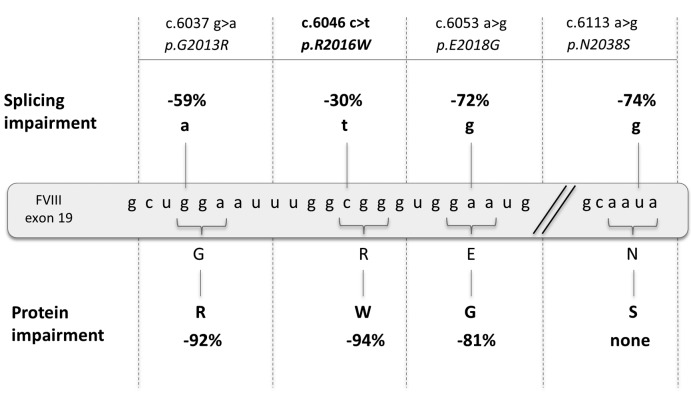
Dissection of pleiotropic effects of missense mutations, rarely investigated in inherited diseases, is fundamental to understanding genotype-phenotype relationships. Missense mutations might impair mRNA processing in addition to protein properties. As a model for hemophilia A, we investigated the highly prevalent c.6046c>t/p.R2016W (exon 19) mutation. In expression studies exploiting lentiviral vectors, we demonstrated that the amino acid change impairs both Factor VIII (FVIII) secretion (antigen 11.0±0.4% of wild-type) and activity (6.0±2.9%). Investigations in patients' ectopic mRNA and with minigenes showed that the corresponding nucleotide change also decreases correct splicing to 70±5%, which is predicted to lower further FVIII activity (4.2±2%), consistently with patients' levels (<1-5%). Masking the mutated exon 19 region by antisense U7snRNA supported the presence of a splicing regulatory element, potentially affected by several missense mutations causing hemophilia A. Among these, the c.6037g>a (p.G2013R) reduced exon inclusion to 41±3% and the c.6053a>g (p.E2018G) to 28±2%, similarly to a variant affecting the 5' splice site (c.6113a>g, p.N2038S, 26±2%), which displayed normal protein features upon recombinant expression. The p.G2013R reduced both antigen (7.0±0.9%) and activity (8.4±0.8%), while the p.E2018G produced a dysfunctional molecule (antigen: 69.0±18.1%; activity: 19.4±2.3%). In conclusion, differentially altered mRNA and protein patterns produce a gradient of residual activity, and clarify genotype-phenotype relationships. Data detail pathogenic mechanisms that, only in combination, account for moderate/severe disease forms, which in turn determine the mutation profile. Taken together we provide a clear example of interplay between mRNA and protein mechanisms of disease that operate in shaping many other inherited disorders.
对多效错义突变的剖析,这些突变在遗传性疾病中很少被研究,对于理解基因型-表型关系至关重要。错义突变除了影响蛋白质特性外,还可能损害 mRNA 加工。我们以血友病 A 为模型,研究了高度普遍存在的 c.6046c>t/p.R2016W(外显子 19)突变。在利用慢病毒载体进行的表达研究中,我们证明该氨基酸变化既损害了凝血因子 VIII(FVIII)的分泌(抗原为野生型的 11.0±0.4%),也损害了其活性(6.0±2.9%)。在患者异位 mRNA 中的研究以及利用小基因进行的研究表明,相应的核苷酸变化也将正确剪接降低至 70±5%,这预计会进一步降低 FVIII 活性(4.2±2%),与患者水平一致(<1-5%)。反义 U7snRNA 对突变外显子 19 区域的掩蔽支持存在剪接调节元件的存在,该元件可能受导致血友病 A 的几种错义突变影响。其中,c.6037g>a(p.G2013R)使外显子包含降低至 41±3%,c.6053a>g(p.E2018G)降低至 28±2%,类似于影响 5'剪接位点的变体(c.6113a>g,p.N2038S,26±2%),该变体在重组表达时显示出正常的蛋白质特征。p.G2013R 降低了抗原(7.0±0.9%)和活性(8.4±0.8%),而 p.E2018G 产生了功能失调的分子(抗原:69.0±18.1%;活性:19.4±2.3%)。总之,不同改变的 mRNA 和蛋白质模式产生了残留活性的梯度,并阐明了基因型-表型关系。数据详细说明了导致中度/重度疾病形式的致病机制,而这些机制反过来又决定了突变谱。综上所述,我们提供了一个清楚的例子,说明了疾病的 mRNA 和蛋白质机制之间的相互作用,这些机制在塑造许多其他遗传性疾病方面发挥了作用。