Ghosh Sumit
Biotechnology Division, Council of Scientific and Industrial Research-Central Institute of Medicinal and Aromatic Plants, Lucknow, India.
Front Plant Sci. 2017 Nov 9;8:1886. doi: 10.3389/fpls.2017.01886. eCollection 2017.
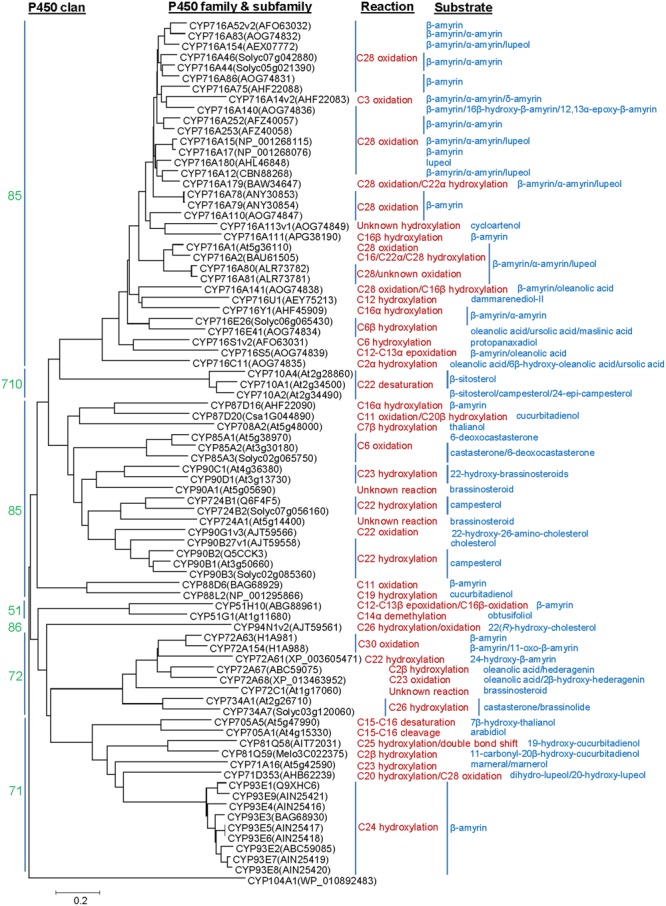
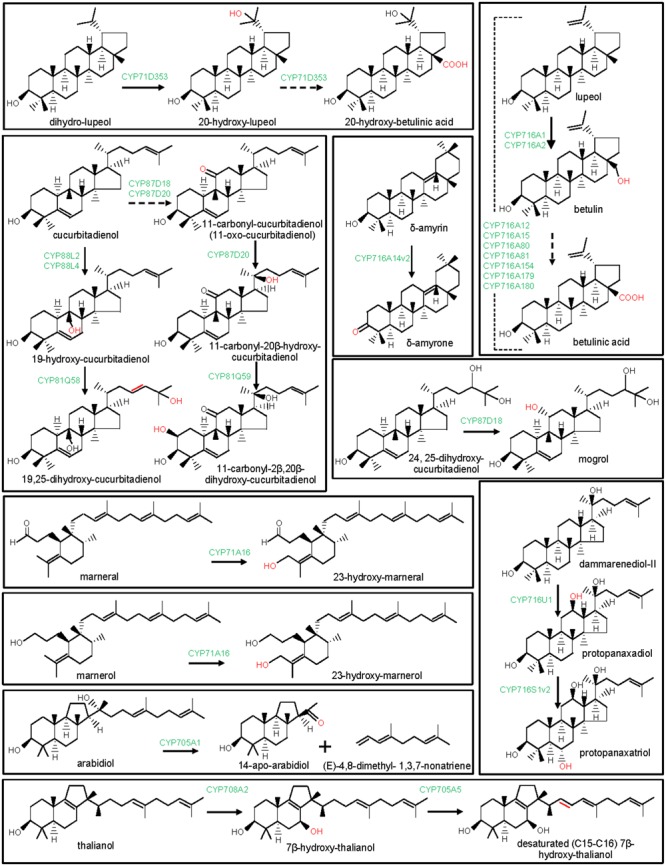
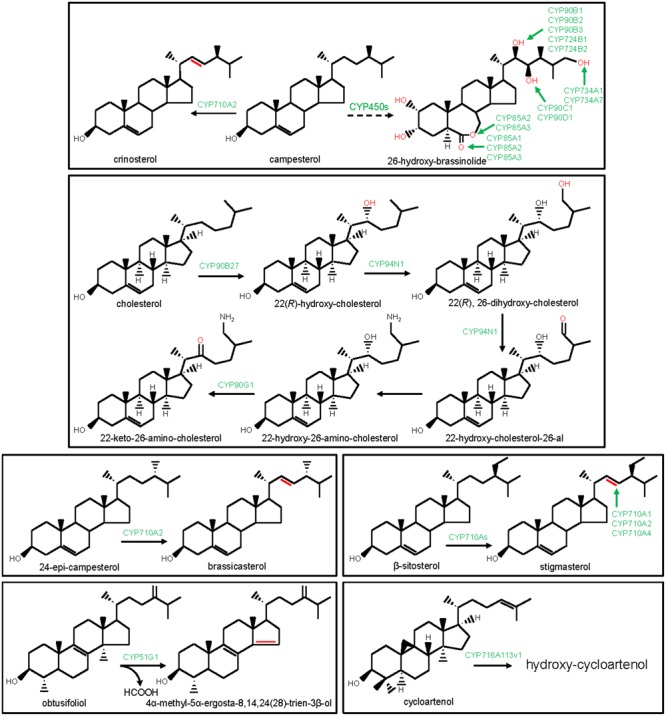
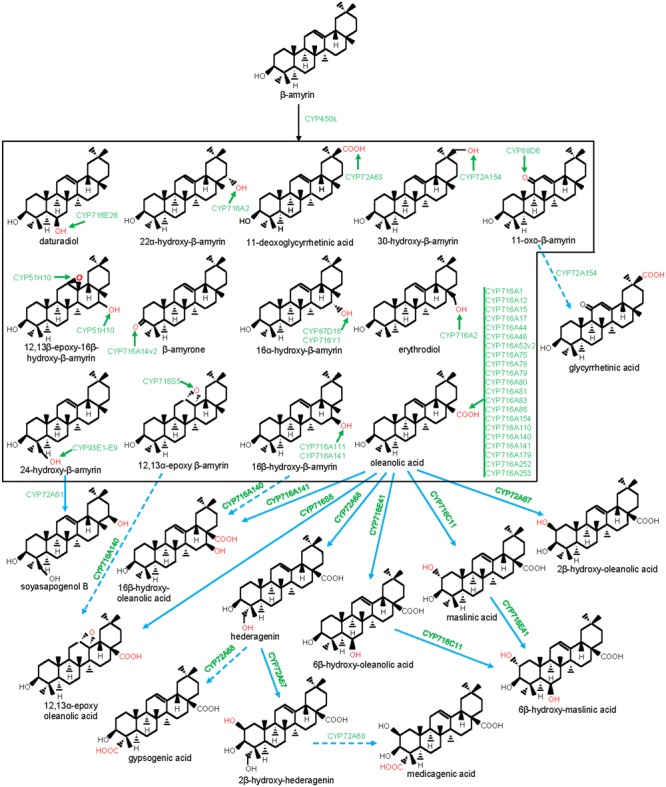
Cytochrome P450 monooxygenases (P450s) represent the largest enzyme family of the plant metabolism. Plants typically devote about 1% of the protein-coding genes for the P450s to execute primary metabolism and also to perform species-specific specialized functions including metabolism of the triterpenes, isoprene-derived 30-carbon compounds. Triterpenes constitute a large and structurally diverse class of natural products with various industrial and pharmaceutical applications. P450-catalyzed structural modification is crucial for the diversification and functionalization of the triterpene scaffolds. In recent times, a remarkable progress has been made in understanding the function of the P450s in plant triterpene metabolism. So far, ∼80 P450s are assigned biochemical functions related to the plant triterpene metabolism. The members of the subfamilies CYP51G, CYP85A, CYP90B-D, CYP710A, CYP724B, and CYP734A are generally conserved across the plant kingdom to take part in plant primary metabolism related to the biosynthesis of essential sterols and steroid hormones. However, the members of the subfamilies CYP51H, CYP71A,D, CYP72A, CYP81Q, CYP87D, CYP88D,L, CYP93E, CYP705A, CYP708A, and CYP716A,C,E,S,U,Y are required for the metabolism of the specialized triterpenes that might perform species-specific functions including chemical defense toward specialized pathogens. Moreover, a recent advancement in high-throughput sequencing of the transcriptomes and genomes has resulted in identification of a large number of candidate P450s from diverse plant species. Assigning biochemical functions to these P450s will be of interest to extend our knowledge on triterpene metabolism in diverse plant species and also for the sustainable production of valuable phytochemicals.
细胞色素P450单加氧酶(P450s)是植物代谢中最大的酶家族。植物通常将约1%的蛋白质编码基因用于P450s,以执行初级代谢,并执行特定物种的特殊功能,包括三萜类化合物(异戊二烯衍生的30碳化合物)的代谢。三萜类化合物是一类庞大且结构多样的天然产物,具有各种工业和医药应用。P450催化的结构修饰对于三萜骨架的多样化和功能化至关重要。近年来,在理解P450s在植物三萜代谢中的功能方面取得了显著进展。到目前为止,约80种P450s被赋予了与植物三萜代谢相关的生化功能。CYP51G、CYP85A、CYP90B-D、CYP710A、CYP724B和CYP734A亚家族的成员在植物界普遍保守,参与与必需甾醇和类固醇激素生物合成相关的植物初级代谢。然而,CYP51H、CYP71A、D、CYP72A、CYP81Q、CYP87D、CYP88D、L、CYP93E、CYP705A、CYP708A以及CYP716A、C、E、S、U、Y亚家族的成员对于可能执行特定物种功能(包括对特定病原体的化学防御)的特殊三萜类化合物的代谢是必需的。此外,转录组和基因组高通量测序的最新进展导致从不同植物物种中鉴定出大量候选P450s。确定这些P450s的生化功能将有助于扩展我们对不同植物物种三萜代谢的认识,也有助于可持续生产有价值的植物化学物质。