Yutaka Seino Distinguished Center for Diabetes Research, Kansai Electric Power Medical Research Institute, Kobe, Japan.
Center for Diabetes, Endocrinology and Metabolism, Kansai Electric Power Hospital, Osaka, Japan.
J Diabetes Investig. 2018 Sep;9(5):1153-1158. doi: 10.1111/jdi.12779. Epub 2017 Dec 26.
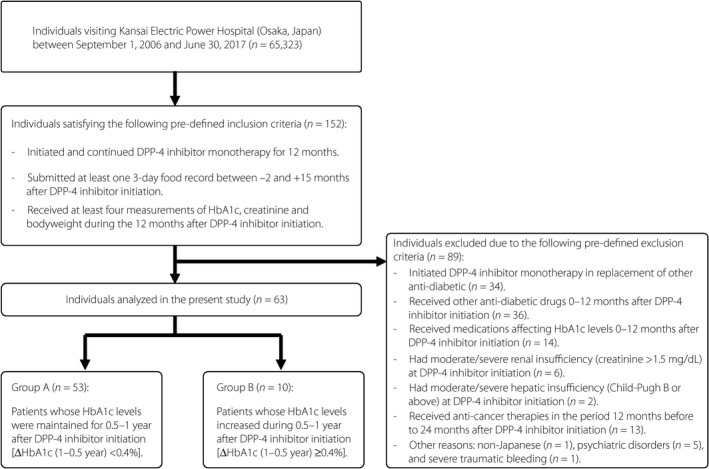
The present study was designed to assess possible relationships between deterioration of the glycated hemoglobin (HbA1c)-lowering effects in dipeptidyl peptidase-4 inhibitor (DPP4i) monotherapy and macronutrient intake among individuals with type 2 diabetes. Type 2 diabetes patients who began and continued DPP4i monotherapy without any prescription change for 1 year were retrospectively stratified into two groups: (i) patients who maintained their HbA1c levels during the 0.5- to 1-year period after DPP4i initiation (group A, ΔHbA1c [1-0.5 year] <0.4%, n = 53); and (ii) those whose HbA1c levels increased [group B, ΔHbA1c (1-0.5 year] ≥0.4%, n = 10). Group B had significantly higher ΔHbA1c (1-0.5 year), Δbodyweight (1-0.5 year) and fat intake, especially of saturated and monounsaturated fats; the carbohydrate and protein intake were similar between groups. Multiple regression analyses showed that fat intake, especially saturated fat intake, was significantly correlated with ΔHbA1c (1-0.5 year). Thus, dietary habits, especially saturated fat intake, might well contribute to deterioration of the HbA1c-lowering effects in DPP4i monotherapy.
本研究旨在评估 2 型糖尿病患者二肽基肽酶-4 抑制剂 (DPP4i) 单药治疗中糖化血红蛋白 (HbA1c) 降低效果恶化与宏量营养素摄入之间的可能关系。将起始并持续 1 年无任何处方改变的 DPP4i 单药治疗的 2 型糖尿病患者回顾性分层为两组:(i) 在起始 DPP4i 后 0.5 至 1 年内维持 HbA1c 水平的患者 (组 A,ΔHbA1c [1-0.5 年] <0.4%,n=53);和 (ii) HbA1c 水平升高的患者 (组 B,ΔHbA1c [1-0.5 年] ≥0.4%,n=10)。组 B 的 ΔHbA1c (1-0.5 年)、Δ体重 (1-0.5 年) 和脂肪摄入显著更高,特别是饱和脂肪和单不饱和脂肪;两组的碳水化合物和蛋白质摄入相似。多元回归分析显示,脂肪摄入,特别是饱和脂肪摄入,与 ΔHbA1c (1-0.5 年) 显著相关。因此,饮食习惯,特别是饱和脂肪摄入,可能导致 DPP4i 单药治疗中 HbA1c 降低效果恶化。