Seino Yutaka, Yabe Daisuke
Kansai Electric Power Hospital.
Division of Diabetes Clinical Nutrition and Endocrinology Kansai Electric Power Hospital Osaka Japan.
J Diabetes Investig. 2013 Mar 18;4(2):108-30. doi: 10.1111/jdi.12065.
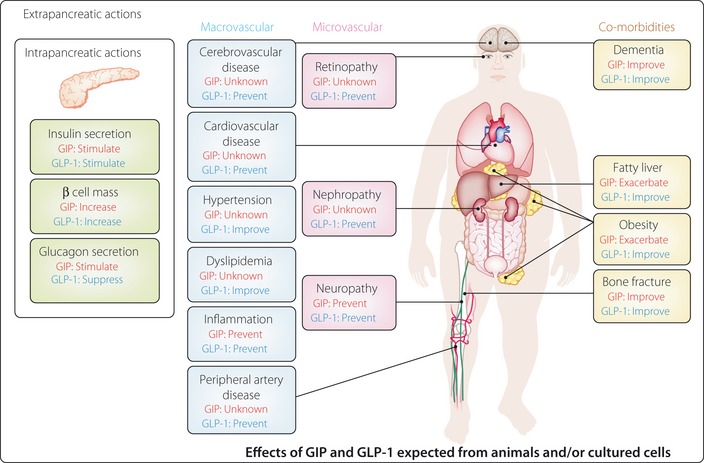
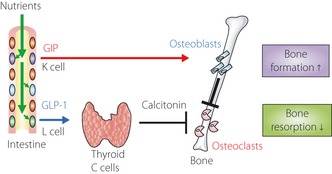
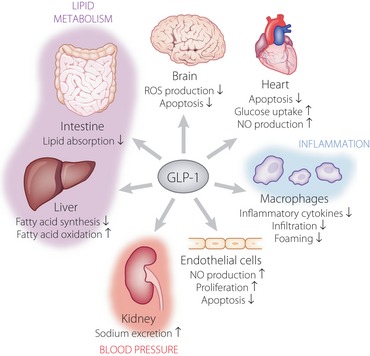
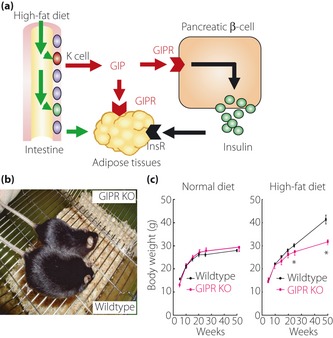
Glucose-dependent insulinotropic polypeptide (GIP) and glucagon-like peptide-1 (GLP-1) are the two primary incretin hormones secreted from the intestine on ingestion of various nutrients to stimulate insulin secretion from pancreatic β-cells glucose-dependently. GIP and GLP-1 undergo degradation by dipeptidyl peptidase-4 (DPP-4), and rapidly lose their biological activities. The actions of GIP and GLP-1 are mediated by their specific receptors, the GIP receptor (GIPR) and the GLP-1 receptor (GLP-1R), which are expressed in pancreatic β-cells, as well as in various tissues and organs. A series of investigations using mice lacking GIPR and/or GLP-1R, as well as mice lacking DPP-4, showed involvement of GIP and GLP-1 in divergent biological activities, some of which could have implications for preventing diabetes-related microvascular complications (e.g., retinopathy, nephropathy and neuropathy) and macrovascular complications (e.g., coronary artery disease, peripheral artery disease and cerebrovascular disease), as well as diabetes-related comorbidity (e.g., obesity, non-alcoholic fatty liver disease, bone fracture and cognitive dysfunction). Furthermore, recent studies using incretin-based drugs, such as GLP-1 receptor agonists, which stably activate GLP-1R signaling, and DPP-4 inhibitors, which enhance both GLP-1R and GIPR signaling, showed that GLP-1 and GIP exert effects possibly linked to prevention or treatment of diabetes-related complications and comorbidities independently of hyperglycemia. We review recent findings on the extrapancreatic effects of GIP and GLP-1 on the heart, brain, kidney, eye and nerves, as well as in the liver, fat and several organs from the perspective of diabetes-related complications and comorbidities.
葡萄糖依赖性促胰岛素多肽(GIP)和胰高血糖素样肽-1(GLP-1)是在摄入各种营养物质后从肠道分泌的两种主要肠促胰岛素激素,可葡萄糖依赖性地刺激胰腺β细胞分泌胰岛素。GIP和GLP-1会被二肽基肽酶-4(DPP-4)降解,并迅速丧失其生物活性。GIP和GLP-1的作用是由它们的特异性受体介导的,即GIP受体(GIPR)和GLP-1受体(GLP-1R),这些受体在胰腺β细胞以及各种组织和器官中表达。一系列使用缺乏GIPR和/或GLP-1R的小鼠以及缺乏DPP-4的小鼠进行的研究表明,GIP和GLP-1参与了多种生物活性,其中一些可能对预防糖尿病相关的微血管并发症(如视网膜病变、肾病和神经病变)和大血管并发症(如冠状动脉疾病、外周动脉疾病和脑血管疾病)以及糖尿病相关的合并症(如肥胖、非酒精性脂肪性肝病、骨折和认知功能障碍)具有重要意义。此外,最近使用基于肠促胰岛素的药物的研究,如稳定激活GLP-1R信号的GLP-1受体激动剂和增强GLP-1R和GIPR信号的DPP-4抑制剂,表明GLP-1和GIP发挥的作用可能与预防或治疗糖尿病相关并发症和合并症有关,而与高血糖无关。我们从糖尿病相关并发症和合并症的角度综述了关于GIP和GLP-1对心脏、大脑、肾脏、眼睛和神经以及肝脏、脂肪和其他几个器官的胰腺外作用的最新研究结果。