Department of Psychiatry and Behavioral Sciences, Emory University School of Medicine, Atlanta, GA, United States.
Winship Cancer Institute, Emory University, Atlanta, GA, United States.
Curr Neuropharmacol. 2018;16(5):533-558. doi: 10.2174/1570159X15666171123201142.
Studies investigating the impact of a variety of inflammatory stimuli on the brain and behavior have reported evidence that inflammation and release of inflammatory cytokines affect circuitry relevant to both reward and threat sensitivity to contribute to behavioral change. Of relevance to mood and anxiety-related disorders, biomarkers of inflammation such as inflammatory cytokines and acute-phase proteins are reliably elevated in a significant proportion of patients with major depressive disorder (MDD), bipolar disorder, anxiety disorders and post-traumatic stress disorder (PTSD).
This review summarized clinical and translational work demonstrating the impact of peripheral inflammation on brain regions and neurotransmitter systems relevant to both reward and threat sensitivity, with a focus on neuroimaging studies involving administration of inflammatory stimuli. Recent translation of these findings to further understand the role of inflammation in mood and anxiety-related disorders is also discussed.
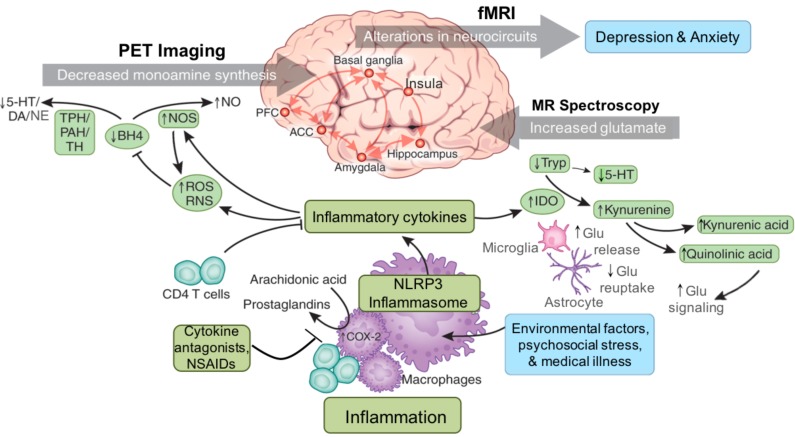
Inflammation was consistently found to affect basal ganglia and cortical reward and motor circuits to drive reduced motivation and motor activity, as well as anxiety-related brain regions including amygdala, insula and anterior cingulate cortex, which may result from cytokine effects on monoamines and glutamate. Similar relationships between inflammation and altered neurocircuitry have been observed in MDD patients with increased peripheral inflammatory markers, and such work is on the horizon for anxiety disorders and PTSD.
Neuroimaging effects of inflammation on reward and threat circuitry may be used as biomarkers of inflammation for future development of novel therapeutic strategies to better treat mood and anxiety-related disorders in patients with high inflammation.
研究各种炎症刺激物对大脑和行为的影响的报告表明,炎症和炎症细胞因子的释放会影响与奖赏和威胁敏感性相关的回路,从而导致行为改变。与情绪和焦虑相关障碍相关的是,炎症的生物标志物,如炎症细胞因子和急性期蛋白,在很大比例的重度抑郁症(MDD)、双相情感障碍、焦虑症和创伤后应激障碍(PTSD)患者中可靠地升高。
本文综述了临床和转化工作,这些工作表明外周炎症对与奖赏和威胁敏感性相关的大脑区域和神经递质系统的影响,重点是涉及炎症刺激物给药的神经影像学研究。还讨论了最近将这些发现进一步理解炎症在情绪和焦虑相关障碍中的作用的翻译。
炎症被一致发现会影响基底神经节和皮质奖赏和运动回路,导致动机和运动活动减少,以及与焦虑相关的大脑区域,包括杏仁核、脑岛和前扣带皮层,这可能是细胞因子对单胺类和谷氨酸的影响所致。在炎症标志物升高的 MDD 患者中也观察到了炎症与改变的神经回路之间的类似关系,而在焦虑症和 PTSD 中也正在开展此类工作。
炎症对奖赏和威胁回路的神经影像学影响可以作为炎症的生物标志物,用于开发新的治疗策略,以更好地治疗高炎症患者的情绪和焦虑相关障碍。