Craig Tom Kj, Rus-Calafell Mar, Ward Thomas, Leff Julian P, Huckvale Mark, Howarth Elizabeth, Emsley Richard, Garety Philippa A
Department of Health Service and Population Research, Institute of Psychiatry, Psychology and Neuroscience, King's College London, London, UK.
Department of Health Service and Population Research, Institute of Psychiatry, Psychology and Neuroscience, King's College London, London, UK.
Lancet Psychiatry. 2018 Jan;5(1):31-40. doi: 10.1016/S2215-0366(17)30427-3. Epub 2017 Nov 23.
A quarter of people with psychotic conditions experience persistent auditory verbal hallucinations, despite treatment. AVATAR therapy (invented by Julian Leff in 2008) is a new approach in which people who hear voices have a dialogue with a digital representation (avatar) of their presumed persecutor, voiced by the therapist so that the avatar responds by becoming less hostile and concedes power over the course of therapy. We aimed to investigate the effect of AVATAR therapy on auditory verbal hallucinations, compared with a supportive counselling control condition.
We did this single-blind, randomised controlled trial at a single clinical location (South London and Maudsley NHS Trust). Participants were aged 18 to 65 years, had a clinical diagnosis of a schizophrenia spectrum (ICD10 F20-29) or affective disorder (F30-39 with psychotic symptoms), and had enduring auditory verbal hallucinations during the previous 12 months, despite continued treatment. Participants were randomly assigned (1:1) to receive AVATAR therapy or supportive counselling with randomised permuted blocks (block size randomly varying between two and six). Assessments were done at baseline, 12 weeks, and 24 weeks, by research assessors who were masked to therapy allocation. The primary outcome was reduction in auditory verbal hallucinations at 12 weeks, measured by total score on the Psychotic Symptoms Rating Scales Auditory Hallucinations (PSYRATS-AH). Analysis was by intention-to-treat with linear mixed models. The trial was prospectively registered with the ISRCTN registry, number 65314790.
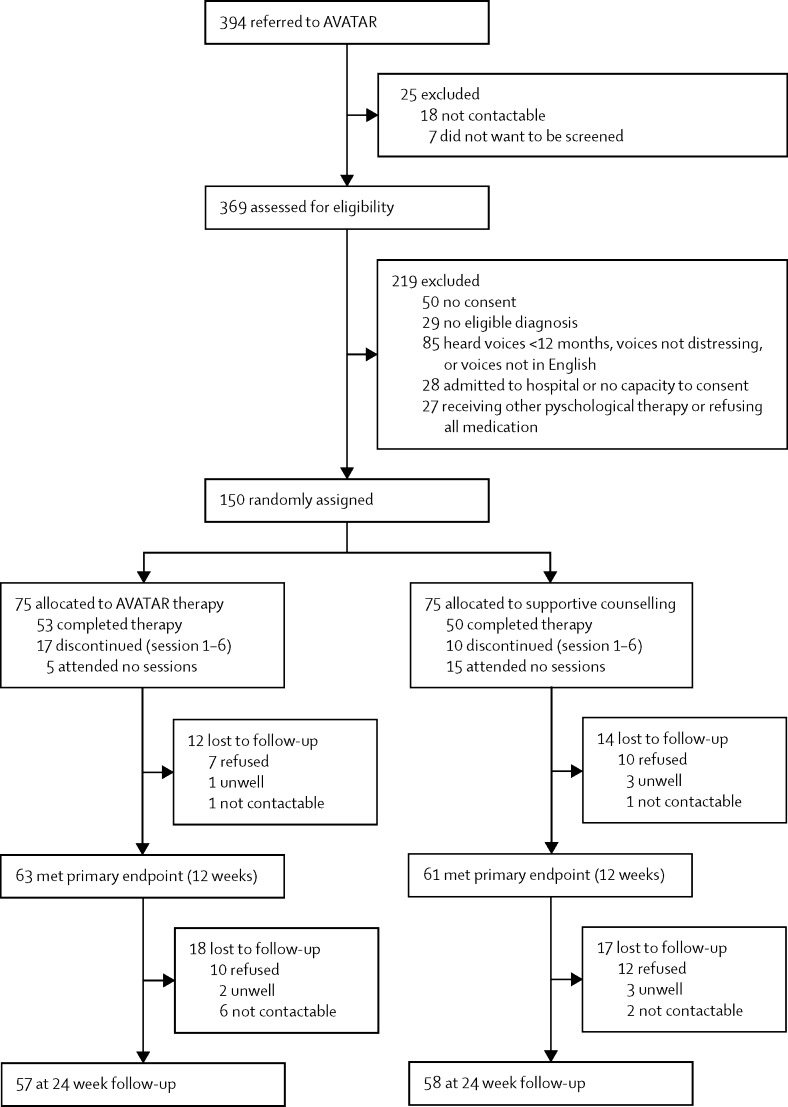
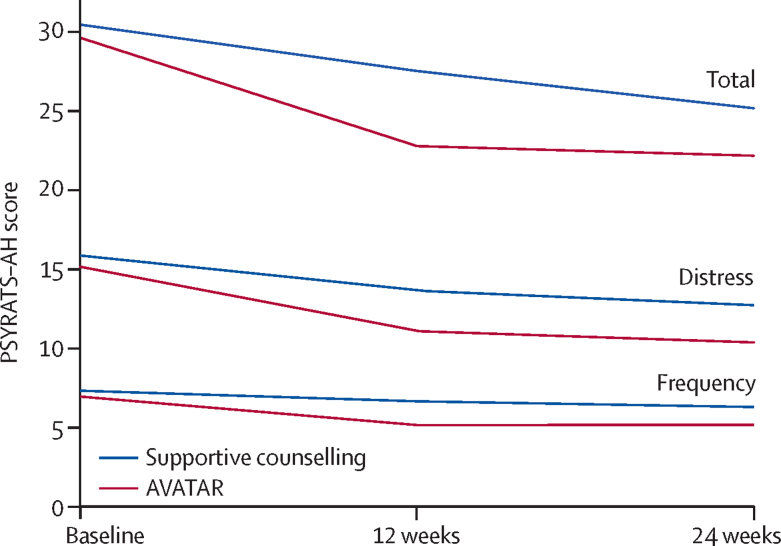
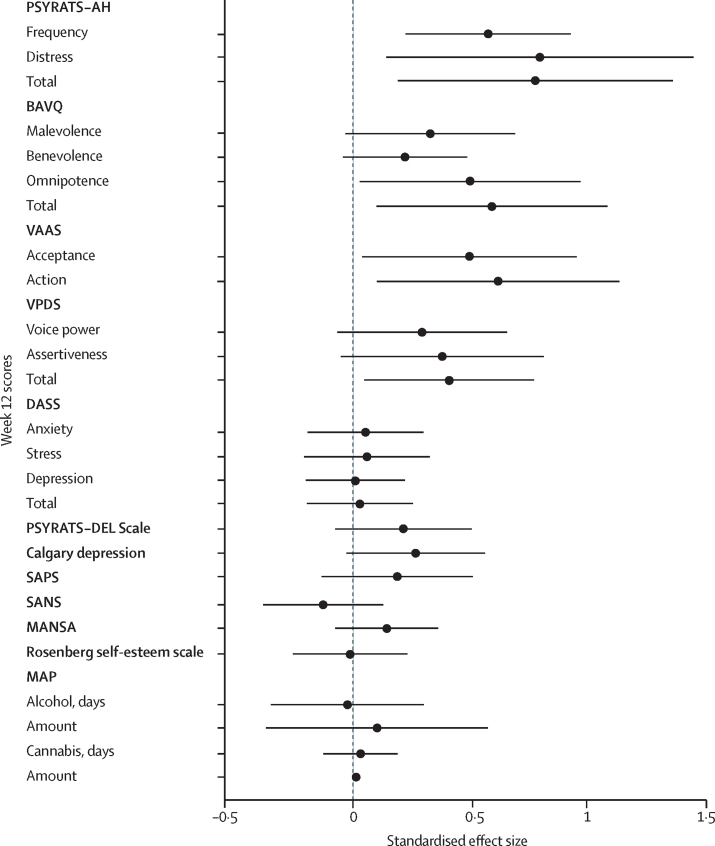
Between Nov 1, 2013, and Jan 28, 2016, 394 people were referred to the study, of whom 369 were assessed for eligibility. Of these people, 150 were eligible and were randomly assigned to receive either AVATAR therapy (n=75) or supportive counselling (n=75). 124 (83%) met the primary outcome. The reduction in PSYRATS-AH total score at 12 weeks was significantly greater for AVATAR therapy than for supportive counselling (mean difference -3·82 [SE 1·47], 95% CI -6·70 to -0·94; p<0·0093). There was no evidence of any adverse events attributable to either therapy.
To our knowledge, this is the first powered, randomised controlled trial of AVATAR therapy. This brief, targeted therapy was more effective after 12 weeks of treatment than was supportive counselling in reducing the severity of persistent auditory verbal hallucinations, with a large effect size. Future multi-centre studies are needed to establish the effectiveness of AVATAR therapy and, if proven effective, we think it should become an option in the psychological treatment of auditory verbal hallucinations.
Wellcome Trust.
四分之一患有精神病性疾病的人尽管接受了治疗,但仍会经历持续性幻听。阿凡达疗法(由朱利安·莱夫于2008年发明)是一种新方法,在该疗法中,有幻听的人会与他们假定的迫害者的数字化身进行对话,由治疗师为化身配音,以便化身在治疗过程中通过变得不那么敌对并让出权力来做出回应。我们旨在研究与支持性咨询对照条件相比,阿凡达疗法对幻听的影响。
我们在单一临床地点(伦敦南部和莫兹利国民保健服务信托基金)进行了这项单盲随机对照试验。参与者年龄在18至65岁之间,临床诊断为精神分裂症谱系(国际疾病分类第10版F20 - 29)或情感障碍(F30 - 39伴有精神病性症状),并且在过去12个月中尽管持续接受治疗仍有持续性幻听。参与者被随机分配(1:1)接受阿凡达疗法或支持性咨询,采用随机排列区组(区组大小在2至6之间随机变化)。评估在基线、12周和24周时由对治疗分配不知情的研究评估人员进行。主要结局是12周时幻听的减少,通过精神病症状评定量表幻听(PSYRATS - AH)总分来衡量。分析采用意向性分析,使用线性混合模型。该试验已在国际标准随机对照试验编号注册中心前瞻性注册,编号为65314790。
在2013年11月1日至2016年1月28日期间,394人被转介到该研究,其中369人接受了资格评估。在这些人中,150人符合条件并被随机分配接受阿凡达疗法(n = 75)或支持性咨询(n = 75)。124人(83%)达到了主要结局。阿凡达疗法在12周时PSYRATS - AH总分的降低显著大于支持性咨询(平均差值 -3·82 [标准误1·47],95%置信区间 -6·70至 -0·94;p < 0·0093)。没有证据表明任何一种疗法会导致不良事件。
据我们所知,这是第一项关于阿凡达疗法的有足够样本量的随机对照试验。这种简短、有针对性的疗法在治疗12周后比支持性咨询在减轻持续性幻听的严重程度方面更有效,且效应量较大。未来需要进行多中心研究以确定阿凡达疗法的有效性,如果被证明有效,我们认为它应该成为幻听心理治疗的一种选择。
惠康信托基金会。