Yang Bicheng, Wang Liqun, Wan Xiaoju, Li Yunjun, Yu Xiaohong, Qin Yunna, Luo Yong, Wang Feng, Huang Ouping
Jiangxi Provincial Maternal and Child Health Hospital, No. 318 Bayi street, Nanchang, Jiangxi, 330006, People's Republic of China.
BMC Womens Health. 2017 Nov 25;17(1):118. doi: 10.1186/s12905-017-0474-z.
Given the important roles of the receptor-mediated lysophosphatidic acid (LPA) signaling in both reproductive tract function and gynecological cancers, it will be informative to investigate the potential role of LPA in the development of adenomyosis. The objective of this study was to evaluate the levels of LPA in plasma and the expression of six LPA receptors in the endometrial tissue collected from women with and without adenomyosis.
Plasma and endometrial tissue samples were collected form women with and without adenomyosis. The levels of LPA in plasma were determined by using high-performance liquid chromatography electrospray ionization tandem mass spectrometry (HPLC-ESI-MS/MS). Immunohistochemistry was performed to evaluate the expression of six LPA receptors (LPA1-6) in endometrial tissue samples. The effects of LPA on IL-8 production, VEGF production and cell proliferation in human endometrial stromal cells (ESCs) were also assessed.
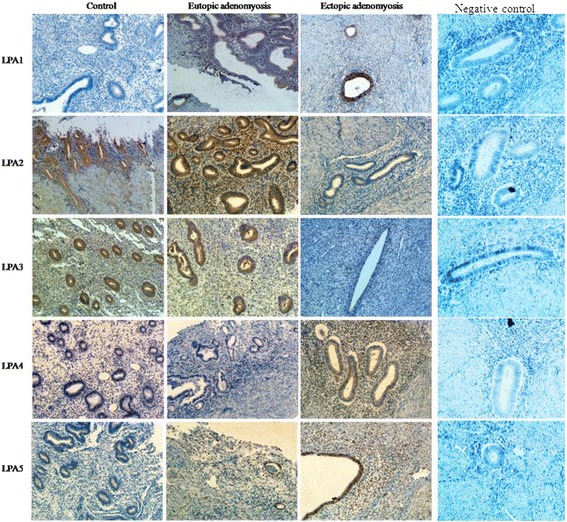
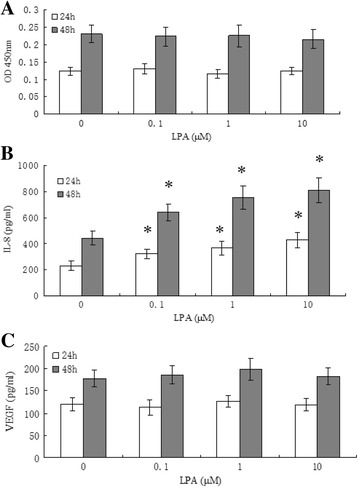
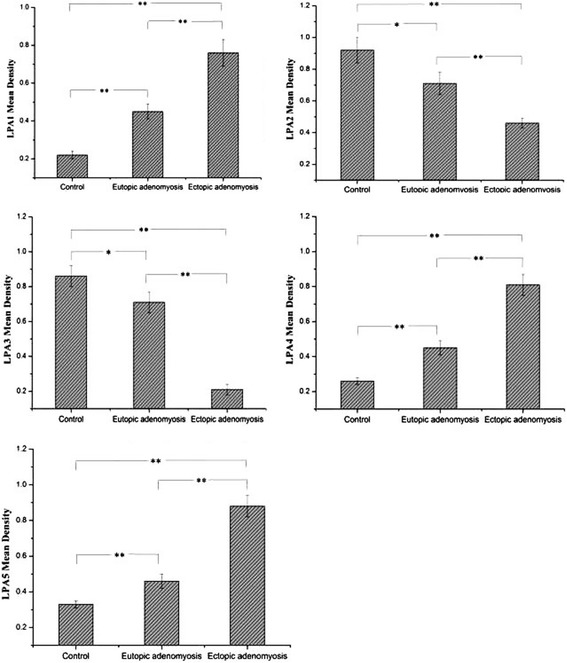
LPA1 staining was localized to the cytoplasm, membrances of the epithelial cells of the endometrial glands, and there was little staining in the stromal cells. LPA2-5 staining were localized to the nuclei of stromal and glandular cells. Plasma levels of LPA were increased in adenomyosis. LPA1, LPA4 and LPA5 immunoreactivity were significantly higher in the adenomyosis group than in the control group, while LPA2 and LPA3 immunoreactivity were significantly lower in the adenomyosis group than in the control group. LPA6 was undetectable in the endometria. LPA induced the release of IL-8 from ESCs but did not affect cell proliferation and VEGF production.
These results indicate that elevated plasma levels of LPA and aberrant expression of LPA receptors in the endometria may be associated with the development of adenomyosis.
鉴于受体介导的溶血磷脂酸(LPA)信号通路在生殖道功能和妇科癌症中均发挥重要作用,研究LPA在子宫腺肌病发生发展中的潜在作用将具有重要意义。本研究的目的是评估有或无子宫腺肌病的女性血浆中LPA水平以及子宫内膜组织中六种LPA受体的表达情况。
收集有或无子宫腺肌病女性的血浆和子宫内膜组织样本。采用高效液相色谱电喷雾电离串联质谱法(HPLC-ESI-MS/MS)测定血浆中LPA水平。进行免疫组织化学以评估六种LPA受体(LPA1-6)在子宫内膜组织样本中的表达。还评估了LPA对人子宫内膜基质细胞(ESC)中白细胞介素-8(IL-8)产生、血管内皮生长因子(VEGF)产生和细胞增殖的影响。
LPA1染色定位于子宫内膜腺体上皮细胞的细胞质和细胞膜,基质细胞中染色较少。LPA2-5染色定位于基质细胞和腺细胞的细胞核。子宫腺肌病患者血浆LPA水平升高。子宫腺肌病组中LPA1、LPA4和LPA5的免疫反应性显著高于对照组,而子宫腺肌病组中LPA2和LPA3的免疫反应性显著低于对照组。在子宫内膜中未检测到LPA6。LPA诱导ESC释放IL-8,但不影响细胞增殖和VEGF产生。
这些结果表明,血浆中LPA水平升高以及子宫内膜中LPA受体表达异常可能与子宫腺肌病的发生发展有关。