Högberg Cecilia, Söderström Lars, Lilja Mikael
a Department of Public Health and Clinical Medicine, Unit of Research, Education, and Development - Östersund , Umeå University , Umeå , Sweden.
b Unit of Research, Education, and Development , Region Jämtland Härjedalen , Östersund , Sweden.
Scand J Prim Health Care. 2017 Dec;35(4):369-372. doi: 10.1080/02813432.2017.1397255.
Faecal immunochemical tests (FITs) are used to screen for colorectal cancer (CRC) and as diagnostic aids in symptomatic patients. However, the number of samples per FIT varies. It is unclear if there is any advantage to analyse multiple-sample FITs in symptomatic patients.
This is a post hoc analysis of a retrospective study that included all cases of CRC and adenomas with high-grade dysplasia (HGD) between 2005 and 2009 in the county of Jämtland, Sweden.
All patients with CRC and adenomas with HGD that initially presented with symptoms to primary care and delivered FITs.
The likelihood of a positive FIT in cases of CRC and adenomas with HGD; when analysing one, two or three samples.
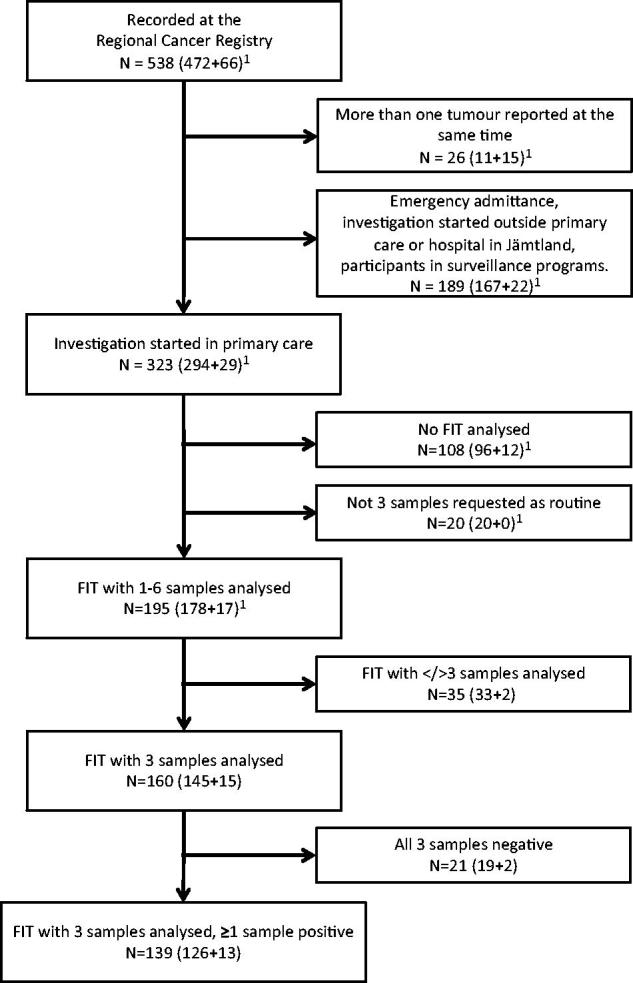
Of 195 patients, 160 delivered three-sample FITs. Using the 139 cases in which at least one sample was positive, the likelihood of detecting a positive sample upon analysis of only one of the three samples was 0.91 (95% CI: 0.85-0.95), indicating that 13 positive cases may have been missed.
Use of a one-sample FIT instead of a three-sample FIT as a diagnostic aid may result in the missing of one tenth of symptomatic CRCs and adenomas with HGD.
粪便免疫化学检测(FITs)用于筛查结直肠癌(CRC),并作为有症状患者的诊断辅助手段。然而,每次FIT检测的样本数量各不相同。对于有症状的患者,分析多个样本的FIT检测是否具有优势尚不清楚。
这是一项回顾性研究的事后分析,纳入了2005年至2009年瑞典耶姆特兰县所有结直肠癌和高级别异型增生(HGD)腺瘤病例。
所有最初因症状就诊于初级保健机构并接受FIT检测的结直肠癌和HGD腺瘤患者。
结直肠癌和HGD腺瘤病例中FIT检测呈阳性的可能性;分析一个、两个或三个样本时的情况。
195例患者中,160例提供了三个样本的FIT检测。在至少一个样本呈阳性的139例病例中,仅分析三个样本中的一个时检测到阳性样本的可能性为0.91(95%CI:0.85 - 0.95),这表明可能有13例阳性病例被漏检。
使用单样本FIT检测而非三样本质FIT检测作为诊断辅助手段,可能会漏诊十分之一有症状的结直肠癌和HGD腺瘤。