University Program in Genetics and Genomics, Duke University, Durham, NC, 27708, USA.
Department of Molecular Genetics and Microbiology, Duke University School of Medicine, Durham, NC, 27708, USA.
Sci Rep. 2017 Nov 28;7(1):16480. doi: 10.1038/s41598-017-16526-8.
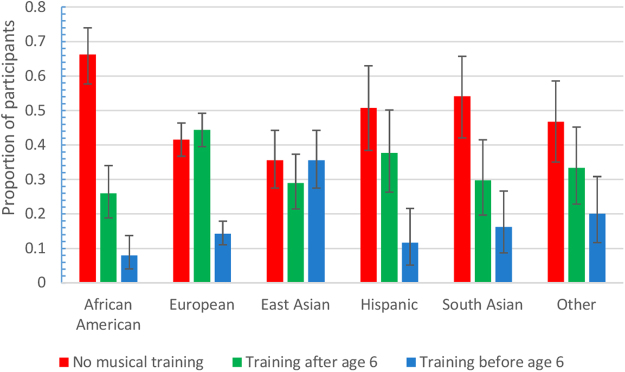
Despite efforts to characterize the different aspects of musical abilities in humans, many elements of this complex area remain unknown. Musical abilities are known to be associated with factors like intelligence, training, and sex, but a comprehensive evaluation of the simultaneous impact of multiple factors has not yet been performed. Here, we assessed 918 healthy volunteers for pitch discrimination abilities-their ability to tell two tones close in pitch apart. We identified the minimal threshold that the participants could detect, and we found that better performance was associated with higher intelligence, East Asian ancestry, male sex, younger age, formal music training-especially before age 6-and English as the native language. All these factors remained significant when controlling for the others, with general intelligence, musical training, and male sex having the biggest impacts. We also performed a small GWAS and gene-based collapsing analysis, identifying no significant associations. Future genetic studies of musical abilities should involve large sample sizes and an unbiased genome-wide approach, with the factors highlighted here included as important covariates.
尽管人们努力描述人类音乐能力的不同方面,但这个复杂领域的许多元素仍然未知。音乐能力已知与智力、训练和性别等因素有关,但尚未对多个因素的综合影响进行全面评估。在这里,我们评估了 918 名健康志愿者的音高辨别能力——他们区分两个接近音高的音的能力。我们确定了参与者可以检测到的最小阈值,我们发现更好的表现与更高的智力、东亚血统、男性性别、更年轻的年龄、正规的音乐训练——尤其是在 6 岁之前——以及英语作为母语有关。在控制其他因素的情况下,所有这些因素仍然很重要,其中一般智力、音乐训练和男性性别影响最大。我们还进行了小规模的全基因组关联研究和基于基因的合并分析,未发现显著关联。未来对音乐能力的遗传研究应涉及大样本量和无偏的全基因组方法,并将这里强调的因素作为重要的协变量。