Shanghai Chenshan Plant Science Research Center, Chinese Academy of Sciences, 3888 Chenhua Road, Songjiang, Shanghai 201602, China.
Shanghai Key Laboratory of Plant Functional Genomics and Resources, Shanghai Chenshan Botanical Garden, 3888 Chenhua Road, Songjiang, Shanghai 201602, China.
Gigascience. 2018 Feb 1;7(2):1-11. doi: 10.1093/gigascience/gix116.
Ferns, originated about 360 million years ago, are the sister group of seed plants. Despite the remarkable progress in our understanding of fern phylogeny, with conflicting molecular evidence and different morphological interpretations, relationships among major fern lineages remain controversial.
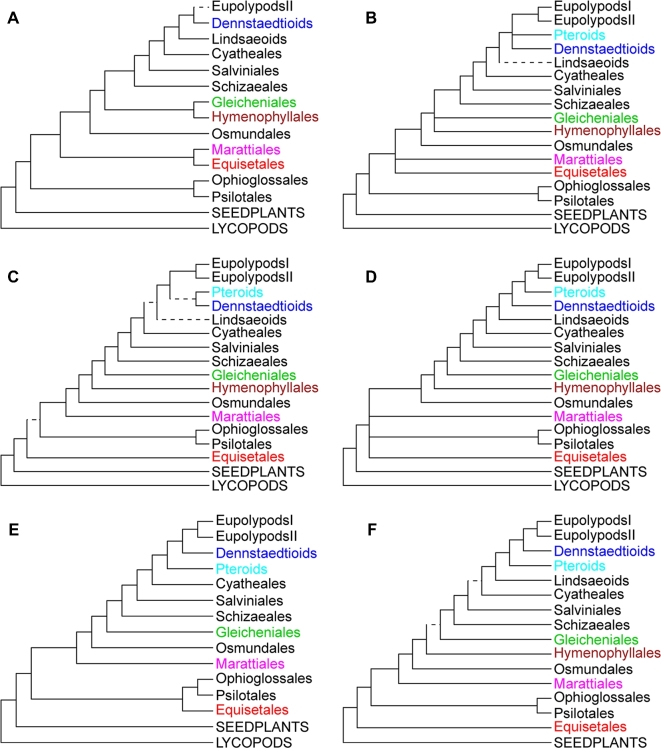
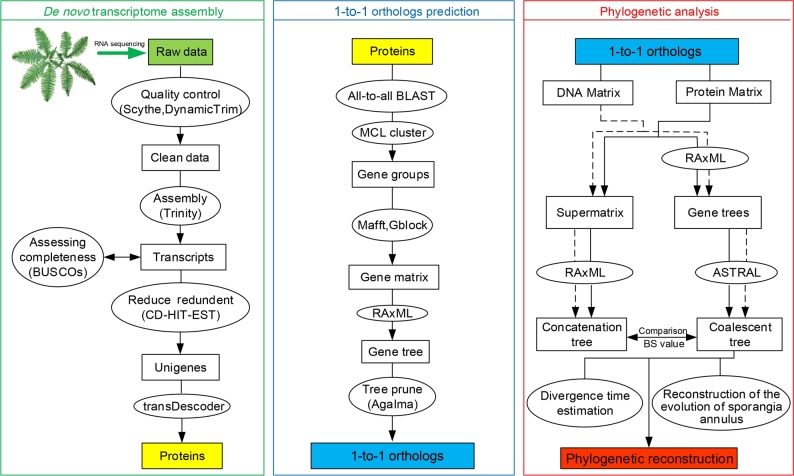
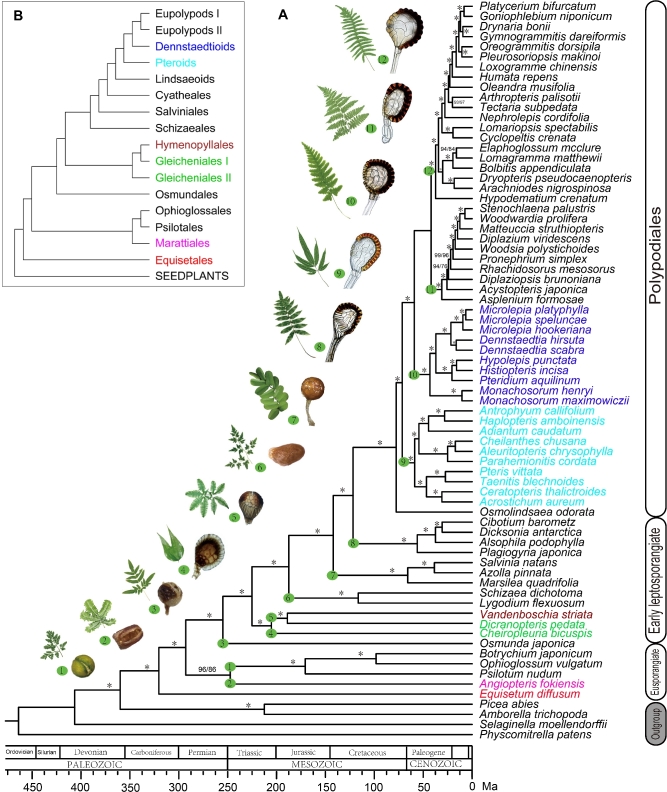
With the aim to obtain a robust fern phylogeny, we carried out a large-scale phylogenomic analysis using high-quality transcriptome sequencing data, which covered 69 fern species from 38 families and 11 orders. Both coalescent-based and concatenation-based methods were applied to both nucleotide and amino acid sequences in species tree estimation. The resulting topologies are largely congruent with each other, except for the placement of Angiopteris fokiensis, Cheiropleuria bicuspis, Diplaziopsis brunoniana, Matteuccia struthiopteris, Elaphoglossum mcclurei, and Tectaria subpedata.
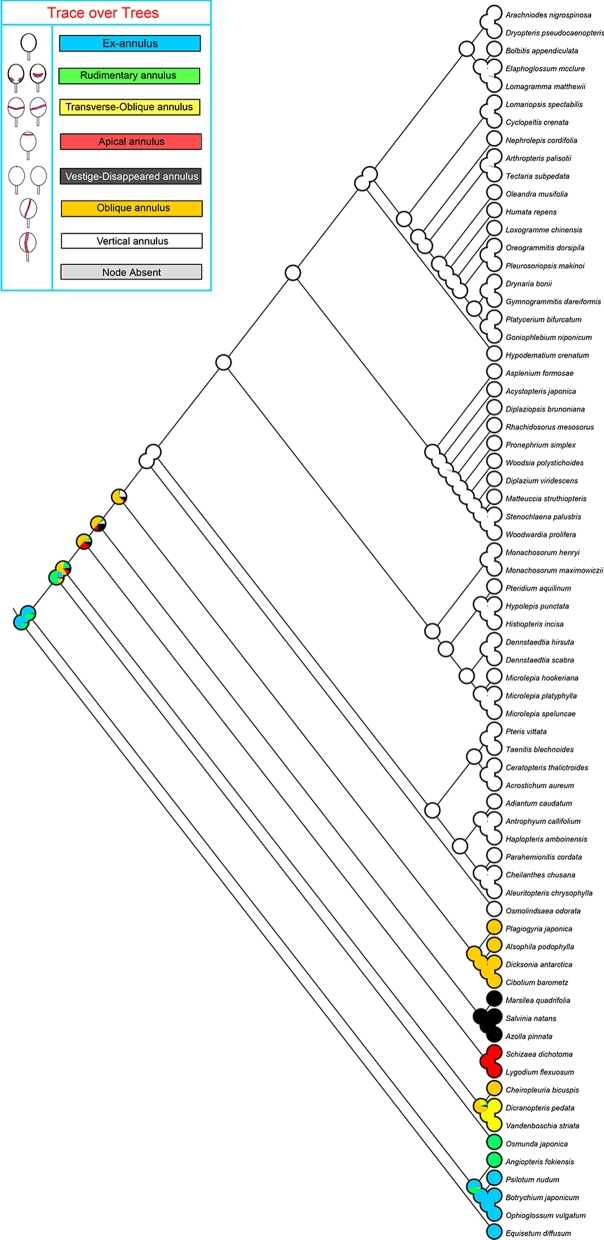
Our result confirmed that Equisetales is sister to the rest of ferns, and Dennstaedtiaceae is sister to eupolypods. Moreover, our result strongly supported some relationships different from the current view of fern phylogeny, including that Marattiaceae may be sister to the monophyletic clade of Psilotaceae and Ophioglossaceae; that Gleicheniaceae and Hymenophyllaceae form a monophyletic clade sister to Dipteridaceae; and that Aspleniaceae is sister to the rest of the groups in eupolypods II. These results were interpreted with morphological traits, especially sporangia characters, and a new evolutionary route of sporangial annulus in ferns was suggested. This backbone phylogeny in ferns sets a foundation for further studies in biology and evolution in ferns, and therefore in plants.
蕨类植物起源于约 3.6 亿年前,是种子植物的姐妹群。尽管我们对蕨类植物系统发育的理解取得了显著进展,但由于分子证据存在冲突以及形态学解释不同,主要蕨类谱系之间的关系仍存在争议。
为了获得稳健的蕨类植物系统发育,我们使用高质量的转录组测序数据进行了大规模的基因组分析,这些数据涵盖了来自 38 个科和 11 个目的 69 种蕨类植物。在种系发生树估计中,我们同时应用了基于合并和基于串联的方法,分别使用核苷酸和氨基酸序列。除了凤尾蕨科、海金沙科、双盖蕨科、蹄盖蕨科、里白科和膜蕨科的位置外,得到的拓扑结构在很大程度上彼此一致。
我们的结果证实,木贼目是蕨类植物其余部分的姐妹群,水龙骨目是水龙骨亚目和真蕨亚目的姐妹群。此外,我们的结果强烈支持了一些与当前蕨类植物系统发育观点不同的关系,包括凤尾蕨科可能与石松目和瓶尔小草目的单系群为姐妹群;里白科和膜蕨科与水龙骨科形成一个单系群;金星蕨科与真蕨亚目的其余部分为姐妹群。这些结果与形态特征,特别是孢子囊特征有关,并提出了蕨类植物孢子囊环的一个新进化途径。这个蕨类植物的骨干系统发育为进一步研究蕨类植物生物学和进化,以及因此研究植物学奠定了基础。