The Lewis B, and Dorothy Cullman Program for Molecular Systematics Studies, The New York Botanical Garden, Bronx, NY 10458, USA.
BMC Evol Biol. 2010 Oct 23;10:321. doi: 10.1186/1471-2148-10-321.
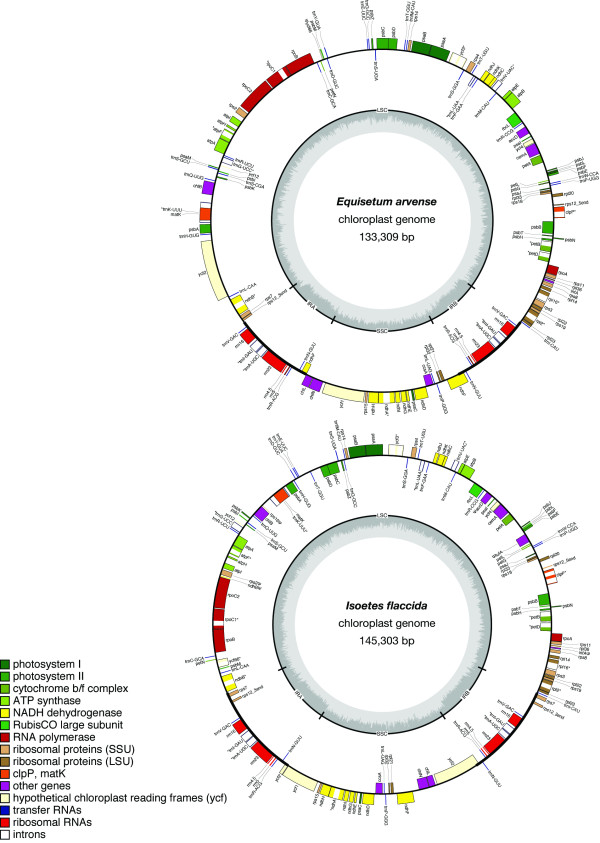
Despite considerable progress in our understanding of land plant phylogeny, several nodes in the green tree of life remain poorly resolved. Furthermore, the bulk of currently available data come from only a subset of major land plant clades. Here we examine early land plant evolution using complete plastome sequences including two previously unexamined and phylogenetically critical lineages. To better understand the evolution of land plants and their plastomes, we examined aligned nucleotide sequences, indels, gene and nucleotide composition, inversions, and gene order at the boundaries of the inverted repeats.
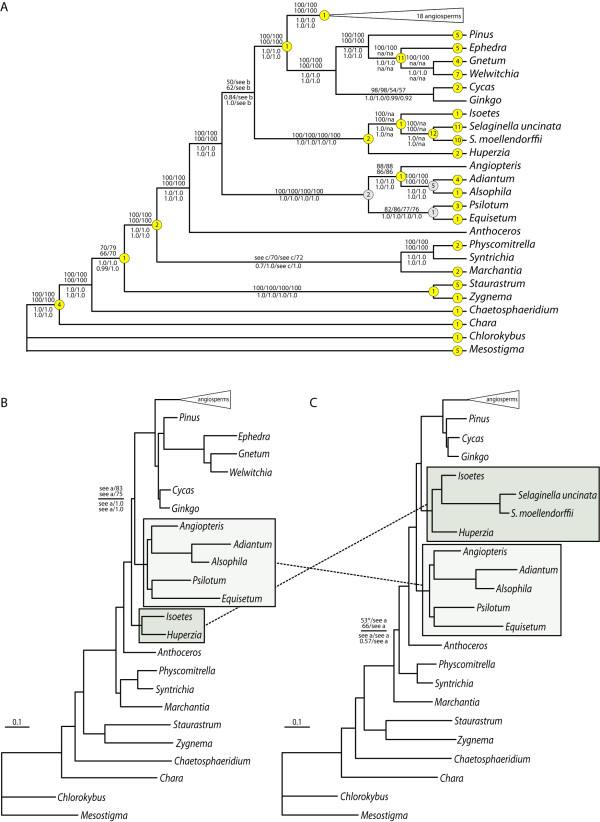
We present the plastome sequences of Equisetum arvense, a horsetail, and of Isoetes flaccida, a heterosporous lycophyte. Phylogenetic analysis of aligned nucleotides from 49 plastome genes from 43 taxa supported monophyly for the following clades: embryophytes (land plants), lycophytes, monilophytes (leptosporangiate ferns + Angiopteris evecta + Psilotum nudum + Equisetum arvense), and seed plants. Resolution among the four monilophyte lineages remained moderate, although nucleotide analyses suggested that P. nudum and E. arvense form a clade sister to A. evecta + leptosporangiate ferns. Results from phylogenetic analyses of nucleotides were consistent with the distribution of plastome gene rearrangements and with analysis of sequence gaps resulting from insertions and deletions (indels). We found one new indel and an inversion of a block of genes that unites the monilophytes.
Monophyly of monilophytes has been disputed on the basis of morphological and fossil evidence. In the context of a broad sampling of land plant data we find several new pieces of evidence for monilophyte monophyly. Results from this study demonstrate resolution among the four monilophytes lineages, albeit with moderate support; we posit a clade consisting of Equisetaceae and Psilotaceae that is sister to the "true ferns," including Marattiaceae.
尽管我们对陆地植物系统发育的理解取得了相当大的进展,但生命之树的几个节点仍未得到很好的解决。此外,目前可用的数据大部分来自主要陆地植物类群的一个子集。在这里,我们使用包括两个以前未被研究过的、具有系统发育关键地位的谱系在内的完整质体基因组序列来研究早期陆地植物的进化。为了更好地了解陆地植物及其质体的进化,我们检查了在反转重复边界处的对齐核苷酸序列、插入缺失、基因和核苷酸组成、反转和基因顺序。
我们展示了来自两种植物的质体序列:一种是木贼属(Equisetum arvense),一种是石松属(Isoetes flaccida)。对来自 43 个分类群的 49 个质体基因的对齐核苷酸进行的系统发育分析支持以下分支的单系性:胚胎植物(陆地植物)、石松类植物、单叶植物(具孢子叶的蕨类植物+满江红属+石松属+木贼属)和种子植物。虽然核苷酸分析表明,木贼属和石松属形成了一个与满江红属+具孢子叶的蕨类植物姐妹群,但四个单叶植物谱系之间的分辨率仍然是中等的。核苷酸分析结果与质体基因重排的分布以及由插入和缺失(插入缺失)产生的序列间隙分析一致。我们发现了一个新的插入缺失和一个基因块的反转,该基因块将单叶植物结合在一起。
单叶植物的单系性一直基于形态学和化石证据存在争议。在广泛的陆地植物数据采样的背景下,我们发现了一些支持单叶植物单系性的新证据。本研究的结果表明,尽管支持力度适中,但四个单叶植物谱系之间的分辨率较高;我们提出了一个由木贼科和石松科组成的分支,与包括海金沙科在内的“真正的蕨类植物”是姐妹关系。