Renal Research Institute, Research Department, New York, NY, USA.
University of California at Santa Barbara, Department of Statistics and Applied Probability, Santa Barbara, CA, USA.
Nephrol Dial Transplant. 2018 Jun 1;33(6):1040-1045. doi: 10.1093/ndt/gfx309.
The pathophysiology of a paradoxical systolic blood pressure (SBP) rise during hemodialysis (HD) is not yet fully understood. Recent research indicated that 10% of chronic HD patients suffer from prolonged intradialytic hypoxemia. Since hypoxemia induces a sympathetic response we entertained the hypothesis that peridialytic SBP change is associated with arterial oxygen saturation (SaO2).
We retrospectively analyzed intradialytic SaO2 and peridialytic SBP change in chronic HD patients with arteriovenous vascular access. Patients were followed for 6 months. We defined persistent intradialytic hypertension (piHTN) as average peridialytic SBP increase ≥10 mmHg over 6 months. Linear mixed effects (LME) models were used to explore associations between peridialytic SBP change and intradialytic SaO2 in univariate and adjusted analyses.
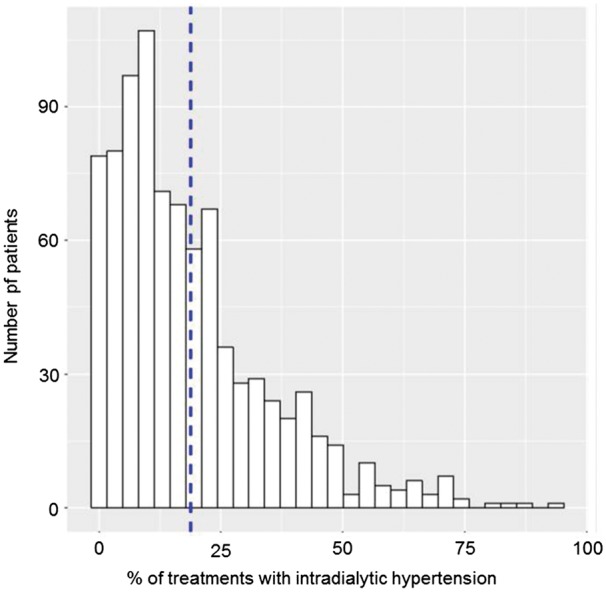
We assessed 982 patients (29 872 HD treatments; 59% males; 53% whites). Pre-dialysis SBP was 146.7 ± 26.5 mmHg and decreased on average by 10.1 ± 24.5 mmHg. Fifty-three (5.7%) patients had piHTN. piHTN patients had lower intradialytic SaO2, body weight and interdialytic weight gain. LME models revealed that with every percentage point lower mean SaO2, the peridialytic SBP change increased by 0.46 mmHg (P < 0.001). This finding was corroborated in multivariate analyses.
We observed an inverse relationship between intradialytic SaO2 and the blood pressure response to HD. These findings support the notion that hypoxemia activates mechanisms that partially blunt the intradialytic blood pressure decline, possibly by sympathetic activation and endothelin-1 secretion. To further explore that hypothesis, specifically designed prospective studies are required.
血液透析(HD)过程中收缩压(SBP)反常升高的病理生理学机制尚未完全阐明。最近的研究表明,10%的慢性 HD 患者存在持续性透析中低氧血症。由于低氧血症会引起交感神经反应,我们推测透析中 SBP 的变化与动脉血氧饱和度(SaO2)有关。
我们回顾性分析了有动静脉血管通路的慢性 HD 患者的透析中 SaO2 和透析中 SBP 的变化。患者随访 6 个月。我们将持续透析中高血压(piHTN)定义为 6 个月期间平均透析中 SBP 升高≥10mmHg。线性混合效应(LME)模型用于在单变量和调整分析中探索透析中 SBP 变化与透析中 SaO2 之间的关联。
我们评估了 982 名患者(29872 次 HD 治疗;59%为男性;53%为白人)。透析前 SBP 为 146.7±26.5mmHg,平均下降 10.1±24.5mmHg。53 名(5.7%)患者有 piHTN。piHTN 患者的透析中 SaO2、体重和透析间体重增加较低。LME 模型显示,平均 SaO2 每降低 1 个百分点,透析中 SBP 变化增加 0.46mmHg(P<0.001)。这一发现在多变量分析中得到了证实。
我们观察到透析中 SaO2 与 HD 时血压反应之间存在负相关。这些发现支持低氧血症激活机制的观点,这些机制部分削弱了透析中的血压下降,可能通过交感神经激活和内皮素-1 分泌。为了进一步探索这一假说,需要进行专门设计的前瞻性研究。