
增强集约化管理草地田边繁殖无脊椎动物的多样性:替代管理措施的影响。
Enhancing the diversity of breeding invertebrates within field margins of intensively managed grassland: Effects of alternative management practices.
作者信息
Fritch Rochelle A, Sheridan Helen, Finn John A, McCormack Stephen, Ó hUallacháin Daire
机构信息
UCD School of Agriculture & Food Science University College Dublin Dublin Ireland.
Teagasc Environment Research Centre Wexford Ireland.
出版信息
Ecol Evol. 2017 Oct 19;7(22):9763-9774. doi: 10.1002/ece3.3302. eCollection 2017 Nov.
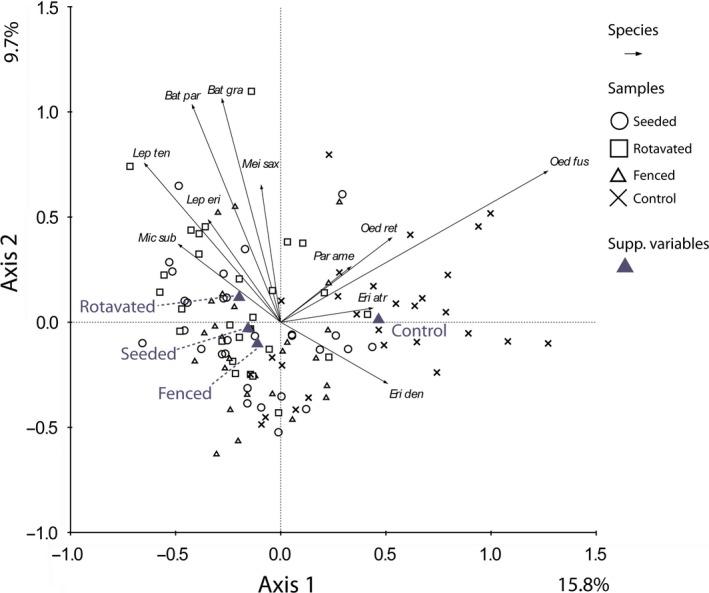
Severe declines in biodiversity have been well documented for many taxonomic groups due to intensification of agricultural practices. Establishment and appropriate management of arable field margins can improve the diversity and abundance of invertebrate groups; however, there is much less research on field margins within grassland systems. Three grassland field margin treatments (fencing off the existing vegetation "fenced"; fencing with rotavation and natural regeneration "rotavated" and; fencing with rotavation and seeding "seeded") were compared to a grazed control in the adjacent intensively managed pasture. Invertebrates were sampled using emergence traps to investigate species breeding and overwintering within the margins. Using a manipulation experiment, we tested whether the removal of grazing pressure and nutrient inputs would increase the abundance and richness of breeding invertebrates within grassland field margins. We also tested whether field margin establishment treatments, with their different vegetation communities, would change the abundance and richness of breeding invertebrates in the field margins. Exclusion of grazing and nutrient inputs led to increased abundance and richness in nearly all invertebrate groups that we sampled. However, there were more complex effects of field margin establishment treatment on the abundance and richness of invertebrate taxa. Each of the three establishment treatments supported a distinct invertebrate community. The removal of grazing from grassland field margins provided a greater range of overwintering/breeding habitat for invertebrates. We demonstrate the capacity of field margin establishment to increase the abundance and richness in nearly all invertebrate groups in study plots that were located on previously more depauperate areas of intensively managed grassland. These results from grassland field margins provide evidence to support practical actions that can inform Greening (Pillar 1) and agri-environment measures (Pillar 2) of the Common Agricultural Policy (CAP). Before implementing specific management regimes, the conservation aims of agri-environment measures should be clarified by defining the target species or taxonomic groups.
由于农业生产方式的集约化,许多分类群的生物多样性已出现严重下降,这一点已有充分记录。建立和妥善管理耕地边缘可以提高无脊椎动物群体的多样性和数量;然而,针对草地系统内的田边地埂开展的研究要少得多。我们将三种草地田边地埂处理方式(用栅栏隔开现有植被,即“围栏式”;旋耕并自然再生后围栏,即“旋耕式”;旋耕并播种后围栏,即“播种式”)与相邻集约管理牧场的放牧对照区进行了比较。使用诱虫器对无脊椎动物进行采样,以调查边缘区域内物种的繁殖和越冬情况。通过一项操纵实验,我们测试了去除放牧压力和养分输入是否会增加草地田边地埂内繁殖无脊椎动物的数量和丰富度。我们还测试了具有不同植被群落的田边地埂建立处理方式是否会改变田边地埂内繁殖无脊椎动物的数量和丰富度。排除放牧和养分输入导致我们采样的几乎所有无脊椎动物群体的数量和丰富度增加。然而,田边地埂建立处理方式对无脊椎动物类群的数量和丰富度有更复杂的影响。三种建立处理方式中的每一种都支持一个独特的无脊椎动物群落。从草地田边地埂去除放牧为无脊椎动物提供了更多样化的越冬/繁殖栖息地。我们证明了在先前管理集约但较为贫瘠的草地上的研究样地中,建立田边地埂能够增加几乎所有无脊椎动物群体的数量和丰富度。草地田边地埂的这些结果为支持实际行动提供了证据,这些行动可为共同农业政策(CAP)的绿化(支柱1)和农业环境措施(支柱2)提供参考。在实施具体管理制度之前,应通过定义目标物种或分类群来明确农业环境措施的保护目标。


 Zotero 插件