Anderson Peter, O'Donnell Amy, Kaner Eileen, Gual Antoni, Schulte Bernd, Pérez Gómez Augusto, de Vries Hein, Natera Rey Guillermina, Rehm Jürgen
Institute of Health & Society, Newcastle University, Newcastle upon Tyne, NE2 4AX, UK.
Faculty of Health, Medicine and Life Sciences, Maastricht University, Maastricht, 6221 HA, Netherlands.
F1000Res. 2017 Mar 23;6:311. doi: 10.12688/f1000research.11173.3. eCollection 2017.
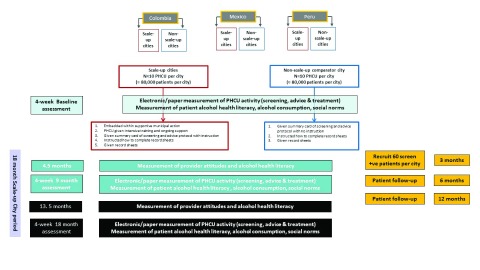
: While primary health care (PHC)-based prevention and management of heavy drinking is clinically effective and cost-effective, it remains poorly implemented in routine practice. Systematic reviews and multi-country studies have demonstrated the ability of training and support programmes to increase PHC-based screening and brief advice activity to reduce heavy drinking. However, gains have been only modest and short term at best. WHO studies have concluded that a more effective uptake could be achieved by embedding PHC activity within broader community and municipal support. : A quasi-experimental study will compare PHC-based prevention and management of heavy drinking in three intervention cities from Colombia, Mexico and Peru with three comparator cities from the same countries. In the implementation cities, primary health care units (PHCUs) will receive training embedded within ongoing supportive municipal action over an 18-month implementation period. In the comparator cities, practice as usual will continue at both municipal and PHCU levels. The primary outcome will be the proportion of consulting adult patients intervened with (screened and advice given to screen positives). The study is powered to detect a doubling of the outcome measure from an estimated 2.5/1,000 patients at baseline. Formal evaluation points will be at baseline, mid-point and end-point of the 18-month implementation period. We will present the ratio (plus 95% confidence interval) of the proportion of patients receiving intervention in the implementation cities with the proportions in the comparator cities. Full process evaluation will be undertaken, coupled with an analysis of potential contextual, financial and political-economy influencing factors. : This multi-country study will test the extent to which embedding PHC-based prevention and management of alcohol use disorder with supportive municipal action leads to improved scale-up of more patients with heavy drinking receiving appropriate advice and treatment. : The four-year study will start on 1 December 2017.
虽然基于初级卫生保健(PHC)的重度饮酒预防和管理在临床上有效且具有成本效益,但在常规实践中其实施情况仍然不佳。系统评价和多国研究表明,培训和支持项目有能力增加基于初级卫生保健的筛查和简短建议活动,以减少重度饮酒。然而,所取得的成效充其量只是适度且短期的。世界卫生组织的研究得出结论,通过将初级卫生保健活动纳入更广泛的社区和市政支持中,可以实现更有效的推广。:一项准实验研究将比较哥伦比亚、墨西哥和秘鲁的三个干预城市中基于初级卫生保健的重度饮酒预防和管理情况,与来自相同国家的三个对照城市进行比较。在实施城市,初级卫生保健单位(PHCUs)将在为期18个月的实施期内,接受嵌入在持续的支持性市政行动中的培训。在对照城市,市政和初级卫生保健单位层面将继续照常开展工作。主要结果将是接受干预的咨询成年患者(对筛查呈阳性者进行筛查和提供建议)的比例。该研究有能力检测出结果指标从基线时估计的每1000名患者2.5例增加一倍的情况。正式评估点将在18个月实施期的基线、中点和终点。我们将呈现实施城市中接受干预的患者比例与对照城市中患者比例的比值(加上95%置信区间)。将进行全面的过程评估,并分析潜在的背景、财务和政治经济影响因素。:这项多国研究将测试将基于初级卫生保健的酒精使用障碍预防和管理与支持性市政行动相结合,在多大程度上能导致更多重度饮酒患者获得适当建议和治疗的扩大推广。:这项为期四年的研究将于2017年12月1日开始。