Rojanasarot Sirikan
Sirikan Rojanasarot, BSc (Pharm), Social and Administrative Pharmacy Graduate Program, Department of Pharmaceutical Care & Health Systems, College of Pharmacy, University of Minnesota, Minneapolis.
J Wound Ostomy Continence Nurs. 2018 Jan/Feb;45(1):43-49. doi: 10.1097/WON.0000000000000395.
To evaluate the impact of a postdischarge ostomy support program as an adjunct to nurse-led ostomy care on preventable healthcare utilization.
A cross-sectional study.
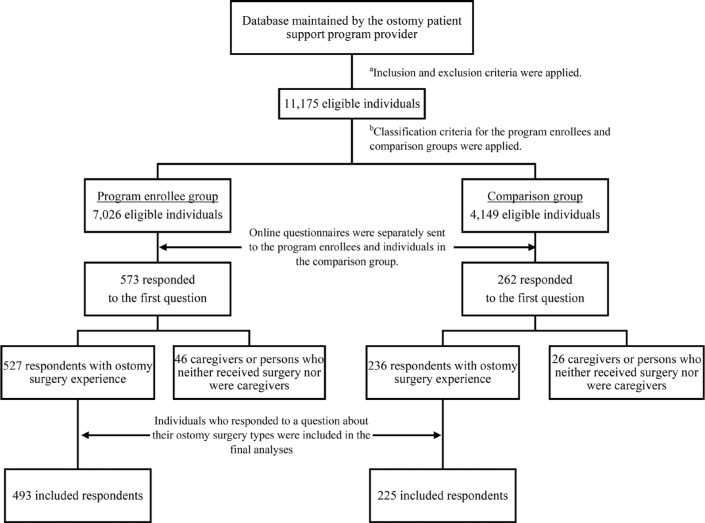
A postdischarge support program offered by an ostomy product's manufacturer provides persons living with an ostomy with patient-centered and easily accessible assistance. Individuals who underwent ostomy surgery within 18 months prior to the survey date were selected from an ostomy patient database maintained by the ostomy patient support program provider. Of 7026 surveys sent to program enrollees, 493 (7%) responded, compared with 225 (5%) out of 4149 surveys sent to individuals in a comparison group. The 2 groups were similar in demographics. A majority of the survey respondents were female (60% of program enrollees vs 55% of respondents in the comparison group). Among the program enrollees, 44% had colostomy, 43% had ileostomy, 10% had urostomy, and 4% had at least 2 types of ostomy surgery compared with 52%, 32%, 12%, and 4% of the respondents in a comparison group, respectively.
The study compared hospital readmission and emergency room (ER) visit rates attributable to ostomy complications between program enrollees and respondents in the comparison group. The event rates were measured in 2 study periods: within the first month of discharge and after the first month of discharge. Eligible individuals received an online survey that included the following domains: characteristics of ostomy surgery; readmissions and ER visits within the first month or after the first month of discharge, including reasons for preventable events; and level of health care access. Multivariate logistic regressions controlling for covariates were applied to investigate associations between program enrollment and ostomy-related readmission or ER visit rates.
Logistic regression analyses showed that, when compared with respondents in the comparison group, program enrollees had a significantly lower likelihood of being readmitted and visiting the ER due to ostomy complications after the first month of hospital discharge and up to 18 months postdischarge (odds ratio [OR] = 0.45; 95% confidence interval [CI], 0.27-0.73; and OR = 0.37; 95% CI, 0.22-0.64, respectively).
Findings suggest that enrolling patients in the postdischarge ostomy support program provides an effective approach to reducing preventable healthcare utilization.
评估出院后造口支持项目作为护士主导的造口护理辅助措施对可预防医疗保健利用的影响。
一项横断面研究。
造口产品制造商提供的出院后支持项目为造口患者提供以患者为中心且易于获得的帮助。从造口患者支持项目提供者维护的造口患者数据库中选取在调查日期前18个月内接受造口手术的个体。在发送给项目参与者的7026份调查问卷中,493份(7%)得到回复,而在发送给对照组个体的4149份调查问卷中,225份(5%)得到回复。两组在人口统计学特征方面相似。大多数调查受访者为女性(项目参与者中的60%,对照组受访者中的55%)。在项目参与者中,44%进行了结肠造口术,43%进行了回肠造口术,10%进行了尿路造口术,4%进行了至少两种类型的造口手术,而对照组受访者的相应比例分别为52%、32%、12%和4%。
该研究比较了项目参与者和对照组受访者因造口并发症导致的医院再入院率和急诊室就诊率。在两个研究时间段内测量事件发生率:出院后的第一个月内和出院第一个月后。符合条件的个体接受了一项在线调查,该调查包括以下领域:造口手术的特征;出院后第一个月内或第一个月后再入院和急诊室就诊情况,包括可预防事件的原因;以及医疗保健可及性水平。应用控制协变量的多因素逻辑回归分析来研究项目参与与造口相关再入院率或急诊室就诊率之间的关联。
逻辑回归分析表明,与对照组受访者相比,项目参与者在出院后第一个月至出院后18个月内因造口并发症再次入院和前往急诊室就诊的可能性显著降低(比值比[OR]=0.45;95%置信区间[CI],0.27 - 0.73;以及OR = 0.37;95% CI,0.22 - 0.64)。
研究结果表明,让患者参加出院后造口支持项目是减少可预防医疗保健利用的有效方法。