Ruiz Felicitas, Castelletto Michelle L, Gang Spencer S, Hallem Elissa A
Department of Microbiology, Immunology, and Molecular Genetics, University of California, Los Angeles, Los Angeles, California, United States of America.
Molecular Biology Institute, University of California, Los Angeles, Los Angeles, California, United States of America.
PLoS Pathog. 2017 Nov 30;13(11):e1006709. doi: 10.1371/journal.ppat.1006709. eCollection 2017 Nov.
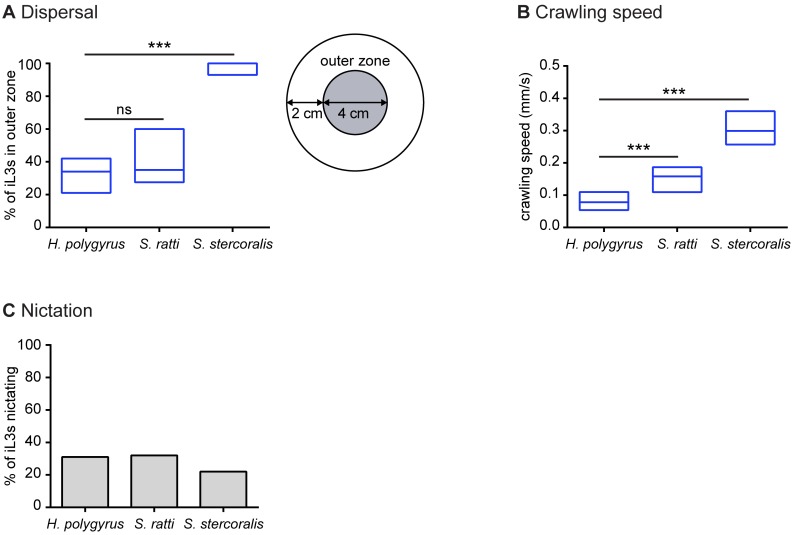
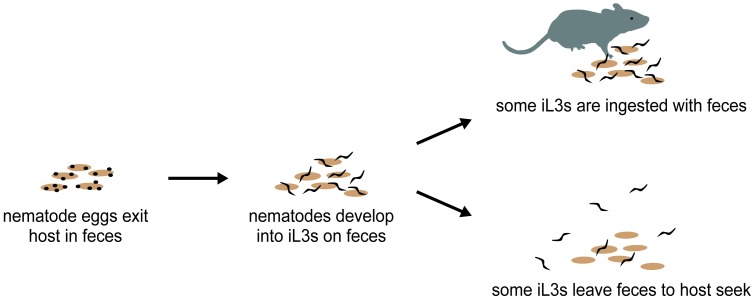
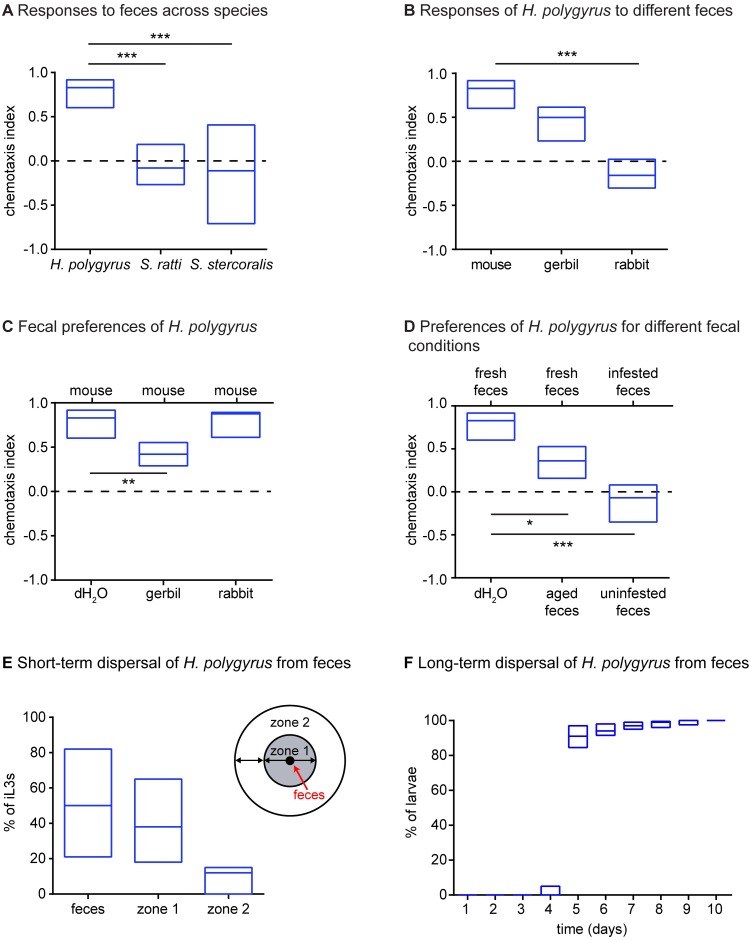
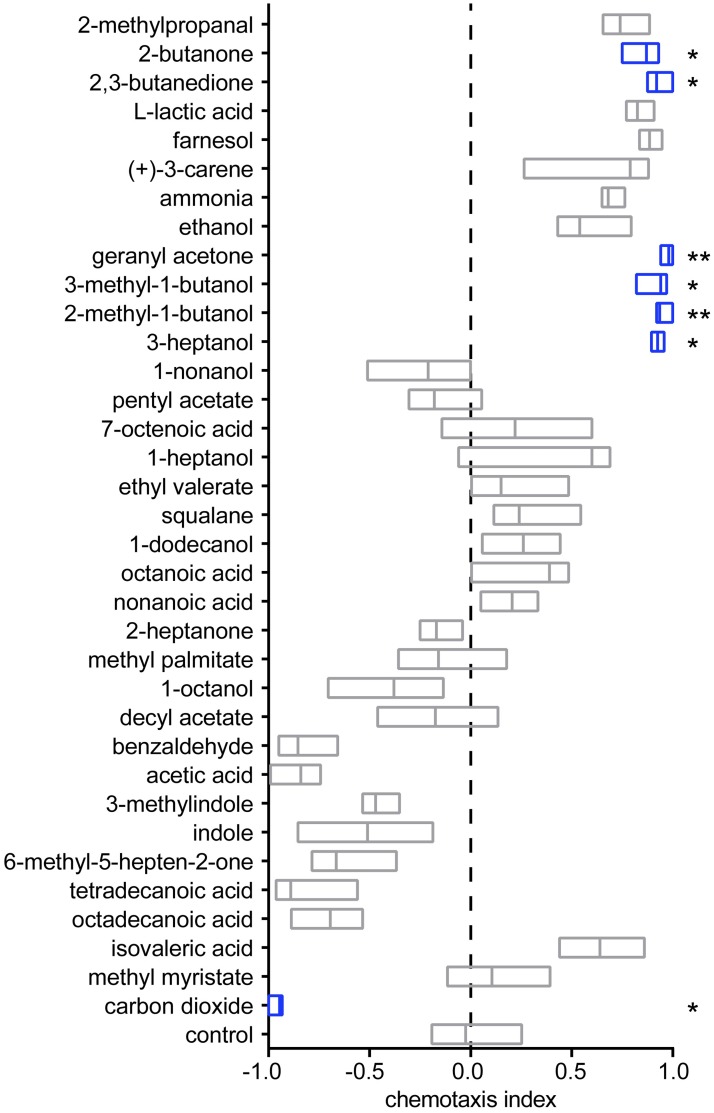
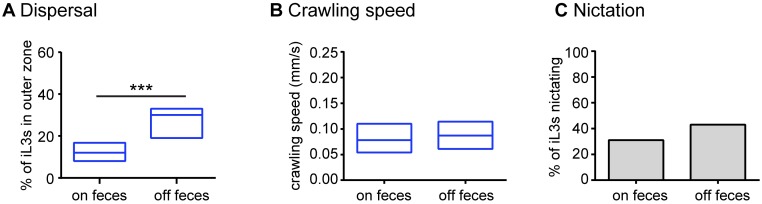
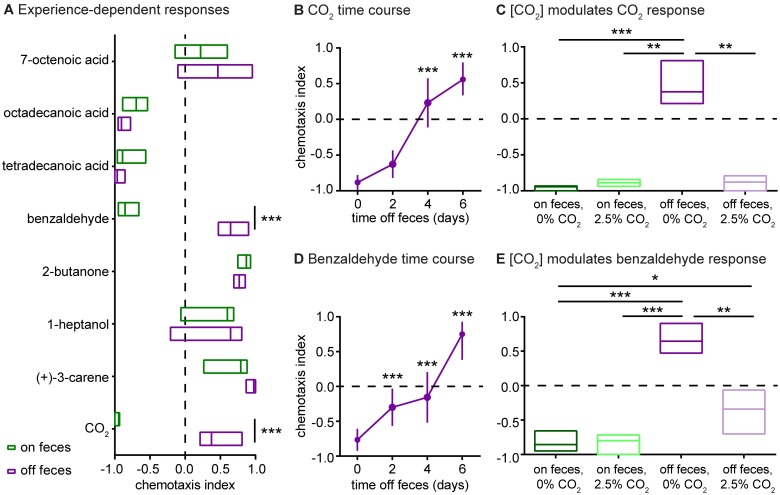
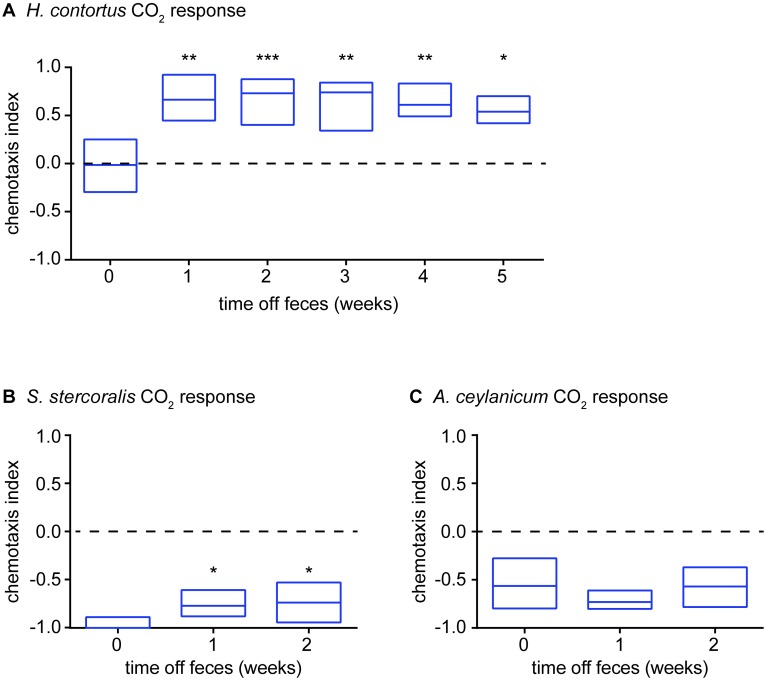
Parasitic nematodes of humans and livestock cause extensive disease and economic loss worldwide. Many parasitic nematodes infect hosts as third-stage larvae, called iL3s. iL3s vary in their infection route: some infect by skin penetration, others by passive ingestion. Skin-penetrating iL3s actively search for hosts using host-emitted olfactory cues, but the extent to which passively ingested iL3s respond to olfactory cues was largely unknown. Here, we examined the olfactory behaviors of the passively ingested murine gastrointestinal parasite Heligmosomoides polygyrus. H. polygyrus iL3s were thought to reside primarily on mouse feces, and infect when mice consume feces containing iL3s. However, iL3s can also adhere to mouse fur and infect orally during grooming. Here, we show that H. polygyrus iL3s are highly active and show robust attraction to host feces. Despite their attraction to feces, many iL3s migrate off feces to engage in environmental navigation. In addition, H. polygyrus iL3s are attracted to mammalian skin odorants, suggesting that they migrate toward hosts. The olfactory preferences of H. polygyrus are flexible: some odorants are repulsive for iL3s maintained on feces but attractive for iL3s maintained off feces. Experience-dependent modulation of olfactory behavior occurs over the course of days and is mediated by environmental carbon dioxide (CO2) levels. Similar experience-dependent olfactory plasticity occurs in the passively ingested ruminant-parasitic nematode Haemonchus contortus, a major veterinary parasite. Our results suggest that passively ingested iL3s migrate off their original fecal source and actively navigate toward hosts or new host fecal sources using olfactory cues. Olfactory plasticity may be a mechanism that enables iL3s to switch from dispersal behavior to host-seeking behavior. Together, our results demonstrate that passively ingested nematodes do not remain inactive waiting to be swallowed, but rather display complex sensory-driven behaviors to position themselves for host ingestion. Disrupting these behaviors may be a new avenue for preventing infections.
人类和家畜的寄生线虫在全球范围内造成广泛的疾病和经济损失。许多寄生线虫以第三期幼虫(称为iL3s)的形式感染宿主。iL3s的感染途径各不相同:一些通过皮肤穿透感染,另一些通过被动摄取感染。穿透皮肤的iL3s利用宿主发出的嗅觉线索积极寻找宿主,但被动摄取的iL3s对嗅觉线索的反应程度在很大程度上尚不清楚。在这里,我们研究了被动摄取的小鼠胃肠道寄生虫多房棘球绦虫的嗅觉行为。多房棘球绦虫iL3s被认为主要存在于小鼠粪便上,当小鼠食用含有iL3s的粪便时感染。然而,iL3s也可以附着在小鼠皮毛上,并在梳理过程中经口感染。在这里,我们表明多房棘球绦虫iL3s具有高度活性,并对宿主粪便表现出强烈的吸引力。尽管它们对粪便有吸引力,但许多iL3s会离开粪便进行环境导航。此外,多房棘球绦虫iL3s被哺乳动物皮肤气味吸引,表明它们向宿主迁移。多房棘球绦虫的嗅觉偏好是灵活的:一些气味剂对粪便上的iL3s有排斥作用,但对离开粪便的iL3s有吸引作用。嗅觉行为的经验依赖性调节在数天内发生,并由环境二氧化碳(CO2)水平介导。类似的经验依赖性嗅觉可塑性也发生在被动摄取的反刍动物寄生线虫捻转血矛线虫中,它是一种主要的兽医寄生虫。我们的结果表明,被动摄取的iL3s会离开它们原来的粪便来源,并利用嗅觉线索积极向宿主或新的宿主粪便来源导航。嗅觉可塑性可能是一种机制,使iL3s能够从扩散行为转变为寻找宿主的行为。总之,我们的结果表明,被动摄取的线虫不会静止不动地等待被吞咽,而是表现出复杂的感官驱动行为,以便为被宿主摄取做好定位。破坏这些行为可能是预防感染的新途径。