Merino Irene, Porter Stephen B, Johnston Brian D, Clabots Connie, Shaw Evelyn, Horcajada Juan Pablo, Cantón Rafael, Ruiz-Garbajosa Patricia, Johnson James R
Servicio de Microbiología, Hospital Universitario Ramón y Cajal-Instituto Ramón y Cajal de Investigación Sanitaria (IRYCIS), Madrid, Spain.
Spanish Network for Research in Infectious Diseases (REIPI), Madrid, Spain.
PLoS One. 2017 Nov 30;12(11):e0188838. doi: 10.1371/journal.pone.0188838. eCollection 2017.
To assess experimental virulence among sequence type 131 (ST131) Escherichia coli bloodstream isolates in relation to virulence genotype and subclone.
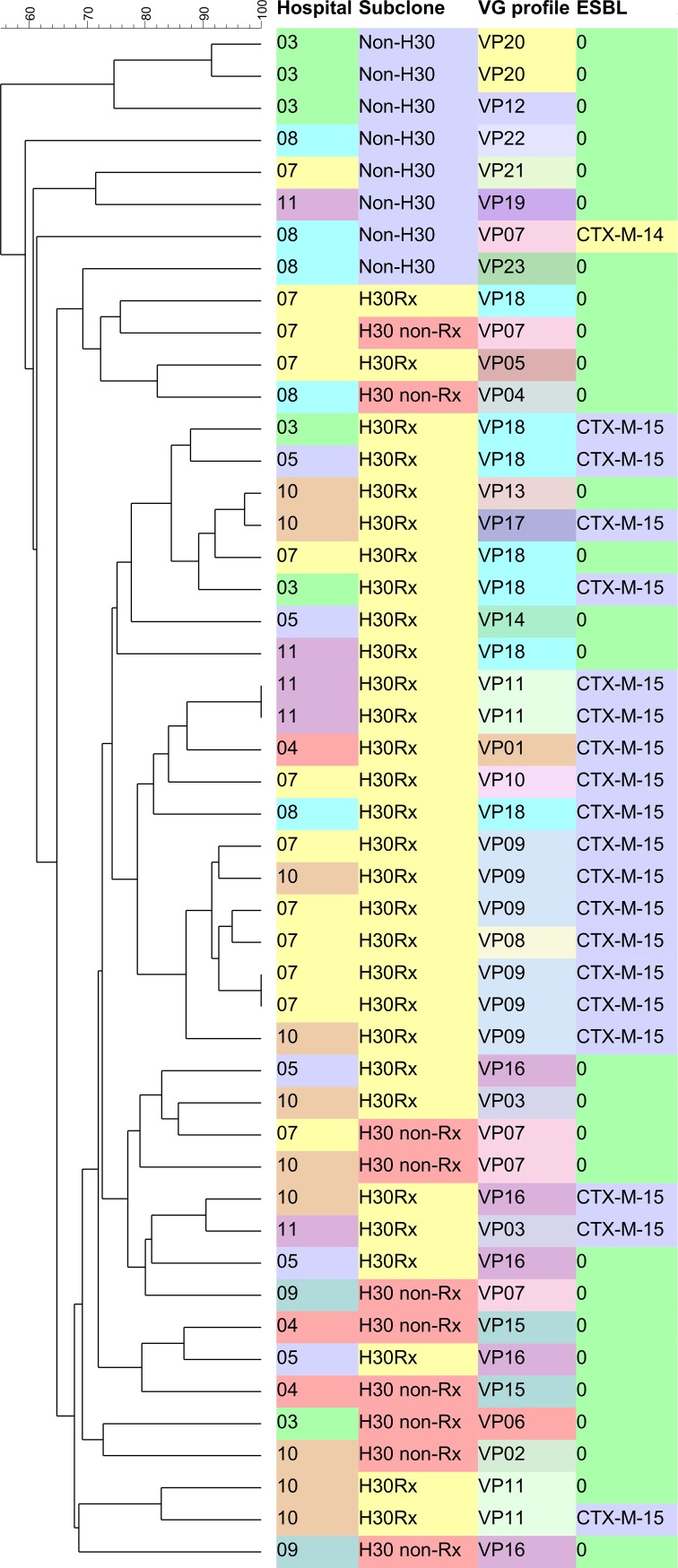
We analysed 48 Spanish ST131 bloodstream isolates (2010) by PCR for ST131 subclone status (H30Rx, H30 non-Rx, or non-H30), virulence genes (VGs), and O-type. Then we compared these traits with virulence in a murine sepsis model, as measured by illness severity score (ISS) and rapid lethality (mean ISS ≥ 4).
Of the 48 study isolates, 65% were H30Rx, 21% H30 non-Rx, and 15% non-H30; 44% produced ESBLs, 98% were O25b, and 83% qualified as extraintestinal pathogenic E. coli (ExPEC). Of 49 VGs, ibeA and iss were associated significantly with non-H30 isolates, and sat, iha and malX with H30 isolates. Median VG scores differed by subclone, i.e., 12 (H30Rx), 10 (H30 non-Rx), and 11 (non-H30) (p < 0.01). Nearly 80% of isolates represented a described virotype. In mice, H30Rx and non-H30 isolates were more virulent than H30 non-Rx isolates (according to ISS [p = 0.03] and rapid lethality [p = 0.03]), as were ExPEC isolates compared with non-ExPEC isolates (median ISS, 4.3 vs. 2.7: p = 0.03). In contrast, most individual VGs, VG scores, VG profiles, and virotypes were not associated with mouse virulence.
ST131 subclone and ExPEC status, but not individual VGs, VG scores or profiles, or virotypes, predicted mouse virulence. Given the lower virulence of non-Rx H30 isolates, hypervirulence probably cannot explain the ST131-H30 clade's epidemic emergence.
评估131序列型(ST131)大肠杆菌血流分离株的实验毒力与毒力基因型和亚克隆的关系。
我们通过PCR分析了48株西班牙ST131血流分离株(2010年),以确定其ST131亚克隆状态(H30Rx、H30非Rx或非H30)、毒力基因(VGs)和O型。然后我们将这些特征与小鼠败血症模型中的毒力进行比较,通过疾病严重程度评分(ISS)和快速致死率(平均ISS≥4)来衡量。
在48株研究分离株中,65%为H30Rx,21%为H30非Rx,15%为非H30;44%产生超广谱β-内酰胺酶(ESBLs),98%为O25b,83%被鉴定为肠道外致病性大肠杆菌(ExPEC)。在49个VGs中,ibeA和iss与非H30分离株显著相关,sat、iha和malX与H30分离株相关。VG评分中位数因亚克隆而异,即12(H30Rx)、10(H30非Rx)和11(非H30)(p<0.01)。近80%的分离株代表一种已描述的病毒型。在小鼠中,H30Rx和非H30分离株比H30非Rx分离株更具毒力(根据ISS[p=0.03]和快速致死率[p=0.03]),ExPEC分离株与非ExPEC分离株相比也是如此(中位数ISS,4.3对2.7:p=0.03)。相比之下,大多数单个VGs、VG评分、VG谱和病毒型与小鼠毒力无关。
ST131亚克隆和ExPEC状态可预测小鼠毒力,而单个VGs、VG评分或谱以及病毒型则不能。鉴于非Rx H30分离株毒力较低,高毒力可能无法解释ST131-H30分支的流行出现。