Service de Biogéochimie et Modélisation du Système Terre - Océanographie Chimique et Géochimie des Eaux, Université Libre de Bruxelles (ULB), Brussels, Belgium.
Earth System Sciences & Analytical, Environmental and Geo-Chemistry, Vrije Universiteit Brussel (VUB), Brussels, Belgium.
PLoS One. 2017 Nov 30;12(11):e0188615. doi: 10.1371/journal.pone.0188615. eCollection 2017.
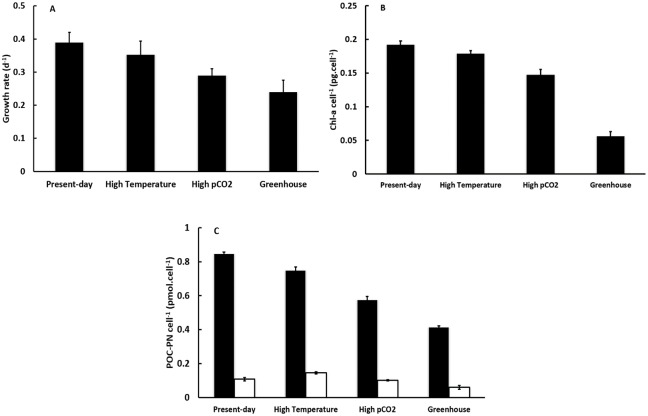
Diatoms constitute a major group of phytoplankton, accounting for ~20% of the world's primary production. It has been shown that iron (Fe) can be the limiting factor for phytoplankton growth, in particular, in the HNLC (High Nutrient Low Chlorophyll) regions. Iron plays thus an essential role in governing the marine primary productivity and the efficiency of biological carbon pump. Oceanic systems are undergoing continuous modifications at varying rates and magnitudes as a result of changing climate. The objective of our research is to evaluate how changing environmental conditions (dust deposition, ocean warming and acidification) can affect marine Fe biogeochemistry and diatom growth. Laboratory culture experiments using a marine diatom Chaetoceros socialis were conducted at two temperatures (13°C and 18°C) and under two pCO2 (carbon dioxide partial pressure) (400 μatm and 800 μatm) conditions. The present study clearly highlights the effect of ocean acidification on enhancing the release of Fe upon dust deposition. Our results also confirm that being a potential source of Fe, dust provides in addition a readily utilizable source of macronutrients such as dissolved phosphate (PO4) and silicate (DSi). However, elevated atmospheric CO2 concentrations may also have an adverse impact on diatom growth, causing a decrease in cell size and possible further changes in phytoplankton composition. Meanwhile, ocean warming may lead to the reduction of diatom production and cell size, inducing poleward shifts in the biogeographic distribution of diatoms. The changing climate has thus a significant implication for ocean phytoplankton growth, cell size and primary productivity, phytoplankton distribution and community composition, and carbon (C), nitrogen (N), phosphorus (P), silicon (Si) and Fe biogeochemical cycles in various ways.
硅藻是浮游植物的主要组成部分,约占世界初级生产力的 20%。已经表明,铁(Fe)可以成为浮游植物生长的限制因素,特别是在高营养低叶绿素(HNLC)区域。因此,铁在控制海洋初级生产力和生物碳泵效率方面起着至关重要的作用。由于气候变化,海洋系统正在以不同的速度和幅度不断发生变化。我们研究的目的是评估环境条件的变化(尘埃沉积、海洋变暖、酸化)如何影响海洋 Fe 生物地球化学和硅藻生长。使用海洋硅藻 Chaetoceros socialis 在两个温度(13°C 和 18°C)和两个 pCO2(二氧化碳分压)(400 μatm 和 800 μatm)条件下进行了实验室培养实验。本研究清楚地强调了海洋酸化对增强尘埃沉积时 Fe 释放的影响。我们的结果还证实,尘埃作为 Fe 的潜在来源,除了提供易于利用的大量营养物质(如溶解磷酸盐(PO4)和硅酸盐(DSi))之外。然而,大气中 CO2 浓度的升高也可能对硅藻生长产生不利影响,导致细胞尺寸减小,并可能进一步改变浮游植物的组成。同时,海洋变暖可能导致硅藻产量和细胞尺寸减少,从而导致硅藻生物地理分布向极地转移。气候变化因此对海洋浮游植物生长、细胞大小和初级生产力、浮游植物分布和群落组成以及碳(C)、氮(N)、磷(P)、硅(Si)和 Fe 生物地球化学循环产生了重大影响。