Hecking Thomas, Thiesler Thore, Schiller Cynthia, Lunkenheimer Jean-Marc, Ayub Tiyasha H, Rohr Andrea, Condic Mateja, Keyver-Paik Mignon-Denise, Fimmers Rolf, Kirfel Jutta, Kuhn Walther, Kristiansen Glen, Kübler Kirsten
Department of Obstetrics and Gynecology, Center for Integrated Oncology, University of Bonn, Bonn, Germany.
Institute of Pathology, Center for Integrated Oncology, University of Bonn, Bonn, Germany.
Oncotarget. 2017 Oct 6;8(54):92890-92903. doi: 10.18632/oncotarget.21641. eCollection 2017 Nov 3.
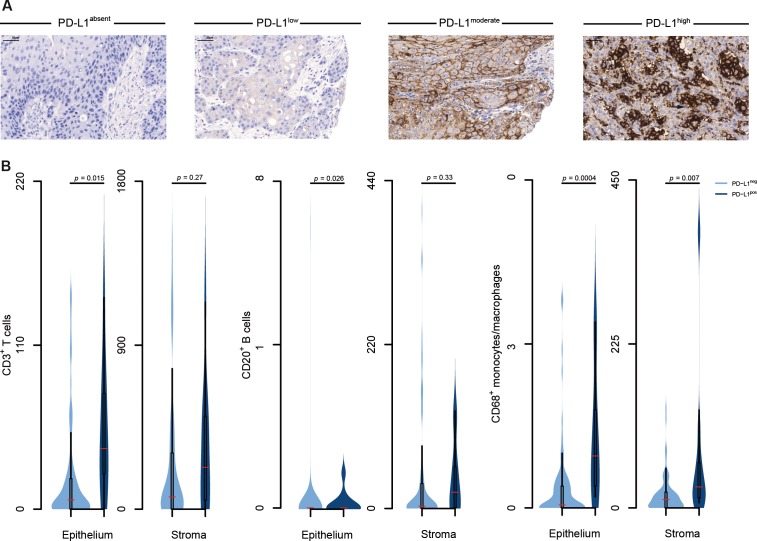
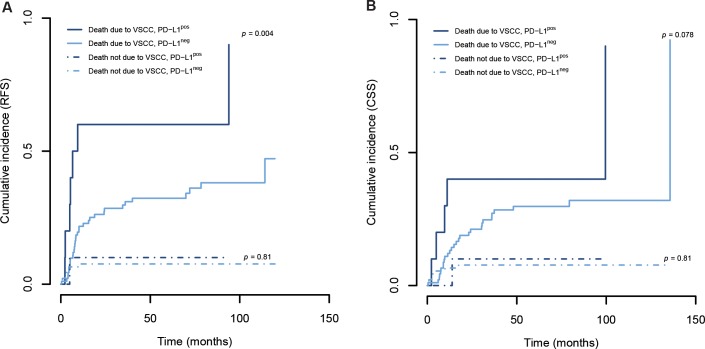
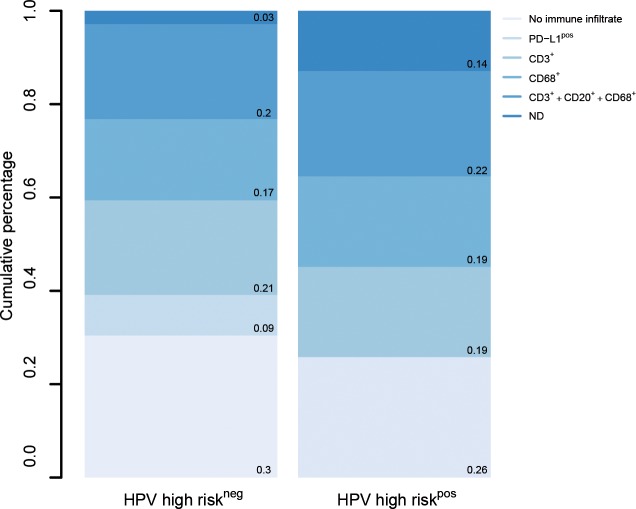
Vulvar cancer is rare but incidence rates are increasing due to an aging population and higher frequencies of young women being affected. In locally advanced, metastatic or recurrent disease prognosis is poor and new treatment modalities are needed. Immune checkpoint blockade of the PD-1/PD-L1 pathway is one of the most important advancements in cancer therapy in the last years. The clinical relevance of PD-L1 expression in vulvar cancer, however, has not been studied so far. We determined PD-L1 expression, numbers of CD3 T cells, CD20 B cells, CD68 monocytes/macrophages, Foxp3 regulatory T cells and CD163 tumor-associated macrophages by immunohistochemistry in 103 patients. Correlation analysis with clinicopathological parameters was undertaken; the cause-specific outcome was modeled with competing risk analysis; multivariate Cox regression was used to determine independent predictors of survival. Membranous PD-L1 was expressed in a minority of tumors, defined by HPV-negativity. Its presence geographically correlated with immunocyte-rich regions of cancer islets and was an independent prognostic factor for poor outcome. Our data support the notion that vulvar cancer is an immunomodulatory tumor that harnesses the PD-1/PD-L1 pathway to induce tolerance. Accordingly, immunotherapeutic approaches might have the potential to improve outcome in patients with vulvar cancer and could complement conventional cancer treatment.
外阴癌较为罕见,但由于人口老龄化以及年轻女性受影响频率增加,其发病率正在上升。在局部晚期、转移性或复发性疾病中,预后较差,需要新的治疗方式。PD-1/PD-L1通路的免疫检查点阻断是近年来癌症治疗中最重要的进展之一。然而,PD-L1表达在外阴癌中的临床相关性尚未得到研究。我们通过免疫组织化学检测了103例患者的PD-L1表达、CD3 T细胞、CD20 B细胞、CD68单核细胞/巨噬细胞、Foxp3调节性T细胞和CD163肿瘤相关巨噬细胞的数量。进行了与临床病理参数的相关性分析;采用竞争风险分析对特定病因结局进行建模;使用多变量Cox回归确定生存的独立预测因素。膜性PD-L1在少数由HPV阴性定义的肿瘤中表达。其存在在地理上与癌岛富含免疫细胞的区域相关,并且是预后不良的独立预测因素。我们的数据支持这样的观点,即外阴癌是一种利用PD-1/PD-L1通路诱导耐受的免疫调节性肿瘤。因此,免疫治疗方法可能有改善外阴癌患者结局的潜力,并可补充传统癌症治疗。