Mattingly Alex J, Laitano Orlando, Clanton Thomas L
Department of Applied Physiology & Kinesiology, University of Florida, College of Health and Human Performance, Gainesville, Florida.
Physiol Rep. 2017 Dec;5(23). doi: 10.14814/phy2.13519.
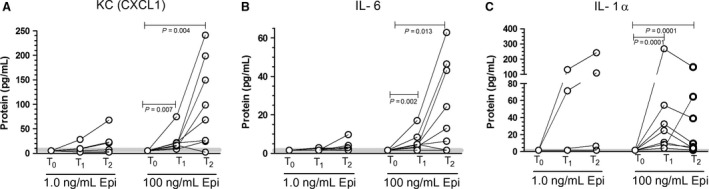
Catecholamines stimulate interleukin-6 (IL-6) secretion in skeletal muscles. However, whether other cytokines are secreted is currently unknown. Skeletal muscle ex vivo preparations commonly used to study cytokine secretion have dealt with limitations including auto-oxidation of catecholamines. The use of metal chelators could be an alternative to avoid auto-oxidation and allow catecholamines to be used at physiological doses. We exposed isolated soleus muscles to 1 or 100 ng/mL epinephrine (EPI) and collected bath samples at 1 and 2 h for multiplex cytokine analysis. Keratinocyte chemoattractant (CXCL1), IL-6, and IL-1 were significantly elevated by 100 ng/mL exposure, but not by 1 ng/mL (median [CXCL1] (2 h) = 83 pg/mL; [IL-6] = 19 pg/mL; IL-1 = 7.5 pg/mL). CXCL1 and IL-6 were highly correlated in each sample ( = 0.0001). A second experiment combined the metal chelator, deferoxamine mesylate (DFO), to prevent EPI autoxidation, with 2 ng/mL EPI and 10.5 ng/mL norepinephrine (NOREPI) to mimic peak exercise. Unexpectedly, DFO alone stimulated both IL-6 and CXCL1 secretion, but together with EPI and NOREPI had no additional effects. Stimulation of cytokine secretory responses from skeletal muscle cells in response to DFO thus precludes its use as a chelating agent in ex vivo models. In conclusion, 100 ng/mL EPI stimulates a robust secretory CXCL1 response, which together with IL-6 and IL-1, may constitute an adrenal-muscle endocrine response system.
儿茶酚胺可刺激骨骼肌分泌白细胞介素-6(IL-6)。然而,目前尚不清楚是否会分泌其他细胞因子。常用于研究细胞因子分泌的骨骼肌离体标本存在一些局限性,包括儿茶酚胺的自动氧化。使用金属螯合剂可能是避免自动氧化并允许以生理剂量使用儿茶酚胺的一种替代方法。我们将分离的比目鱼肌暴露于1或100 ng/mL肾上腺素(EPI),并在1小时和2小时收集浴液样本进行多重细胞因子分析。暴露于100 ng/mL时,角质形成细胞趋化因子(CXCL1)、IL-6和IL-1显著升高,但1 ng/mL时未升高([CXCL1](2小时)中位数 = 83 pg/mL;[IL-6] = 19 pg/mL;IL-1 = 7.5 pg/mL)。每个样本中CXCL1和IL-6高度相关( = 0.0001)。第二个实验将金属螯合剂甲磺酸去铁胺(DFO)与2 ng/mL EPI和10.5 ng/mL去甲肾上腺素(NOREPI)联合使用,以模拟运动高峰,防止EPI自动氧化。出乎意料的是,单独使用DFO会刺激IL-6和CXCL1的分泌,但与EPI和NOREPI一起使用时没有额外影响。因此,DFO刺激骨骼肌细胞的细胞因子分泌反应使其无法在离体模型中用作螯合剂。总之,100 ng/mL EPI可刺激强大的CXCL1分泌反应,其与IL-6和IL-1一起可能构成肾上腺-肌肉内分泌反应系统。