Tianjin Institute of Industrial Biotechnology, Chinese Academy of Sciences, Tianjin, 300308, China.
Key Laboratory of Systems Microbial Biotechnology, Chinese Academy of Sciences, Tianjin, 300308, China.
Sci Rep. 2017 Nov 30;7(1):16624. doi: 10.1038/s41598-017-16998-8.
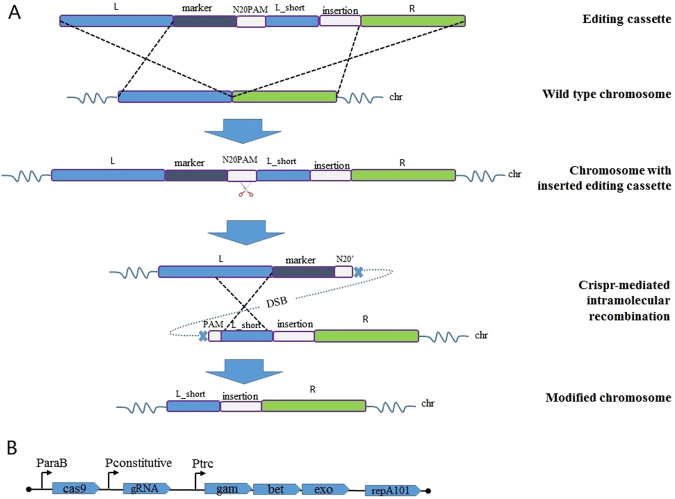
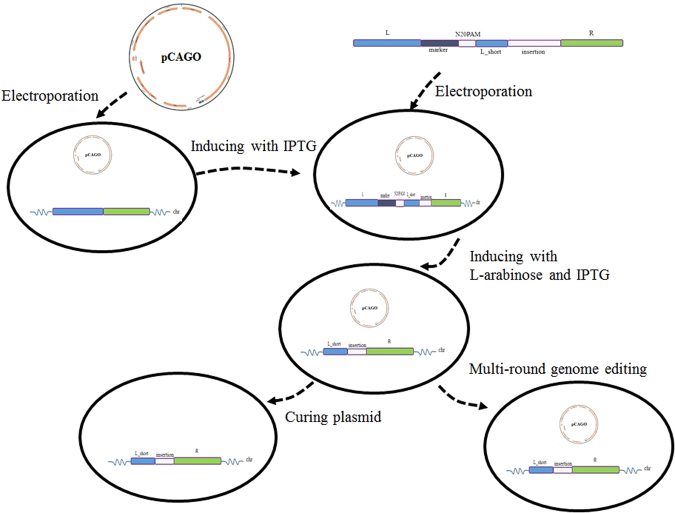
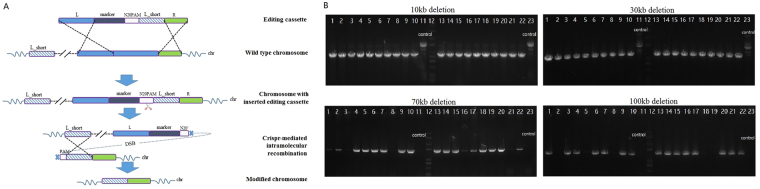
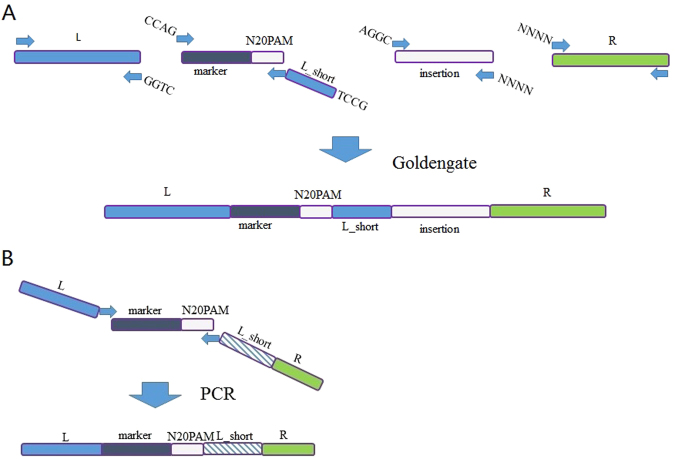
The CRISPR/Cas9 system is a powerful, revolutionary tool for genome editing. However, it is not without limitations. There are PAM-free and CRISPR-tolerant regions that cannot be modified by the standard CRISPR/Cas9 system, and off-target activity impedes its broader applications. To avoid these drawbacks, we developed a very simple CRISPR/Cas9-assisted gRNA-free one-step (CAGO) genome editing technique which does not require the construction of a plasmid to express a specific gRNA. Instead, a universal N20 sequence with a very high targeting efficiency is inserted into the E. coli chromosome by homologous recombination, which in turn undergoes a double-stranded break by CRISPR/Cas9 and induces an intra-chromosomal recombination event to accomplish the editing process. This technique was shown to be able to edit PAM-free and CRISPR-tolerant regions with no off-target effects in Escherichia coli. When applied to multi-locus editing, CAGO was able to modify one locus in two days with a near 100% editing efficiency. Furthermore, modified CAGO was used to edit large regions of up to 100 kbp with at least 75% efficiency. Finally, genome editing by CAGO only requires a transformation procedure and the construction of a linear donor DNA cassette, which was further simplified by applying a modular design strategy. Although the technique was established in E. coli, it should be applicable to other organisms with only minor modifications.
CRISPR/Cas9 系统是一种强大的、革命性的基因组编辑工具。然而,它并非没有局限性。存在着无法被标准 CRISPR/Cas9 系统修饰的 PAM 自由和 CRISPR 耐受区域,并且脱靶活性阻碍了其更广泛的应用。为了避免这些缺点,我们开发了一种非常简单的 CRISPR/Cas9 辅助 gRNA 免费一步(CAGO)基因组编辑技术,该技术不需要构建质粒来表达特定的 gRNA。相反,通过同源重组将具有非常高靶向效率的通用 N20 序列插入大肠杆菌染色体,随后 CRISPR/Cas9 会导致双链断裂,并诱导染色体内重组事件来完成编辑过程。该技术被证明能够在大肠杆菌中编辑 PAM 自由和 CRISPR 耐受区域,而不会产生脱靶效应。当应用于多位点编辑时,CAGO 能够在两天内以接近 100%的编辑效率修饰一个位点。此外,修饰后的 CAGO 可用于编辑长达 100 kbp 的大片段,效率至少为 75%。最后,CAGO 的基因组编辑仅需要转化程序和线性供体 DNA 盒的构建,通过应用模块化设计策略进一步简化了该过程。虽然该技术是在大肠杆菌中建立的,但它应该适用于其他仅需进行微小修改的生物体。