Pollak Agnieszka, Lechowicz Urszula, Murcia Pieńkowski Victor Abel, Stawiński Piotr, Kosińska Joanna, Skarżyński Henryk, Ołdak Monika, Płoski Rafał
Department of Genetics, Institute of Physiology and Pathology of Hearing, Mochnackiego 10, Warsaw, 02-042, Poland.
Department of Medical Genetics, Warsaw Medical University, Pawinskiego 3c, Warsaw, 02-106, Poland.
BMC Med Genet. 2017 Dec 2;18(1):142. doi: 10.1186/s12881-017-0499-z.
Implementation of whole exome sequencing has provided unique opportunity for a wide screening of causative variants in genetically heterogeneous diseases, including nonsyndromic hearing impairment. TRIOBP in the inner ear is responsible for proper structure and function of stereocilia and is necessary for sound transduction.
Whole exome sequencing followed by Sanger sequencing was conducted on patients derived from Polish hearing loss family.
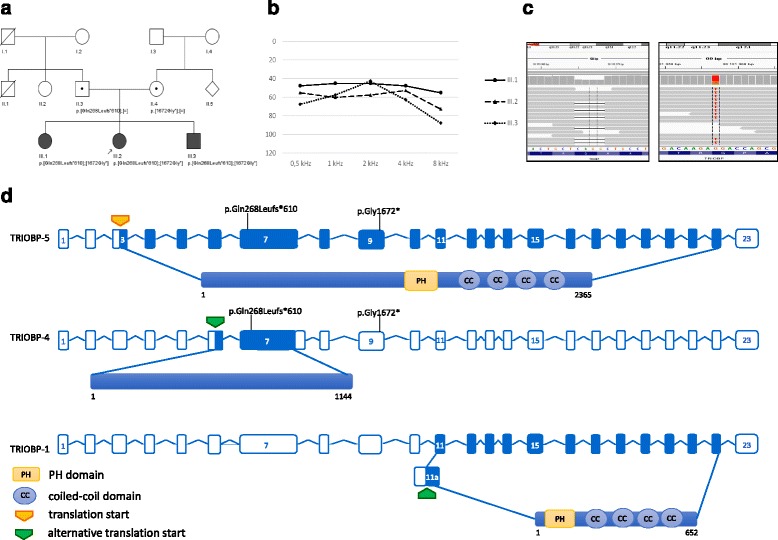
Based on whole exome analysis, we identified two TRIOBP pathogenic variants (c.802_805delCAGG, p.Gln268Leufs610 and c.5014G>T, p.Gly1672, the first of which was novel) causative of nonsyndromic, peri- to postlingual, moderate-to-severe hearing loss in three siblings from a Polish family. Typically, TRIOBP pathogenic variants lead to prelingual, severe-to-profound hearing loss, thus the onset and degree of hearing impairment in our patients represent a distinct phenotypic manifestation caused by TRIOBP variants. The pathogenic variant p.Gln268Leufs610 disrupts the TRIOBP-4 and TRIOBP-5 isoforms (both expressed exclusively in the inner ear and retina) whereas the second pathogenic variant c.514G>T, p.Gly1672 affects only TRIOBP-5.
The onset and degree of hearing impairment, characteristic for our patients, represent a unique phenotypic manifestation caused by TRIOBP pathogenic variants. Although TRIOBP alterations are not a frequent cause of hearing impairment, this gene should be thoroughly analyzed especially in patients with a postlingual hearing loss. A delayed onset of hearing impairment due to TRIOBP pathogenic variants creates a potential therapeutic window for future targeted therapies.
全外显子组测序的实施为广泛筛查遗传异质性疾病(包括非综合征性听力损失)的致病变异提供了独特机会。内耳中的TRIOBP负责静纤毛的正常结构和功能,是声音传导所必需的。
对来自波兰听力损失家族的患者进行全外显子组测序,随后进行桑格测序。
基于全外显子组分析,我们在一个波兰家族的三名兄弟姐妹中鉴定出两个TRIOBP致病变异(c.802_805delCAGG,p.Gln268Leufs610和c.5014G>T,p.Gly1672,其中第一个是新发现的),这些变异导致非综合征性、围产期至学语后、中度至重度听力损失。通常,TRIOBP致病变异会导致学语前、重度至极重度听力损失,因此我们患者的听力障碍发作和程度代表了由TRIOBP变异引起的独特表型表现。致病变异p.Gln268Leufs610破坏了TRIOBP-4和TRIOBP-5异构体(两者仅在内耳和视网膜中表达),而第二个致病变异c.514G>T,p.Gly1672仅影响TRIOBP-5。
我们患者所特有的听力障碍发作和程度代表了由TRIOBP致病变异引起的独特表型表现。虽然TRIOBP改变不是听力损失的常见原因,但该基因应进行全面分析,尤其是在学语后听力损失的患者中。由TRIOBP致病变异导致的听力障碍延迟发作为未来的靶向治疗创造了潜在的治疗窗口。