• 文献检索
  • 文档翻译
  • 深度研究
  • 学术资讯
  • Suppr Zotero 插件Zotero 插件
  • 邀请有礼
  • 套餐&价格
  • 历史记录
应用&插件
Suppr Zotero 插件Zotero 插件浏览器插件Mac 客户端Windows 客户端微信小程序
定价
高级版会员购买积分包购买API积分包
服务
文献检索文档翻译深度研究API 文档MCP 服务
关于我们
关于 Suppr公司介绍联系我们用户协议隐私条款
关注我们

Suppr 超能文献

核心技术专利:CN118964589B侵权必究
粤ICP备2023148730 号-1Suppr @ 2026

文献检索

告别复杂PubMed语法,用中文像聊天一样搜索,搜遍4000万医学文献。AI智能推荐,让科研检索更轻松。

立即免费搜索

文件翻译

保留排版,准确专业,支持PDF/Word/PPT等文件格式,支持 12+语言互译。

免费翻译文档

深度研究

AI帮你快速写综述,25分钟生成高质量综述,智能提取关键信息,辅助科研写作。

立即免费体验

免疫止血:脓毒症期间止血的新观点

Immunohaemostasis: a new view on haemostasis during sepsis.

作者信息

Delabranche Xavier, Helms Julie, Meziani Ferhat

机构信息

Université de Strasbourg, Faculté de Médecine & Hôpitaux Universitaires de Strasbourg, Service de Réanimation, Nouvel Hôpital Civil, Strasbourg, France.

INSERM (French National Institute of Health and Medical Research), UMR 1260, Regenerative Nanomedicine (RNM), FMTS, Université de Strasbourg, Strasbourg, France.

出版信息

Ann Intensive Care. 2017 Dec 2;7(1):117. doi: 10.1186/s13613-017-0339-5.

DOI:10.1186/s13613-017-0339-5
PMID:29197958
原文链接:https://pmc.ncbi.nlm.nih.gov/articles/PMC5712298/
Abstract

Host infection by a micro-organism triggers systemic inflammation, innate immunity and complement pathways, but also haemostasis activation. The role of thrombin and fibrin generation in host defence is now recognised, and thrombin has become a partner for survival, while it was seen only as one of the "principal suspects" of multiple organ failure and death during septic shock. This review is first focused on pathophysiology. The role of contact activation system, polyphosphates and neutrophil extracellular traps has emerged, offering new potential therapeutic targets. Interestingly, newly recognised host defence peptides (HDPs), derived from thrombin and other "coagulation" factors, are potent inhibitors of bacterial growth. Inhibition of thrombin generation could promote bacterial growth, while HDPs could become novel therapeutic agents against pathogens when resistance to conventional therapies grows. In a second part, we focused on sepsis-induced coagulopathy diagnostic challenge and stratification from "adaptive" haemostasis to "noxious" disseminated intravascular coagulation (DIC) either thrombotic or haemorrhagic. Besides usual coagulation tests, we discussed cellular haemostasis assessment including neutrophil, platelet and endothelial cell activation. Then, we examined therapeutic opportunities to prevent or to reduce "excess" thrombin generation, while preserving "adaptive" haemostasis. The fail of international randomised trials involving anticoagulants during septic shock may modify the hypothesis considering the end of haemostasis as a target to improve survival. On the one hand, patients at low risk of mortality may not be treated to preserve "immunothrombosis" as a defence when, on the other hand, patients at high risk with patent excess thrombin and fibrin generation could benefit from available (antithrombin, soluble thrombomodulin) or ongoing (FXI and FXII inhibitors) therapies. We propose to better assess coagulation response during infection by an improved knowledge of pathophysiology and systematic testing including determination of DIC scores. This is one of the clues to allocate the right treatment for the right patient at the right moment.

摘要

微生物对宿主的感染会引发全身炎症、固有免疫和补体途径,同时也会激活止血过程。凝血酶和纤维蛋白生成在宿主防御中的作用现已得到认可,凝血酶已成为生存的伙伴,而它曾仅被视为脓毒性休克期间多器官功能衰竭和死亡的“主要嫌疑对象”之一。本综述首先聚焦于病理生理学。接触激活系统、多磷酸盐和中性粒细胞胞外陷阱的作用已显现,提供了新的潜在治疗靶点。有趣的是,新发现的源自凝血酶和其他“凝血”因子的宿主防御肽(HDPs)是细菌生长的强效抑制剂。抑制凝血酶生成可能会促进细菌生长,而当对传统疗法产生耐药性时,HDPs可能会成为对抗病原体的新型治疗药物。在第二部分中,我们聚焦于脓毒症诱导的凝血病的诊断挑战以及从“适应性”止血到“有害的”血栓性或出血性弥散性血管内凝血(DIC)的分层。除了常规凝血检测外,我们还讨论了细胞止血评估,包括中性粒细胞、血小板和内皮细胞的激活。然后,我们研究了预防或减少“过量”凝血酶生成同时保留“适应性”止血的治疗机会。脓毒性休克期间涉及抗凝剂的国际随机试验失败可能会改变将止血终点作为改善生存靶点的假设。一方面,低死亡风险的患者可能无需治疗以保留“免疫血栓形成”作为一种防御,而另一方面,高风险且存在过量凝血酶和纤维蛋白生成的患者可能会从现有(抗凝血酶、可溶性血栓调节蛋白)或正在进行研究的(因子XI和因子XII抑制剂)治疗中获益。我们建议通过更好地了解病理生理学和进行包括DIC评分测定在内的系统检测,来更好地评估感染期间的凝血反应。这是在正确的时间为正确的患者分配正确治疗的线索之一。
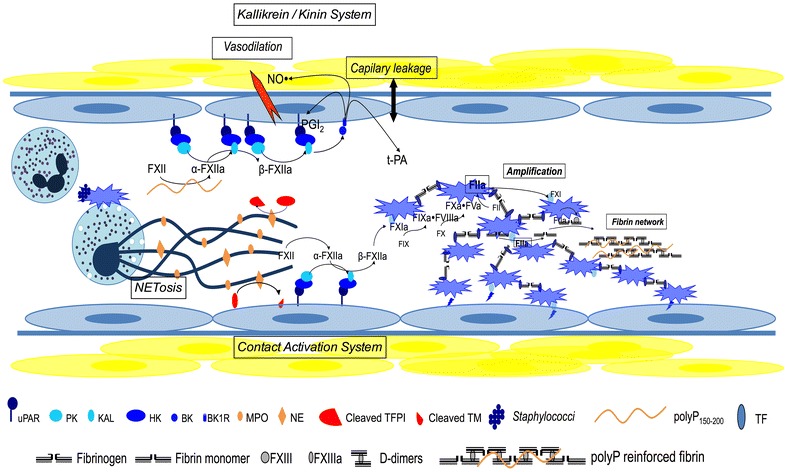
https://cdn.ncbi.nlm.nih.gov/pmc/blobs/f52b/5712298/814e7f04c3ae/13613_2017_339_Fig2_HTML.jpg
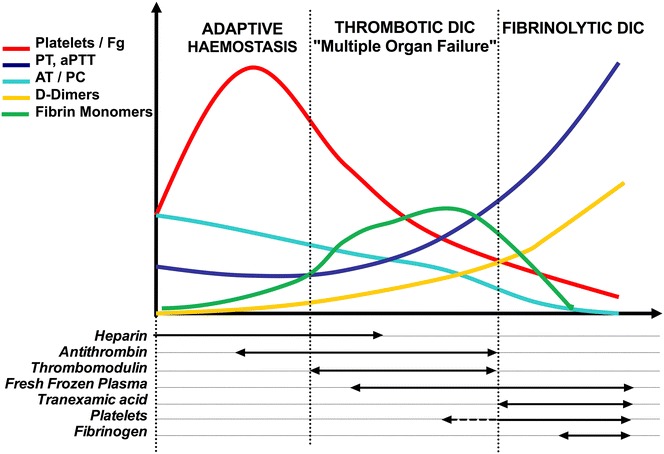
https://cdn.ncbi.nlm.nih.gov/pmc/blobs/f52b/5712298/fc1f4ebd6b16/13613_2017_339_Fig1_HTML.jpg
https://cdn.ncbi.nlm.nih.gov/pmc/blobs/f52b/5712298/814e7f04c3ae/13613_2017_339_Fig2_HTML.jpg
https://cdn.ncbi.nlm.nih.gov/pmc/blobs/f52b/5712298/fc1f4ebd6b16/13613_2017_339_Fig1_HTML.jpg
https://cdn.ncbi.nlm.nih.gov/pmc/blobs/f52b/5712298/814e7f04c3ae/13613_2017_339_Fig2_HTML.jpg

相似文献

1
Immunohaemostasis: a new view on haemostasis during sepsis.免疫止血:脓毒症期间止血的新观点
Ann Intensive Care. 2017 Dec 2;7(1):117. doi: 10.1186/s13613-017-0339-5.
2
Normal prothrombinase activity, increased systemic thrombin activity, and lower antithrombin levels in patients with disseminated intravascular coagulation at an early phase of trauma: comparison with acute coagulopathy of trauma-shock.创伤早期弥散性血管内凝血患者的正常凝血酶原活性、全身性凝血酶活性增加和抗凝血酶水平降低:与创伤性休克急性凝血病的比较。
Surgery. 2013 Jul;154(1):48-57. doi: 10.1016/j.surg.2013.02.004. Epub 2013 May 16.
3
The pathophysiology, diagnosis, and management of sepsis-associated disseminated intravascular coagulation.脓毒症相关弥散性血管内凝血的病理生理学、诊断及管理
J Intensive Care. 2023 May 23;11(1):24. doi: 10.1186/s40560-023-00672-5.
4
International Society on Thrombosis and Haemostasis score for overt disseminated intravascular coagulation predicts organ dysfunction and fatality in sepsis patients.国际血栓与止血学会显性弥散性血管内凝血评分可预测脓毒症患者的器官功能障碍和死亡率。
Blood Coagul Fibrinolysis. 2006 Sep;17(6):445-51. doi: 10.1097/01.mbc.0000240916.63521.2e.
5
Sepsis-Induced Coagulopathy and Disseminated Intravascular Coagulation: What We Need to Know and How to Manage for Prolonged Casualty Care.脓毒症相关性凝血病与弥散性血管内凝血:伤员长期救治中需要了解和处理的问题。
J Spec Oper Med. 2023 Jun 23;23(2):118-121. doi: 10.55460/6OZC-JIOV.
6
Trauma-induced innate immune activation and disseminated intravascular coagulation.创伤诱导的固有免疫激活和弥散性血管内凝血。
J Thromb Haemost. 2024 Feb;22(2):337-351. doi: 10.1016/j.jtha.2023.09.028. Epub 2023 Oct 8.
7
Identification of soluble thrombomodulin and tissue plasminogen activator-inhibitor complex as biomarkers for prognosis and early evaluation of septic shock and sepsis-induced disseminated intravascular coagulation.鉴定可溶性血栓调节蛋白和组织型纤溶酶原激活物抑制剂复合物作为脓毒性休克和脓毒症诱发弥散性血管内凝血的预后和早期评估的生物标志物。
Ann Palliat Med. 2021 Oct;10(10):10170-10184. doi: 10.21037/apm-21-2222. Epub 2021 Sep 14.
8
Roles of Coagulation Abnormalities and Microthrombosis in Sepsis: Pathophysiology, Diagnosis, and Treatment.凝血异常和微血栓形成在脓毒症中的作用:病理生理学、诊断和治疗。
Arch Med Res. 2021 Nov;52(8):788-797. doi: 10.1016/j.arcmed.2021.07.003. Epub 2021 Jul 31.
9
Anticoagulant therapy for sepsis-associated disseminated intravascular coagulation: the view from Japan.脓毒症相关性弥散性血管内凝血的抗凝治疗:来自日本的观点。
J Thromb Haemost. 2014 Jul;12(7):1010-9. doi: 10.1111/jth.12596. Epub 2014 Jun 19.
10
Thrombin contributes to protective immunity in pneumonia-derived sepsis via fibrin polymerization and platelet-neutrophil interactions.凝血酶通过纤维蛋白聚合和血小板-中性粒细胞相互作用促进肺炎相关性脓毒症的保护性免疫。
J Thromb Haemost. 2017 Apr;15(4):744-757. doi: 10.1111/jth.13625. Epub 2017 Feb 16.

引用本文的文献

1
GSDMD-NETs in patients with sepsis-induced coagulopathy and their interaction with glycocalyx damage.脓毒症诱导的凝血病患者中的Gasdermin D孔形成结构域与糖萼损伤的相互作用
Front Immunol. 2025 Jul 22;16:1624128. doi: 10.3389/fimmu.2025.1624128. eCollection 2025.
2
Development and Validation of a Nomogram Prediction Model for Sepsis-Induced Coagulopathy: A Multicenter Retrospective Study.脓毒症诱导的凝血病列线图预测模型的开发与验证:一项多中心回顾性研究
Curr Med Sci. 2025 Jul 16. doi: 10.1007/s11596-025-00093-5.
3
The Procoagulant and Fibrinolytic Balance of Extracellular Vesicles Predicts Mortality in Septic Shock Patients.

本文引用的文献

1
Neutrophil Activation During Septic Shock.脓毒性休克期间的中性粒细胞激活。
Shock. 2018 Apr;49(4):371-384. doi: 10.1097/SHK.0000000000000980.
2
Interferon lambda1/IL-29 and inorganic polyphosphate are novel regulators of neutrophil-driven thromboinflammation.干扰素λ1/IL-29和无机多聚磷酸盐是中性粒细胞驱动的血栓炎症的新型调节因子。
J Pathol. 2017 Sep;243(1):111-122. doi: 10.1002/path.4935. Epub 2017 Aug 7.
3
Exogenous deoxyribonuclease has a protective effect in a mouse model of sepsis.外源性脱氧核糖核酸酶在脓毒症小鼠模型中具有保护作用。
细胞外囊泡的促凝血和纤维蛋白溶解平衡可预测感染性休克患者的死亡率。
J Extracell Vesicles. 2025 Jun;14(6):e70073. doi: 10.1002/jev2.70073.
4
Pathogenesis and treatment strategies of sepsis-induced myocardial injury: modern and traditional medical perspectives.脓毒症诱导的心肌损伤的发病机制及治疗策略:现代医学与传统医学视角
Int J Biol Sci. 2025 May 15;21(8):3478-3504. doi: 10.7150/ijbs.111288. eCollection 2025.
5
Association analysis of sepsis progression to sepsis-induced coagulopathy: a study based on the MIMIC-IV database.脓毒症进展为脓毒症诱导的凝血病的关联分析:一项基于MIMIC-IV数据库的研究
BMC Infect Dis. 2025 Apr 21;25(1):573. doi: 10.1186/s12879-025-10972-w.
6
Protein C in adult patients with sepsis: from pathophysiology to monitoring and supplementation.成年脓毒症患者的蛋白C:从病理生理学到监测与补充
J Anesth Analg Crit Care. 2025 Apr 14;5(1):21. doi: 10.1186/s44158-025-00243-0.
7
Effect of prone position on ventilation-perfusion matching in patients with moderate to severe ARDS with different clinical phenotypes.俯卧位对不同临床表型的中重度急性呼吸窘迫综合征患者通气-灌注匹配的影响。
Respir Res. 2025 Feb 28;26(1):70. doi: 10.1186/s12931-025-03154-4.
8
Risk Factors and Predictive Model for Disseminated Intravascular Coagulation in Patients with Multiple Myeloma.多发性骨髓瘤患者弥散性血管内凝血的危险因素及预测模型
Clin Appl Thromb Hemost. 2025 Jan-Dec;31:10760296251316873. doi: 10.1177/10760296251316873.
9
Biomarkers of sepsis-induced coagulopathy: diagnostic insights and potential therapeutic implications.脓毒症诱导的凝血病的生物标志物:诊断见解及潜在治疗意义
Ann Intensive Care. 2025 Jan 17;15(1):12. doi: 10.1186/s13613-025-01434-2.
10
Understanding, assessing and treating immune, endothelial and haemostasis dysfunctions in bacterial sepsis.了解、评估和治疗细菌性败血症中的免疫、内皮和止血功能障碍。
Intensive Care Med. 2024 Oct;50(10):1580-1592. doi: 10.1007/s00134-024-07586-2. Epub 2024 Sep 2.
Biomed Pharmacother. 2017 Sep;93:8-16. doi: 10.1016/j.biopha.2017.06.009. Epub 2017 Jun 13.
4
Coagulation factor XI improves host defence during murine pneumonia-derived sepsis independent of factor XII activation.凝血因子XI在小鼠肺炎源性脓毒症期间可改善宿主防御,且与因子XII激活无关。
Thromb Haemost. 2017 Jul 26;117(8):1601-1614. doi: 10.1160/TH16-12-0920. Epub 2017 May 11.
5
Platelet polyphosphate: the long and the short of it.血小板多聚磷酸盐:其长短之论
Blood. 2017 Mar 23;129(12):1574-1575. doi: 10.1182/blood-2017-01-761593.
6
Simultaneous targeting of CD14 and factor XIa by a fusion protein consisting of an anti-CD14 antibody and the modified second domain of bikunin improves survival in rabbit sepsis models.由抗CD14抗体和修饰的比基尼环素第二结构域组成的融合蛋白同时靶向CD14和因子Xla可提高兔脓毒症模型的存活率。
Eur J Pharmacol. 2017 May 5;802:60-68. doi: 10.1016/j.ejphar.2017.02.045. Epub 2017 Feb 27.
7
Should all patients with sepsis receive anticoagulation? Yes.所有脓毒症患者都应该接受抗凝治疗吗?答案是肯定的。
Intensive Care Med. 2017 Mar;43(3):452-454. doi: 10.1007/s00134-016-4621-z. Epub 2017 Feb 13.
8
Should all septic patients be given systemic anticoagulation? No.所有脓毒症患者都应该接受全身抗凝治疗吗?不应该。
Intensive Care Med. 2017 Mar;43(3):455-457. doi: 10.1007/s00134-016-4607-x. Epub 2017 Feb 13.
9
Impact of thrombosis on pulmonary endothelial injury and repair following sepsis.血栓形成对败血症后肺内皮损伤及修复的影响。
Am J Physiol Lung Cell Mol Physiol. 2017 Apr 1;312(4):L441-L451. doi: 10.1152/ajplung.00441.2016. Epub 2017 Jan 27.
10
Thrombin contributes to protective immunity in pneumonia-derived sepsis via fibrin polymerization and platelet-neutrophil interactions.凝血酶通过纤维蛋白聚合和血小板-中性粒细胞相互作用促进肺炎相关性脓毒症的保护性免疫。
J Thromb Haemost. 2017 Apr;15(4):744-757. doi: 10.1111/jth.13625. Epub 2017 Feb 16.