Wang Lan, Jin Yuan-Zhe, Zhao Qin-Hua, Jiang Rong, Wu Wen-Hui, Gong Su-Gang, He Jing, Liu Jin-Ming, Jing Zhi-Cheng
Department of Pulmonary Circulation, Shanghai Pulmonary Hospital, Tongji University School of Medicine, Shanghai, China.
Department of Cardiology, The Fourth Affiliated Hospital of China Medical University, Liaoning, China.
Int J Chron Obstruct Pulmon Dis. 2017 Nov 22;12:3353-3360. doi: 10.2147/COPD.S141798. eCollection 2017.
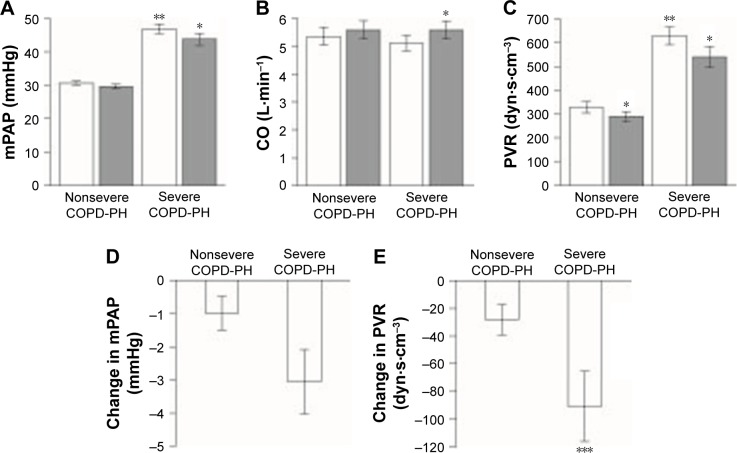
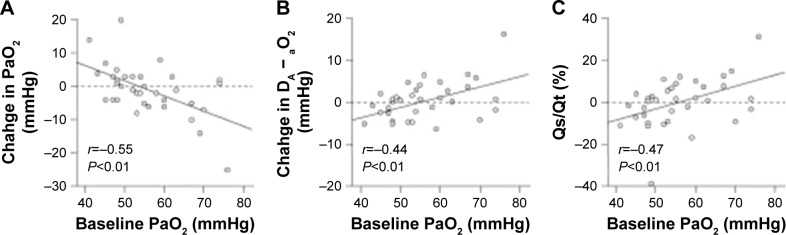
Studies have shown that vasodilators such as iloprost can be useful for treating pulmonary hypertension (PH). However, in patients with COPD, vasodilators may inhibit hypoxic pulmonary vasoconstriction and impair gas exchange. The efficacy and safety of iloprost inhalation was assessed in 67 patients with PH associated with COPD (COPD-PH), diagnosed by right heart catheterization. Of these, 37 patients had severe PH (mean pulmonary arterial pressure [mPAP] >35 mmHg or mPAP 25-35 mmHg with low cardiac index [<2.0 L⋅min⋅m]). All patients received a single 20 µg dose of iloprost via a nebulizer (4.4 µg delivered at the mouthpiece). No serious adverse events were reported. Hemodynamic and gas exchange parameters (arterial blood gas and shunt fraction [Qs/Qt]) were measured or calculated at baseline and 10 min after iloprost inhalation. mPAP decreased by 2.1 mmHg (95% CI, -3.3 to -1.0), pulmonary vascular resistance (PVR) decreased by 62.4 dyn⋅s⋅cm (95% CI, -92.9 to -31.8), and cardiac output increased by 0.4 L⋅min (95% CI, 0.2-0.5). There was a more significant decline in PVR in patients with severe COPD-PH than in those with nonsevere COPD-PH. Hypoxemia and intrapulmonary shunt were more extreme in patients with severe COPD-PH. However, there were no significant differences in arterial blood gas and Qs/Qt between patients with nonsevere and severe forms of COPD-PH. In conclusion, iloprost improved pulmonary hemodynamics without detrimental effects on arterial oxygenation in patients with COPD-PH, even in those with severe PH. These findings suggest that the short-term use of iloprost in patients with COPD-PH is effective and well tolerated.
研究表明,诸如伊洛前列素之类的血管扩张剂可用于治疗肺动脉高压(PH)。然而,在慢性阻塞性肺疾病(COPD)患者中,血管扩张剂可能会抑制低氧性肺血管收缩并损害气体交换。通过右心导管检查确诊的67例COPD相关PH(COPD-PH)患者接受了伊洛前列素吸入的疗效和安全性评估。其中,37例患者患有重度PH(平均肺动脉压[mPAP]>35 mmHg或mPAP 25-35 mmHg且心脏指数低[<2.0 L·min·m])。所有患者均通过雾化器接受单次20μg剂量的伊洛前列素(在吸嘴处输送4.4μg)。未报告严重不良事件。在基线和伊洛前列素吸入后10分钟测量或计算血流动力学和气体交换参数(动脉血气和分流分数[Qs/Qt])。mPAP下降2.1 mmHg(95%CI,-3.3至-1.0),肺血管阻力(PVR)下降62.4 dyn·s·cm(95%CI,-92.9至-31.8),心输出量增加0.4 L·min(95%CI,0.2-0.5)。重度COPD-PH患者的PVR下降比非重度COPD-PH患者更显著。重度COPD-PH患者的低氧血症和肺内分流更为严重。然而,非重度和重度COPD-PH患者之间的动脉血气和Qs/Qt无显著差异。总之,伊洛前列素改善了COPD-PH患者的肺血流动力学,且对动脉氧合无不利影响,即使是重度PH患者。这些发现表明,COPD-PH患者短期使用伊洛前列素是有效的且耐受性良好。