Zhao Wenge, Liu Chuansheng, Shi Changhe, Fan Tianli, Chu Kaiqiu, Ma Yanli
Department of Infectious Disease, Qingdao No. 6 People's Hospital, Qingdao, Shandong 266033, P.R. China.
Department of Pain Management, The Affiliated Hospital of Qingdao University, Qingdao, Shandong 266003, P.R. China.
Exp Ther Med. 2017 Nov;14(5):4807-4812. doi: 10.3892/etm.2017.5119. Epub 2017 Sep 15.
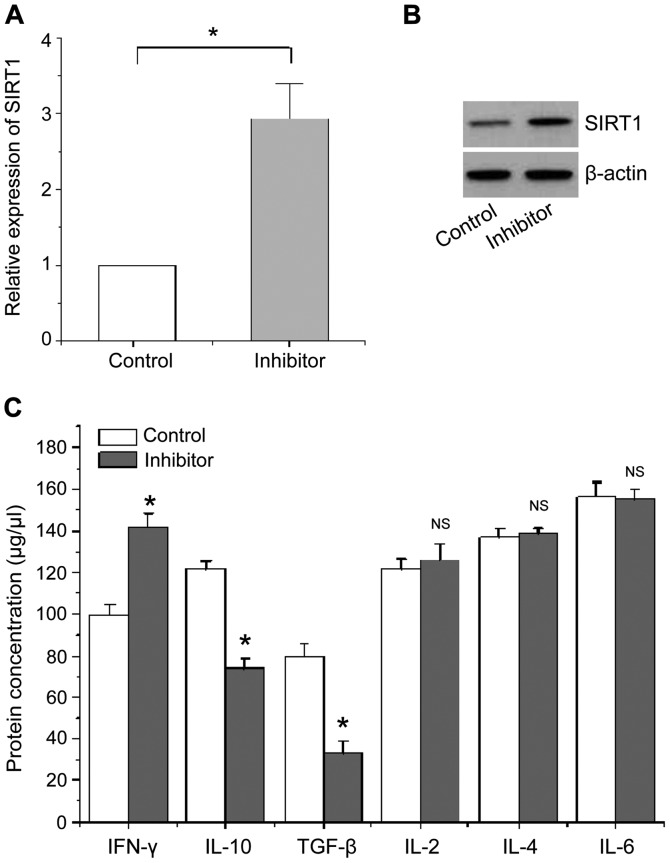
The role of microRNA-124a (miR-124a) in the regulation of T cell activation and immunity in patients with AIDS, was studied to provide new insights for the study, diagnosis, alleviation and treatment of AIDS. RT-qPCR technique was used to quantitatively analyze the expression of miR-124a in peripheral blood CD4 T cells. Dual-luciferase reporter assay system was established to report possible regulatory relations between miR-124a and its potential target gene SIRT1. RT-qPCR and western blot analysis were used to detect the expression level of mRNA and protein of the target genes in T cells. Normal CD4 T cells from controls were transfected with miR-124a mimics and its negative control, and miR-124a inhibitor and its negative control were transfected into CD4 T cells from patients with AIDS by T lymphocyte transfection kit to detect the relative expression level of SIRT1 mRNA and protein. The levels of interferon (IFN)-γ, interleukin (IL)-10, transforming growth factor (TGF)-β, IL-2, IL-4 and IL-6 secreted by T helper cells were detected by enzyme-linked immunosorbent assay (ELISA). miR-124a was upregulated in CD4 T cells of patients with AIDS. The results of firefly luciferase activity detection showed that miR-124a can directly interact with target gene SIRT1 and negatively regulate its expression. miR-124a mimics/inhibitor transfection experiments showed that overexpression of miR-124a in normal CD4 T cells significantly reduced SIRT1 expression compared with control group, and the expression of miR-124a was positively correlated with IL-10 and TGF-β expression and negatively correlated with IFN-γ expression, but showed no correlation with other cytokines. In AIDS patients, the inhibition of expression of miR-124a in CD4 T cells significantly increased the expression of SIRT, at the same time, the expression levels of IL-10 and TGF-β were significantly decreased, while the expression level of IFN-γ was significantly increased and no significant difference was found in the expression of other cytokines. The expression of miR-124a in CD4 T cells of AIDS patients was upregulated and the Th2 type CD4 T cells are activated by SIRT1 expression inhibition, which in turn enhance the immunity of HIV-infected cells. Our study provides a new molecular target for the diagnosis, alleviation and treatment of AIDS.
研究了微小RNA-124a(miR-124a)在艾滋病患者T细胞活化和免疫调节中的作用,为艾滋病的研究、诊断、缓解和治疗提供新的见解。采用RT-qPCR技术定量分析外周血CD4 T细胞中miR-124a的表达。建立双荧光素酶报告基因检测系统,报告miR-124a与其潜在靶基因SIRT1之间可能的调控关系。采用RT-qPCR和蛋白质印迹分析检测T细胞中靶基因的mRNA和蛋白质表达水平。用miR-124a模拟物及其阴性对照转染对照组正常CD4 T细胞,用T淋巴细胞转染试剂盒将miR-124a抑制剂及其阴性对照转染到艾滋病患者的CD4 T细胞中,检测SIRT1 mRNA和蛋白质的相对表达水平。采用酶联免疫吸附测定(ELISA)检测辅助性T细胞分泌的干扰素(IFN)-γ、白细胞介素(IL)-10、转化生长因子(TGF)-β、IL-2、IL-4和IL-6水平。艾滋病患者CD4 T细胞中miR-124a上调。萤火虫荧光素酶活性检测结果表明,miR-124a可直接与靶基因SIRT1相互作用并负向调节其表达。miR-124a模拟物/抑制剂转染实验表明,与对照组相比,正常CD4 T细胞中miR-124a过表达显著降低SIRT1表达,且miR-124a表达与IL-10和TGF-β表达呈正相关,与IFN-γ表达呈负相关,但与其他细胞因子无相关性。在艾滋病患者中,抑制CD4 T细胞中miR-124a的表达显著增加SIRT的表达,同时IL-10和TGF-β的表达水平显著降低,而IFN-γ的表达水平显著增加,其他细胞因子的表达无显著差异。艾滋病患者CD4 T细胞中miR-124a表达上调,Th2型CD4 T细胞通过SIRT1表达抑制而被激活,进而增强HIV感染细胞的免疫力。本研究为艾滋病的诊断、缓解和治疗提供了新的分子靶点。