Zhang Jinghua, Han Jianle, Liu Jinrui, Liang Bing, Wang Xiaobo, Wang Changan
Renal Transplant Division, Department of Nephrology, Zhengzhou No. 7 People's Hospital, Zhengzhou, Henan 450017, P.R. China.
Exp Ther Med. 2017 Nov;14(5):5017-5021. doi: 10.3892/etm.2017.5150. Epub 2017 Sep 20.
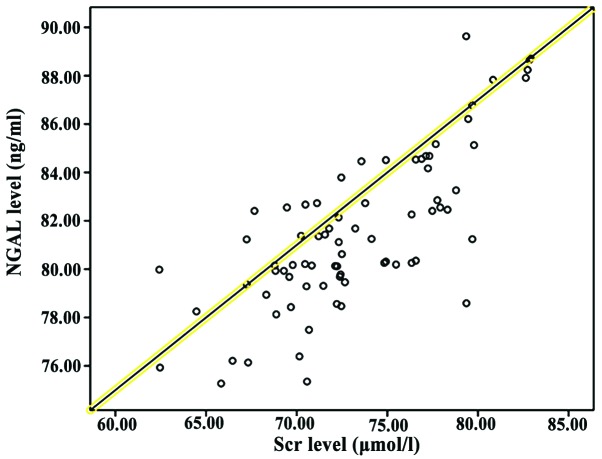
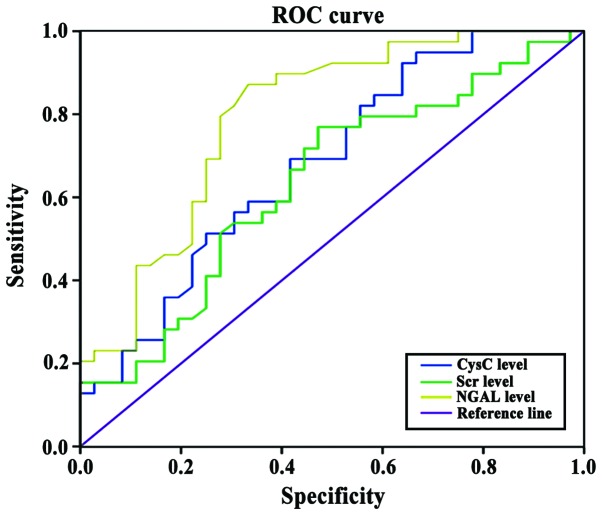
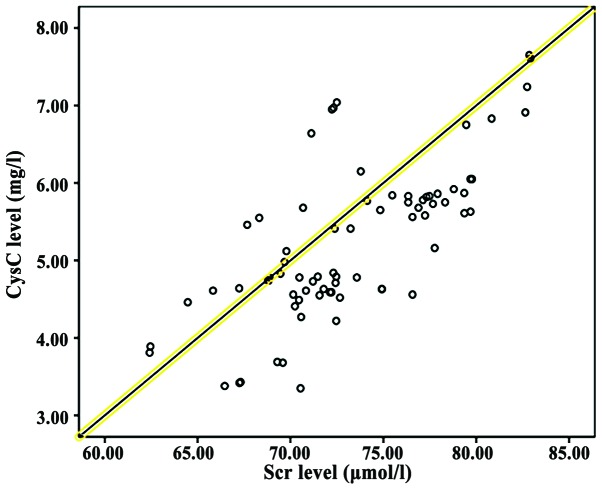
The present study investigated the clinical significance of the novel biomarker neutrophil gelatinase-associated lipocalin (NGAL) for the early diagnosis of acute renal injury (AKI). Thirty-eight critically ill patients with acute renal injury treated at Zhengzhou No. 7 People's Hospital between December 2015 and November 2016 served as the AKI group (observation group). At the same time, 38 critically ill patients without acute renal injury were also selected as the non-AKI group (control group). Serum NGAL and creatinine (SCr) levels were measured by enzyme-linked immunosorbent assay (ELISA) at 2, 8, 12 and 24 h post-operation, whereas particle-enhanced turbidimetric immunoassay (PETIA) was used to quantify the levels of cysteine protease inhibitor cystatin C (CysC) in serum at 2, 8, 12 and 24 h post-operation. The correlations between indicators were also analyzed, with ROC curves used to evaluate the diagnostic values of NGAL, SCr and CysC in AKI. No significant differences in SCr levels were found between the two groups at different time-points after operation (P>0.05), but NGAL and CysC levels in the observation group were significantly higher than in the control group (P<0.05). Pearson correlation coefficient analysis showed NGAL and CysC were positively correlated with Scr levels. For NGAL in early diagnosis, the area under the AKI curve was 0.904, the sensitivity was 90.2% and the specificity was 89.5%; for CysC in early diagnosis, the area under the AKI curve was 0.806, the sensitivity was 79.2% and the specificity was 78.5%; for SCr in early diagnosis, the area under the AKI curve was 0.634, the sensitivity was 64.2% and the specificity was 62.5%. Therefore, NGAL demonstrated a satisfactory early predictive value for AKI and can be used as a biomarker for early AKI diagnosis.
本研究探讨了新型生物标志物中性粒细胞明胶酶相关脂质运载蛋白(NGAL)在急性肾损伤(AKI)早期诊断中的临床意义。选取2015年12月至2016年11月在郑州市第七人民医院治疗的38例急性肾损伤重症患者作为AKI组(观察组)。同时,选取38例无急性肾损伤的重症患者作为非AKI组(对照组)。术后2、8、12和24小时采用酶联免疫吸附测定(ELISA)法检测血清NGAL和肌酐(SCr)水平,而术后2、8、12和24小时采用颗粒增强比浊免疫测定法(PETIA)定量检测血清中半胱氨酸蛋白酶抑制剂胱抑素C(CysC)水平。分析各指标之间的相关性,采用ROC曲线评估NGAL、SCr和CysC对AKI的诊断价值。术后不同时间点两组SCr水平差异无统计学意义(P>0.05),但观察组NGAL和CysC水平显著高于对照组(P<0.05)。Pearson相关系数分析显示NGAL和CysC与Scr水平呈正相关。对于早期诊断中的NGAL,AKI曲线下面积为0.904,灵敏度为90.2%,特异度为89.5%;对于早期诊断中的CysC,AKI曲线下面积为0.806,灵敏度为79.2%,特异度为78.5%;对于早期诊断中的SCr,AKI曲线下面积为0.634,灵敏度为64.2%,特异度为62.5%。因此,NGAL对AKI具有良好的早期预测价值,可作为早期AKI诊断的生物标志物。