Mirza Kiran Kafila, Walsted Emil Schwarz, Backer Vibeke
Respiratory Research Unit, Department of Respiratory Medicine, University Hospital Bispebjerg, Copenhagen, Denmark.
Eur Clin Respir J. 2017 Nov 20;4(1):1399033. doi: 10.1080/20018525.2017.1399033. eCollection 2017.
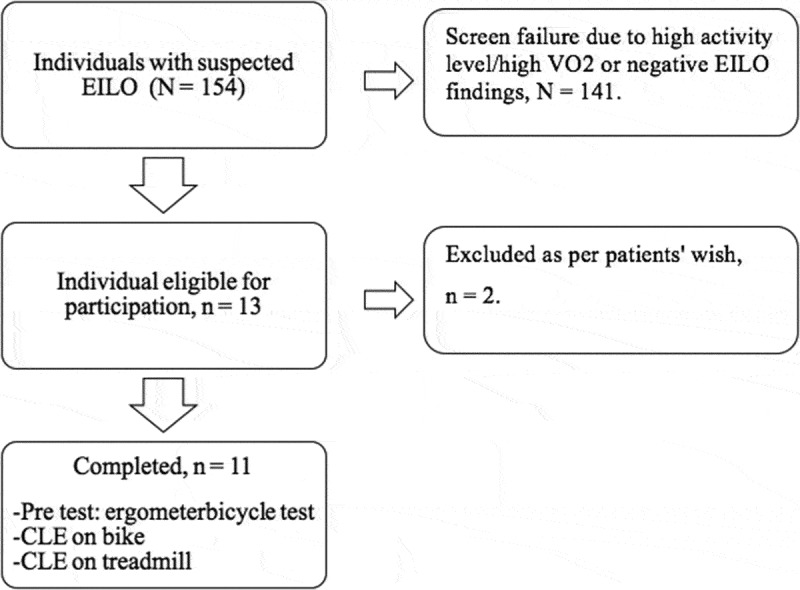
: Patients suffering from exercise-induced laryngeal obstruction (EILO) are subjected to several exhausting tests. We aimed to assess the feasibility of using a single test to obtain diagnostic measurements for maximum oxygen uptake (VOmax) and exercise-induced laryngeal obstruction (EILO). : Patients referred to the outpatient respiratory clinic at the University Hospital of Bispebjerg, Copenhagen with exercise-induced dyspnoea were evaluated for inclusion over 13 months. Eligible patients were aged 18-43 years, had a known EILO diagnosis (moderate or severe) and were inactive (self-reported activity) with less than 3 hours activity per week. In randomised order, all participants (= 11) underwent three tests: a VOmax test with and without concurrent laryngoscopy. VOmax and EILO values from the two testing methods were compared. : There was no difference in VOmax measured by ergospirometry with and without simultaneous continuous laryngoscopy during exercise (CLE) testing (mean difference -22 ml O・min; 95% CI -125 to 81 ml O・min; = 0.647). EILO scores obtained during the CLE testing on the treadmill versus CLE testing on the ergometer bike revealed identical supraglottic scores in nine of the 11 participants (82%) with substantial agreement between the two types of test ( = 0.71). Glottic scores were identical in six of the 11 (55%), showing moderate agreement between test types ( = 0.38). : Based on our findings in inactive individuals, ergospirometry with laryngoscopy is feasible and well tolerated, yielding measurements for maximal oxygen uptake comparable to those of standard bike ergospirometry. Likewise, measurements of supraglottic EILO are comparable to those of the standard treadmill CLE test.
患有运动性喉梗阻(EILO)的患者要接受多项令人疲惫的检查。我们旨在评估使用单一检查来获取最大摄氧量(VOmax)和运动性喉梗阻(EILO)诊断测量值的可行性。:在哥本哈根比斯佩比约格大学医院门诊呼吸科就诊且有运动性呼吸困难的患者,在13个月内接受了纳入评估。符合条件的患者年龄在18至43岁之间,已知患有EILO(中度或重度),且不活跃(自我报告的活动情况),每周活动时间少于3小时。所有参与者(=11人)按随机顺序接受三项检查:一项有同步喉镜检查和一项无同步喉镜检查的VOmax测试。比较了两种测试方法的VOmax和EILO值。:在运动期间进行的连续喉镜检查(CLE)测试中,有同步连续喉镜检查和无同步连续喉镜检查时通过气体代谢测定法测得的VOmax没有差异(平均差异-22毫升O₂/分钟;95%可信区间-125至81毫升O₂/分钟;P=0.647)。在跑步机上进行的CLE测试与在测力计自行车上进行的CLE测试所获得的EILO评分显示,11名参与者中有9名(82%)的声门上评分相同,两种测试类型之间有高度一致性(κ=0.71)。11名参与者中有6名(55%)的声门评分相同,测试类型之间显示出中度一致性(κ=0.38)。:基于我们在不活跃个体中的研究结果,喉镜检查的气体代谢测定法是可行的且耐受性良好,所获得的最大摄氧量测量值与标准自行车测力计测试相当。同样,声门上EILO的测量值与标准跑步机CLE测试相当。