Department of Rehabilitation Medicine St. Vincent's Hospital College of Medicine The Catholic University of Korea Seoul Korea.
Department of Physical Therapy Yongin University Yongin Korea.
Brain Behav. 2017 Oct 25;7(11):e00868. doi: 10.1002/brb3.868. eCollection 2017 Nov.
Gait recovery is an important goal in stroke patients. Several studies have sought to uncover relationships between specific brain lesions and the recovery of gait, but the effects of specific brain lesions on gait remain unclear. Thus, we investigated the effects of stroke lesions on gait recovery in stroke patients.
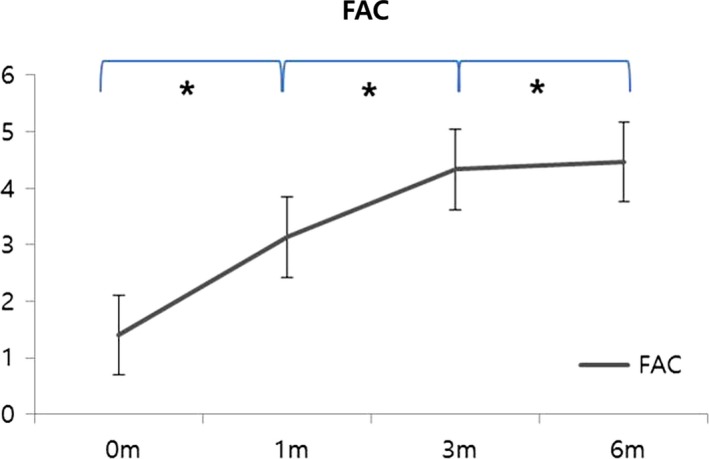
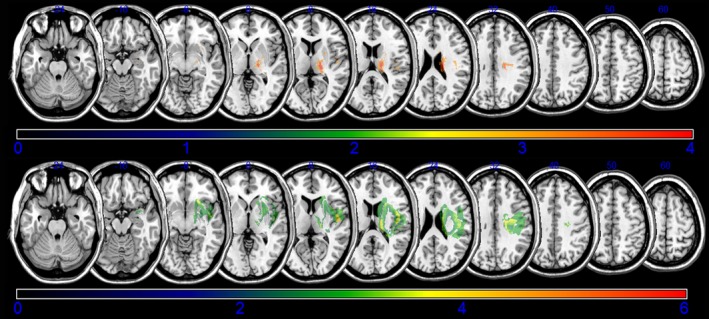
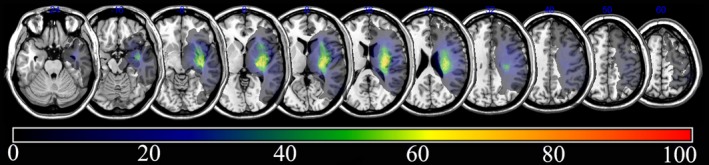
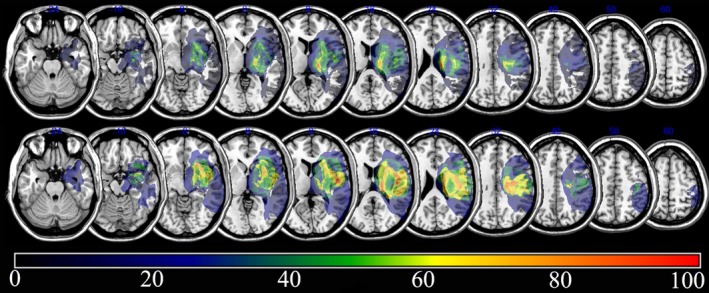
In total, 30 subjects with stroke were assessed in a retrograde longitudinal observational study. To assess gait function, the functional ambulation category (FAC) was tested four times: initially (within 2 weeks) and 1, 3, and 6 months after the onset of the stroke. Brain lesions were analyzed via overlap, subtraction, and voxel-based lesion symptom mapping (VLSM).
Ambulation with FAC improved significantly with time. Subtraction analysis showed that involvement of the corona radiata, internal capsule, globus pallidus, and putamen were associated with poor recovery of gait throughout 6 months after onset. The caudate nucleus did influence poor recovery of gait at 6 months after onset. VLSM revealed that corona radiata, internal capsule, globus pallidus, putamen and cingulum were related with poor recovery of gait at 3 months after onset. Corona radiata, internal capsule, globus pallidus, putamen, primary motor cortex, and caudate nucleus were related with poor recovery of gait at 6 months after onset.
Results identified several important brain lesions for gait recovery in patients with stroke. These results may be useful for planning rehabilitation strategies for gait and understanding the prognosis of gait in stroke patients.
步态恢复是脑卒中患者的重要目标。有几项研究试图揭示特定脑损伤与步态恢复之间的关系,但特定脑损伤对步态的影响仍不清楚。因此,我们研究了脑卒中患者脑损伤对步态恢复的影响。
共对 30 名脑卒中患者进行了回顾性纵向观察性研究。为了评估步态功能,采用功能性步行分类(FAC)进行了 4 次测试:脑卒中发病后最初(2 周内)及 1、3 和 6 个月。通过重叠、相减和基于体素的病变症状映射(VLSM)分析脑损伤。
FAC 步行能力随时间显著改善。相减分析显示,放射冠、内囊、苍白球和壳核受累与发病后 6 个月内步态恢复不良有关。尾状核在发病后 6 个月也影响步态恢复不良。VLSM 显示,放射冠、内囊、苍白球、壳核和扣带回与发病后 3 个月步态恢复不良有关。放射冠、内囊、苍白球、壳核、初级运动皮层和尾状核与发病后 6 个月步态恢复不良有关。
研究结果确定了脑卒中患者步态恢复的几个重要脑损伤部位。这些结果可能有助于为步态康复计划提供依据,并了解脑卒中患者步态的预后。