Yalçin Mustafa, Yalçin Ayla, Bengi Göksel, Nak Selim G
Department of Gastroenterology, Dokuz Eylul University Medical Faculty, Ege, Turkey.
Department of Gastroenterology, Uludağ University Medical Faculty, Bursa, Turkey.
Euroasian J Hepatogastroenterol. 2016 Jul-Dec;6(2):93-96. doi: 10.5005/jp-journals-10018-1177. Epub 2016 Dec 1.
Recurrence is an important problem after infection, and intrafamilial transmission has an important role in recurrence. In this study, we aimed to investigate the significance of intrafamilial transmission for recurrence development after treatment as well as its usefulness in prevention.
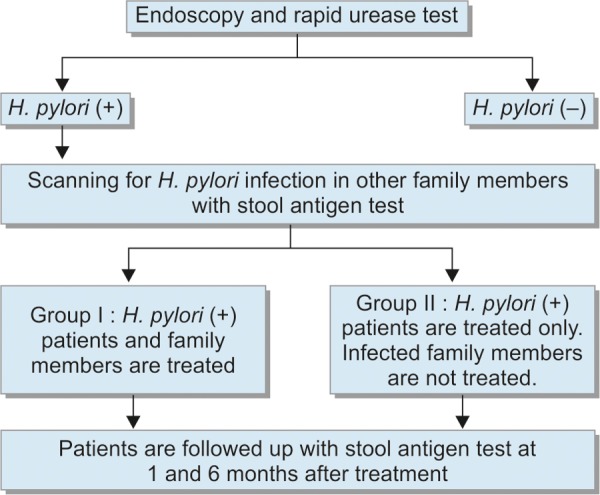
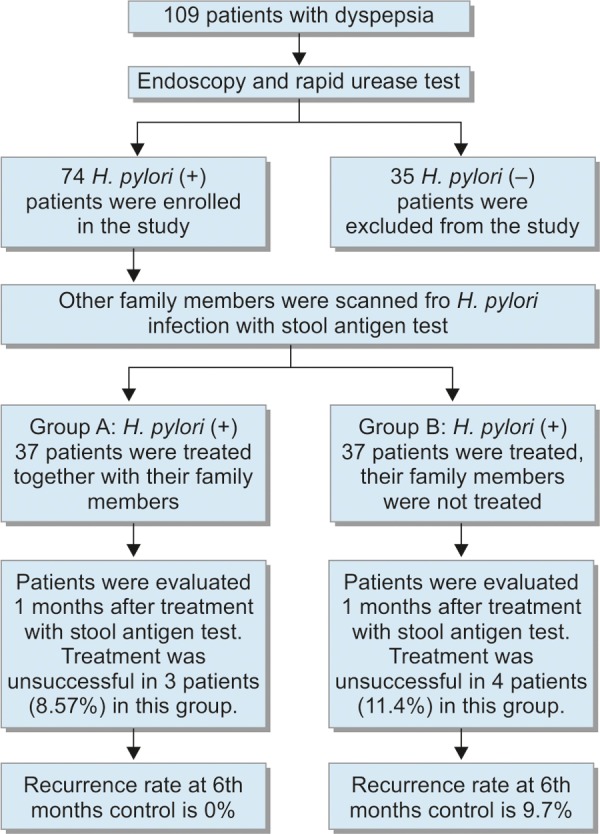
Of the 109 patients who had dyspepsia and underwent endoscopy, 74 patients had infection and were enrolled in this study. Infected family members were also detected. Patients were randomly divided into groups I and II, with each group containing 37 individuals. In group I, patients and their infected family members were treated together at the same time. In group II, only the patients were treated. Treatment success was evaluated at the 1st month and evaluation for recurrence was carried out at the 6th month.
infection was detected in 67.8% of the patients with dyspepsia. Two patients in each group did not show up at the 1st month control. Eradication was achieved in 63 of the 70 patients (90.0%) who completed their treatment. After 6 months, patients with successful treatment had no recurrence in any of the 32 patients in group I. There were recurrence in 3 of the 31 patients (9.7%) in group II; however, there was no statistically significant difference between the groups (p = 0.113).
Our study showed that eradication treatment in patients and family members with infection resulted in a decrease in the number of recurrences even though it was not statistically significant.
Yalçin M, Yalçin A, Bengi G, Nak SG. Infection among Patients with Dyspepsia and Intrafamilial Transmission. Euroasian J Hepato-Gastroenterol 2016;6(2):93-96.
感染后复发是一个重要问题,家庭内传播在复发中起重要作用。在本研究中,我们旨在探讨家庭内传播对治疗后复发发展的意义及其在预防中的作用。
在109例有消化不良症状并接受内镜检查的患者中,74例有感染并纳入本研究。还检测了受感染的家庭成员。患者被随机分为I组和II组,每组37人。I组中,患者及其受感染的家庭成员同时接受治疗。II组中,仅对患者进行治疗。在第1个月评估治疗成功率,在第6个月进行复发评估。
67.8%的消化不良患者检测到感染。每组有2例患者在第1个月的对照中未出现。70例完成治疗的患者中有63例(90.0%)实现了根除。6个月后,I组32例治疗成功的患者均无复发。II组31例患者中有3例复发(9.7%);然而,两组之间无统计学显著差异(p = 0.113)。
我们的研究表明,对感染患者及其家庭成员进行根除治疗可减少复发数量,尽管无统计学显著差异。
Yalçin M, Yalçin A, Bengi G, Nak SG. 消化不良患者中的感染及家庭内传播。《欧亚肝脏胃肠病学杂志》2016;6(2):93 - 96。