Lee Eun-Young, Spence John C
1-149 Van Vliet Complex, Faculty of Physical Education and Recreation, University of Alberta, Edmonton, AB T6G 2H9 Canada.
3-113 Van Vliet Complex, Faculty of Physical Education and Recreation, University of Alberta, Edmonton, AB T6G 2H9 Canada.
Glob Health Res Policy. 2016 Dec 5;1:19. doi: 10.1186/s41256-016-0019-2. eCollection 2016.
This study tested links between pubertal development and screen time among South Korean adolescent boys and girls.
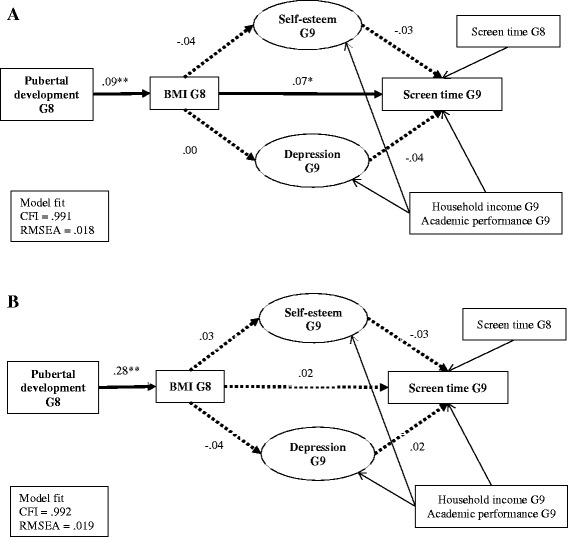
Secondary analysis was conducted on data from the Korean Children and Youth Panel Study (KCYPS) involving 2071 adolescents ( = 13.14 years). Body mass index (BMI) at Grade 8 (baseline), self-esteem and depression at Grade 9 were examined as mediators of the relationship between pubertal development and screen time after adjusting for household income and academic performance. Structural equation modeling was used to assess direct and indirect pathways between pubertal development at Grade 8 and screen time at Grade 9.
No direct effect of pubertal development on screen time was found. But, an indirect effect existed for boys from pubertal development to screen time through BMI. Earlier pubertal development predicted higher BMI, and in turn, higher BMI predicted more time spent in screen time. Among girls, pubertal development negatively predicted BMI; however, no mediation effect of BMI between pubertal development and screen time was observed. No mediation effect of self-esteem or depression was found among boys or girls.
Pubertal development appears to have an indirect influence on screen time through BMI for South Korean boys. More studies examining potential pathways between pubertal development and sedentary behavior are needed to build on these findings.
本研究检验了韩国青少年男孩和女孩青春期发育与屏幕使用时间之间的联系。
对韩国儿童和青少年面板研究(KCYPS)中2071名青少年(平均年龄 = 13.14岁)的数据进行二次分析。在调整家庭收入和学业成绩后,将八年级时的体重指数(BMI)、九年级时的自尊和抑郁作为青春期发育与屏幕使用时间之间关系的中介变量进行检验。采用结构方程模型评估八年级时的青春期发育与九年级时的屏幕使用时间之间的直接和间接路径。
未发现青春期发育对屏幕使用时间有直接影响。但是,男孩从青春期发育到屏幕使用时间通过BMI存在间接影响。青春期发育较早预示着较高的BMI,反过来,较高的BMI预示着更多的屏幕使用时间。在女孩中,青春期发育对BMI有负向预测作用;然而,未观察到BMI在青春期发育和屏幕使用时间之间的中介作用。在男孩或女孩中均未发现自尊或抑郁的中介作用。
对于韩国男孩,青春期发育似乎通过BMI对屏幕使用时间有间接影响。需要更多研究来探讨青春期发育与久坐行为之间的潜在路径,以进一步拓展这些发现。