Department of Physiology, Yong Loo Lin School of Medicine, National University of Singapore, Singapore, Singapore.
NUS Graduate School for Integrative Sciences and Engineering, National University of Singapore, Singapore, Singapore.
Sci Rep. 2017 Dec 4;7(1):16867. doi: 10.1038/s41598-017-17192-6.
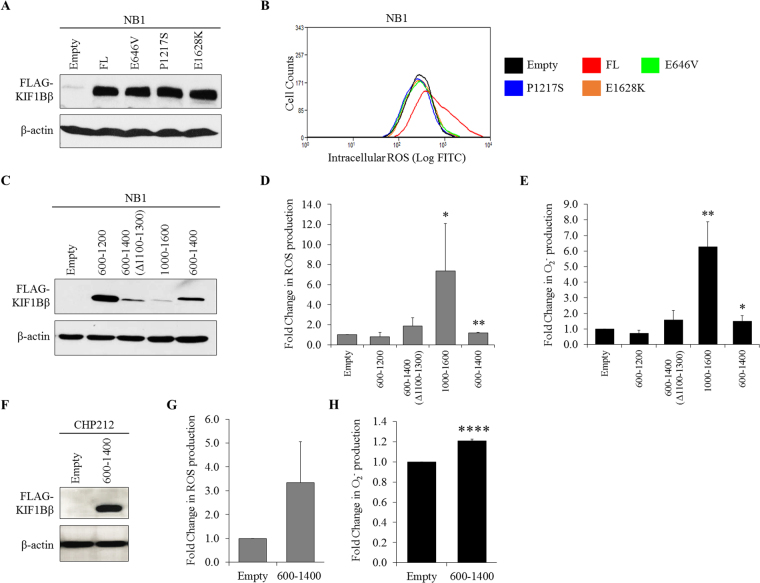
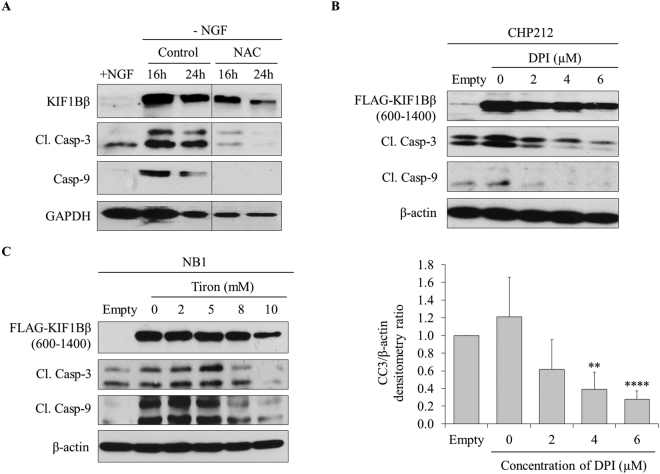
Relapse-prone, poor prognosis neuroblastoma is frequently characterized by deletion of chr1p36 where tumor suppressor gene KIF1Bβ resides. Interestingly, many 1p36-positive patients failed to express KIF1Bβ protein. Since altered cellular redox status has been reported to be involved in cell death and protein modification, we investigated the relationship between reactive oxygen species (ROS) and KIF1Bβ. Here, we showed that wild-type KIF1Bβ protein expression positively correlates with superoxide (O) and total ROS levels in neuroblastoma cells, unlike apoptotic loss-of-function KIF1Bβ mutants. Overexpression of KIF1Bβ apoptotic domain variants increases total ROS and, specifically O, whereas knockdown of endogenous KIF1Bβ decreases ROS and O. Interestingly, O increases KIF1Bβ protein expression, independent of the proteasomal degradation pathway. Scavenging O or ROS decreases KIF1Bβ protein expression and subsequent apoptosis. Moreover, treatment with investigational redox compound Gliotoxin increases O, KIF1Bβ protein expression, apoptosis and colony formation inhibition. Overall, our findings suggest that ROS and O may be important downstream effectors of KIF1Bβ-mediated apoptosis. Subsequently, O produced may increase KIF1Bβ protein expression in a positive feedback mechanism. Therefore, ROS and, specifically O, may be critical regulators of KIF1Bβ-mediated apoptosis and its protein expression in neuroblastoma.
易复发、预后差的神经母细胞瘤通常表现为染色体 1p36 缺失,而肿瘤抑制基因 KIF1Bβ 就位于该区域。有趣的是,许多 1p36 阳性患者未能表达 KIF1Bβ 蛋白。由于细胞氧化还原状态的改变已被报道与细胞死亡和蛋白质修饰有关,我们研究了活性氧(ROS)与 KIF1Bβ 之间的关系。在这里,我们发现野生型 KIF1Bβ 蛋白表达与神经母细胞瘤细胞中超氧化物(O)和总 ROS 水平呈正相关,而凋亡功能丧失的 KIF1Bβ 突变体则不同。过表达 KIF1Bβ 凋亡结构域变体增加总 ROS 水平,特别是 O,而内源性 KIF1Bβ 的敲低则降低 ROS 和 O。有趣的是,O 可增加 KIF1Bβ 蛋白表达,而不依赖于蛋白酶体降解途径。清除 O 或 ROS 可降低 KIF1Bβ 蛋白表达和随后的细胞凋亡。此外,用研究性氧化还原化合物Gliotoxin 处理可增加 O、KIF1Bβ 蛋白表达、细胞凋亡和集落形成抑制。总体而言,我们的研究结果表明,ROS 和 O 可能是 KIF1Bβ 介导的细胞凋亡的重要下游效应子。随后,O 可能通过正反馈机制增加 KIF1Bβ 蛋白表达。因此,ROS 特别是 O,可能是 KIF1Bβ 介导的凋亡及其在神经母细胞瘤中蛋白表达的关键调节剂。