Istituto di Ricovero e Cura a Carattere Scientifico (IRCCS) Neuromed, Via Atinense 18, 86077 Pozzilli, Italy.
Department of Neurosciences, Mental Health, and Sensory Organs, Sant'Andrea Hospital, Sapienza University of Rome, Via di Grottarossa 1035, 00189 Rome, Italy.
Int J Mol Sci. 2017 Dec 2;18(12):2600. doi: 10.3390/ijms18122600.
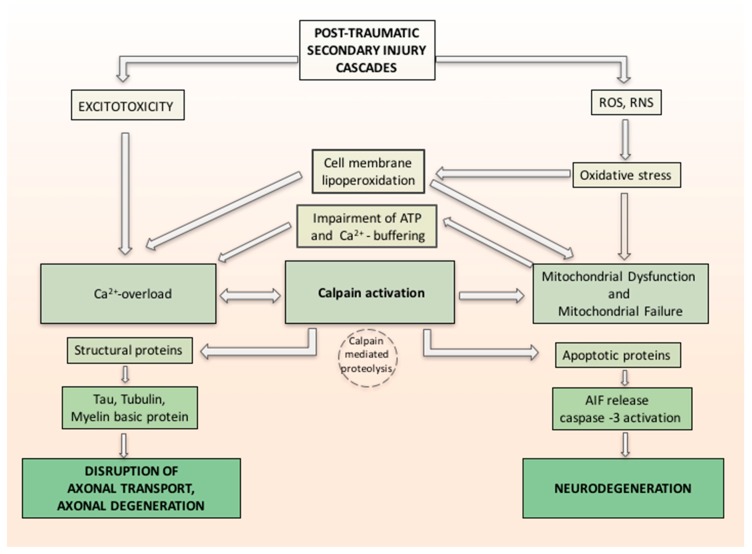
Traumatic brain injury (TBI) is one of the world's leading causes of morbidity and mortality among young individuals. TBI applies powerful rotational and translational forces to the brain parenchyma, which results in a traumatic diffuse axonal injury (DAI) responsible for brain swelling and neuronal death. Following TBI, axonal degeneration has been identified as a progressive process that starts with disrupted axonal transport causing axonal swelling, followed by secondary axonal disconnection and Wallerian degeneration. These modifications in the axonal cytoskeleton interrupt the axoplasmic transport mechanisms, causing the gradual gathering of transport products so as to generate axonal swellings and modifications in neuronal homeostasis. Oxidative stress with consequent impairment of endogenous antioxidant defense mechanisms plays a significant role in the secondary events leading to neuronal death. Studies support the role of an altered axonal calcium homeostasis as a mechanism in the secondary damage of axon, and suggest that calcium channel blocker can alleviate the secondary damage, as well as other mechanisms implied in the secondary injury, and could be targeted as a candidate for therapeutic approaches. Reactive oxygen species (ROS)-mediated axonal degeneration is mainly caused by extracellular Ca. Increases in the defense mechanisms through the use of exogenous antioxidants may be neuroprotective, particularly if they are given within the neuroprotective time window. A promising potential therapeutic target for DAI is to directly address mitochondria-related injury or to modulate energetic axonal energy failure.
创伤性脑损伤(TBI)是导致年轻人发病率和死亡率的世界主要原因之一。TBI 向脑实质施加强大的旋转和平移力,导致外伤性弥漫性轴索损伤(DAI),从而导致脑肿胀和神经元死亡。TBI 后,轴突变性已被确定为一个渐进的过程,从轴突运输中断引起的轴突肿胀开始,然后是继发性轴突分离和沃勒氏变性。这些轴突细胞骨架的改变中断了轴浆运输机制,导致运输产物逐渐聚集,从而产生轴突肿胀和神经元内稳态的改变。氧化应激导致内源性抗氧化防御机制受损,在导致神经元死亡的继发性事件中起着重要作用。研究支持改变的轴突钙稳态作为轴突继发性损伤的机制,并表明钙通道阻滞剂可以减轻继发性损伤,以及继发性损伤中涉及的其他机制,并可能作为治疗方法的候选药物。活性氧(ROS)介导的轴突变性主要是由细胞外 Ca 引起的。通过使用外源性抗氧化剂增加防御机制可能具有神经保护作用,特别是如果在神经保护时间窗内给予它们。直接解决与线粒体相关的损伤或调节能量性轴突能量衰竭是 DAI 的一个很有前途的潜在治疗靶点。