Key Laboratory of Epigenetics and Oncology, Research Center for Preclinical Medicine, Southwest Medical University, Luzhou 646000, China.
State Key Laboratory of Quality Research in Chinese Medicine, Macau University of Science and Technology, Macau 999078, China.
Molecules. 2017 Dec 4;22(12):2105. doi: 10.3390/molecules22122105.
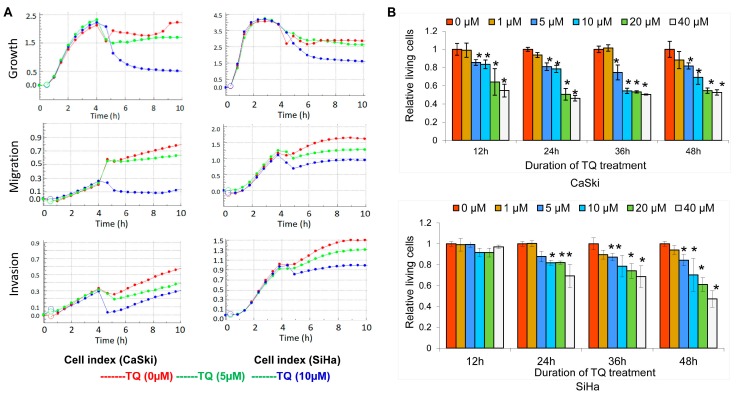
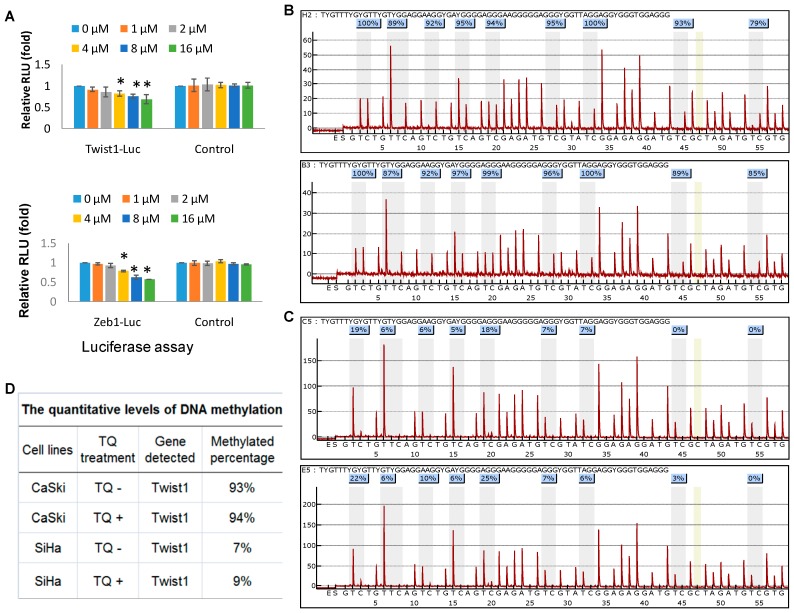
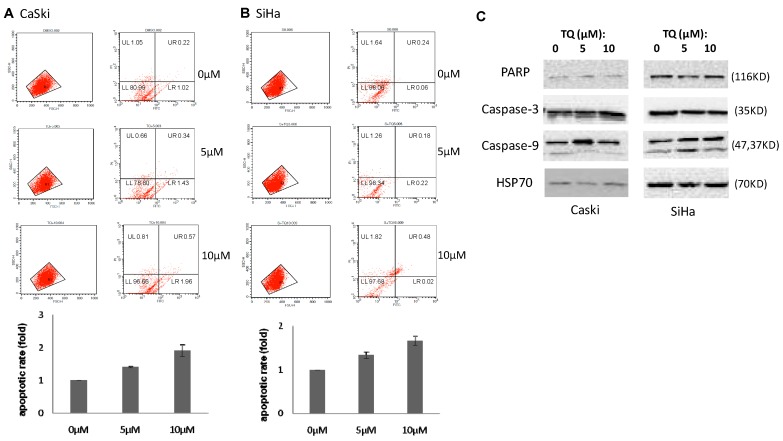
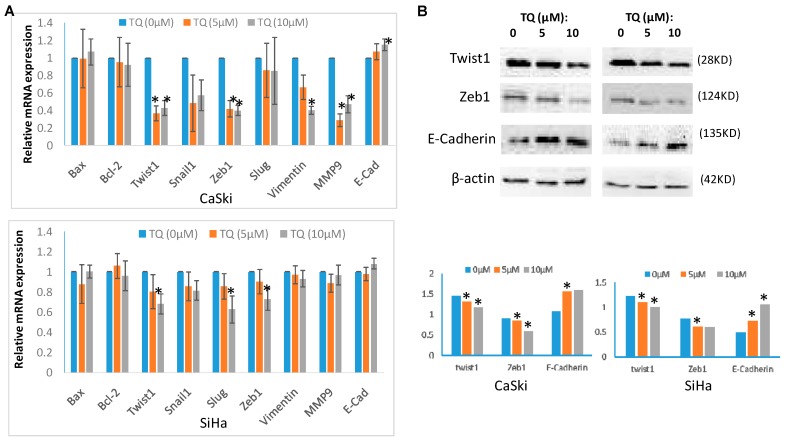
Cervical cancer is one of the most common gynecological malignant tumors worldwide, for which chemotherapeutic strategies are limited due to their non-specific cytotoxicity and drug resistance. The natural product thymoquinone (TQ) has been reported to target a vast number of signaling pathways in carcinogenesis in different cancers, and hence is regarded as a promising anticancer molecule. Inhibition of epithelial to mesenchymal transition (EMT) regulators is an important approach in anticancer research. In this study, TQ was used to treat the cervical cancer cell lines SiHa and CaSki to investigate its effects on EMT-regulatory proteins and cancer metastasis. Our results showed that TQ has time-dependent and dose-dependent cytotoxic effects, and it also inhibits the migration and invasion processes in different cervical cancer cells. At the molecular level, TQ treatment inhibited the expression of Twist1, Zeb1 expression, and increased E-Cadherin expression. Luciferase reporter assay showed that TQ decreases the and promoter activities respectively, indicating that and might be the direct target of TQ. TQ also increased cellular apoptosis in some extent, but apoptotic genes/proteins we tested were not significant affected. We conclude that TQ inhibits the migration and invasion of cervical cancer cells, probably via Twist1/E-Cadherin/EMT or/and Zeb1/E-Cadherin/EMT, among other signaling pathways.
宫颈癌是全球最常见的妇科恶性肿瘤之一,由于其非特异性细胞毒性和耐药性,化疗策略受到限制。天然产物百里醌(TQ)已被报道在不同癌症的致癌作用中靶向大量信号通路,因此被认为是一种有前途的抗癌分子。抑制上皮间质转化(EMT)调节剂是抗癌研究中的重要方法。在这项研究中,使用 TQ 治疗宫颈癌细胞系 SiHa 和 CaSki,以研究其对 EMT 调节蛋白和癌症转移的影响。我们的结果表明,TQ 具有时间和剂量依赖性的细胞毒性作用,并且还抑制了不同宫颈癌细胞中的迁移和侵袭过程。在分子水平上,TQ 处理抑制了 Twist1、Zeb1 表达的表达,并增加了 E-钙粘蛋白的表达。荧光素酶报告基因检测表明,TQ 分别降低了 和 启动子活性,表明 和 可能是 TQ 的直接靶标。TQ 还在一定程度上增加了细胞凋亡,但我们测试的凋亡基因/蛋白没有明显受影响。我们得出结论,TQ 通过 Twist1/E-钙粘蛋白/EMT 或/和 Zeb1/E-钙粘蛋白/EMT 等信号通路抑制宫颈癌细胞的迁移和侵袭。