Microbial Cell Group, Bioprocessing Technology Institute, Agency for Science, Technology and Research (A*STAR), 20 Biopolis Way, #06-01 Centros, Singapore, 138668, Singapore.
Molecular Engineering Lab, Biomedical Sciences Institutes, A*STAR, 61 Biopolis Drive, Singapore, 138673, Singapore.
Microb Cell Fact. 2017 Dec 5;16(1):221. doi: 10.1186/s12934-017-0836-0.
Lactic acid bacteria are a family of "generally regarded as safe" organisms traditionally used for food fermentation. In recent years, they have started to emerge as potential chassis for heterologous protein production. And more recently, due to their beneficial properties in the gut, they have been examined as potential candidates for mucosal delivery vectors, especially for acid-sensitive enzymes. One such application would be the delivery of gluten-digesting endopeptidases for the treatment of celiac disease. To facilitate these applications, an efficient recombinant protein expression toolbox is required, especially for recombinant protein secretion. While current tools for enhancing protein secretion consist mainly of signal peptides, secretion propeptides have also been observed to play a crucial role for protein secretion and improved yields.
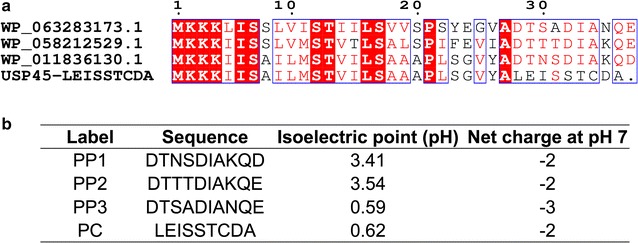
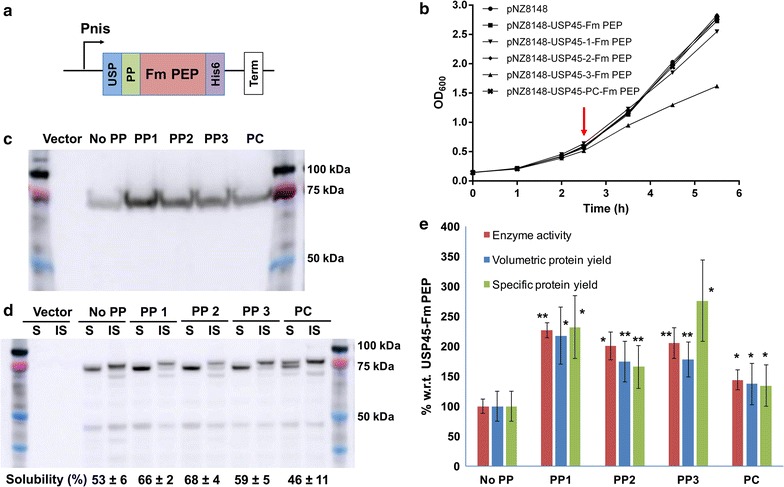
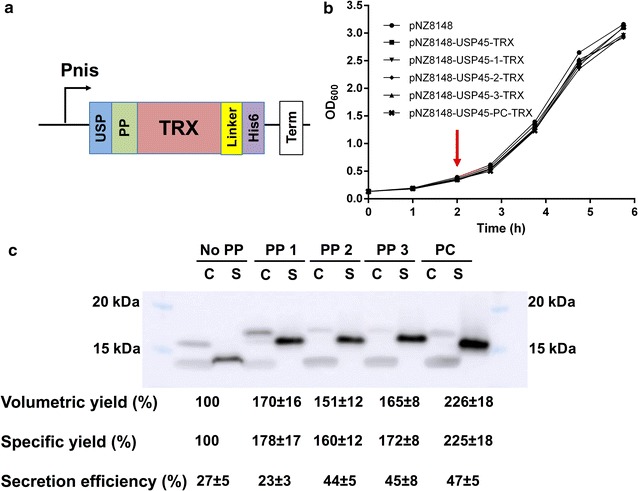
To expand the propeptide library for secretion optimization, we have mined and characterized three naturally occurring propeptides from the sequenced genomes of 109 Lactococcus species. These newly-mined propeptides were introduced after the N-terminal USP45 secretion signal to characterize and compare their effects on the secretion of Escherichia coli thioredoxin (TRX) and Flavobacterium meningosepticum prolyl endopeptidase (Fm PEP) in Lactococcus lactis NZ9000. All three propeptides, along with the positive control LEISSTCDA, improved volumetric secretion yields by 1.4-2.3-folds. However, enhancement of secretion yield is dependent on protein of interest. For TRX, the optimal combination of USP45 signal peptide and LEISSTCDA produced a 2.3-fold increase in secretion yields. Whilst for Fm PEP, propeptide 1 with USP45 signal peptide improved volumetric secretion yields by 2.2-fold compared to a 1.4-fold increase by LEISSTCDA. Similar trends in Fm PEP activity and protein yield also demonstrated minimal effect of the negative charged propeptides on PEP activity and thus folding.
Overall, we have characterized three new propeptides for use in L. lactis secretion optimization. From success of these propeptides for improvement of secretion yields, we anticipate this collection to be valuable to heterologous protein secretion optimisation in lactic acid bacteria. We have also demonstrated for the first time, secretion of Fm PEP in L. lactis for potential use as a therapy agent in celiac disease.
乳酸菌是一类“通常被认为是安全的”生物体,传统上用于食品发酵。近年来,它们开始作为异源蛋白生产的潜在底盘出现。最近,由于它们在肠道中的有益特性,它们被作为潜在的粘膜传递载体进行了研究,特别是对于酸敏感的酶。这样的应用之一是将消化面筋的内切肽酶递送到胃肠道,用于治疗乳糜泻。为了促进这些应用,需要一个有效的重组蛋白表达工具箱,特别是对于重组蛋白分泌。虽然目前用于增强蛋白分泌的工具主要是信号肽,但分泌前肽也被观察到在蛋白分泌和提高产量方面起着关键作用。
为了扩展用于分泌优化的前肽文库,我们从 109 种乳球菌的测序基因组中挖掘和鉴定了三个天然存在的前肽。将这些新挖掘的前肽引入到 N 端 USP45 分泌信号之后,以鉴定和比较它们对大肠杆菌硫氧还蛋白(TRX)和脑膜炎败血黄杆菌脯氨酰内肽酶(Fm PEP)在乳球菌 NZ9000 中的分泌的影响。所有三个前肽,以及阳性对照 LEISSTCDA,将体积分泌产量提高了 1.4-2.3 倍。然而,分泌产量的提高依赖于目标蛋白。对于 TRX,USP45 信号肽和 LEISSTCDA 的最佳组合使分泌产量提高了 2.3 倍。而对于 Fm PEP,前肽 1 与 USP45 信号肽相比,LEISSTCDA 将体积分泌产量提高了 2.2 倍。Fm PEP 活性和蛋白产量也表现出相似的趋势,表明带负电荷的前肽对 PEP 活性和折叠的影响最小。
总的来说,我们已经鉴定了三个新的前肽,用于 L. lactis 的分泌优化。从这些前肽对提高分泌产量的成功,我们预计这一集合对乳酸菌中异源蛋白分泌优化将是有价值的。我们还首次证明了 Fm PEP 在 L. lactis 中的分泌,用于潜在的乳糜泻治疗。