Department of Translational Medicine, Section of Medical Protein Chemistry, Lund University, Inga Marie Nilsson's Street 53, 205 02, Malmö, Sweden.
Rheumatology, Department of Clinical Sciences Lund, Lund University, Lund, Sweden.
Arthritis Res Ther. 2017 Dec 6;19(1):266. doi: 10.1186/s13075-017-1470-2.
In the present study, we sought to evaluate the complement activation product C4d as a marker for lupus nephritis in systemic lupus erythematosus (SLE).
C4d levels were determined by enzyme-linked immunosorbent assay in plasma samples of patients with established SLE using a novel approach based on detection of a short linear cleavage neoepitope. Cross-sectional associations were studied in 98 patients with SLE with samples taken at lower or higher respective disease activity. Temporal associations were investigated in 69 patients with SLE who were followed longitudinally for up to 5 years. Plasma samples from 77 healthy donors were included as controls.
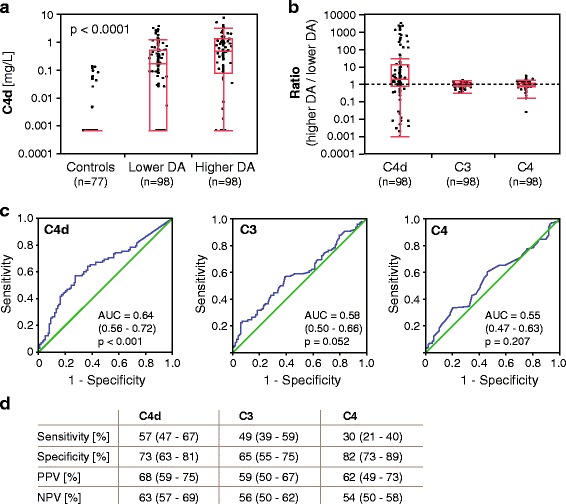
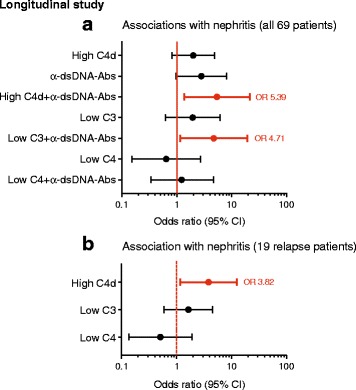
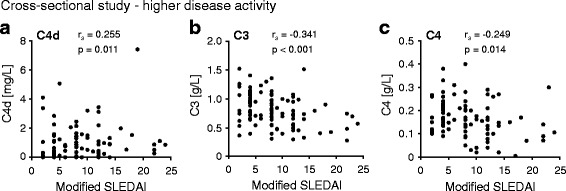
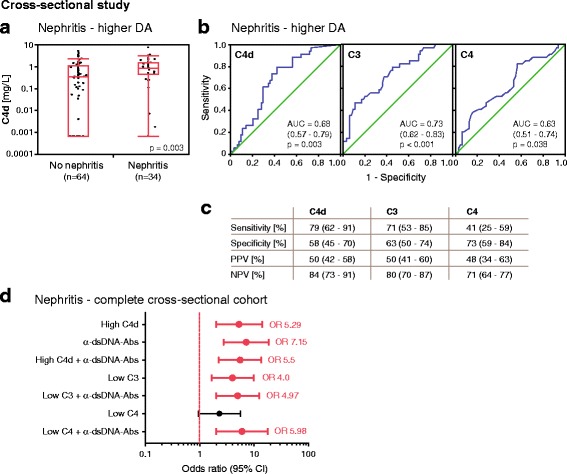
C4d levels were negligible in healthy control subjects and significantly increased in patients with SLE in the cross-sectional study (p < 0.0001). C4d levels discriminated between higher and lower disease activity according to ROC curve analysis (p < 0.001), exhibiting a positive predictive value of 68%. At higher disease activity, C4d levels correlated with the modified Systemic Lupus Erythematosus Disease Activity Index (p = 0.011) and predominantly with lupus nephritis (p = 0.003), exhibiting a sensitivity of 79% to identify patients with nephritis. High C4d levels together with the presence of anti-dsDNA autoantibodies preceded and thus predicted future lupus nephritis in the longitudinal study (OR 5.4, 95% CI 1.4-21.3). When we considered only patients with renal involvement (19 of 69) during the longitudinal study, we found that high C4d levels alone could forecast recurrence of future lupus nephritis (OR 3.3, 95% CI 1.2-9.6).
C4d appears to be a valuable marker for use in monitoring of patients with SLE, particularly for lupus nephritis. Importantly, C4d levels can predict impending flares of lupus nephritis and may thus be useful for informing treatment.
在本研究中,我们试图评估补体激活产物 C4d 作为系统性红斑狼疮(SLE)狼疮肾炎的标志物。
使用基于检测短线性切割新表位的新方法,通过酶联免疫吸附试验测定了 98 例 SLE 患者的血浆样本中的 C4d 水平,这些患者具有既定的 SLE,分别在疾病活动度较低或较高时采集样本。在 69 例 SLE 患者中进行了时间关联研究,这些患者接受了长达 5 年的纵向随访。将 77 名健康供体的血浆样本作为对照。
健康对照组的 C4d 水平可忽略不计,而在横断面研究中 SLE 患者的 C4d 水平显著升高(p < 0.0001)。根据 ROC 曲线分析,C4d 水平可区分更高和更低的疾病活动度(p < 0.001),阳性预测值为 68%。在更高的疾病活动度下,C4d 水平与改良的系统性红斑狼疮疾病活动指数(p = 0.011)相关,主要与狼疮肾炎相关(p = 0.003),对识别患有肾炎的患者的敏感性为 79%。在纵向研究中,高 C4d 水平与抗 dsDNA 自身抗体一起出现,并因此预测了未来的狼疮肾炎(OR 5.4,95%CI 1.4-21.3)。当我们在纵向研究中仅考虑有肾脏受累的患者(69 例中的 19 例)时,我们发现仅高 C4d 水平即可预测未来狼疮肾炎的复发(OR 3.3,95%CI 1.2-9.6)。
C4d 似乎是监测 SLE 患者的有价值的标志物,特别是对狼疮肾炎。重要的是,C4d 水平可以预测狼疮肾炎即将发作,因此可用于告知治疗。