Blizzard LeBlanc Devin R, Rioux Brittany V, Pelech Cody, Moffatt Teri L, Kimber Dustin E, Duhamel Todd A, Dolinsky Vernon W, McGavock Jonathan M, Sénéchal Martin
Faculty of Kinesiology, University of New Brunswick, Fredericton, New Brunswick.
Cardiometabolic Exercise and & Lifestyle Lab, Fredericton, New Brunswick.
Physiol Rep. 2017 Dec;5(23). doi: 10.14814/phy2.13539.
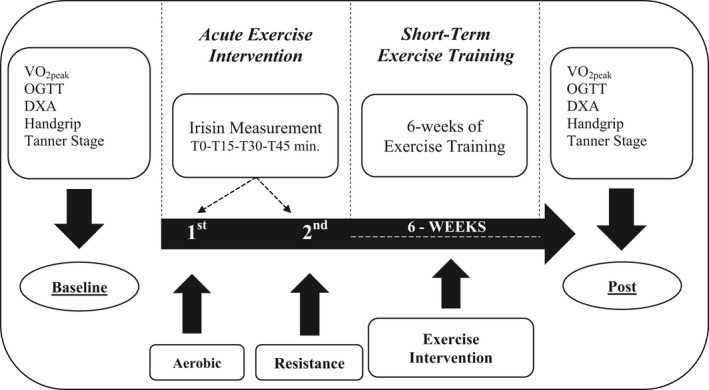
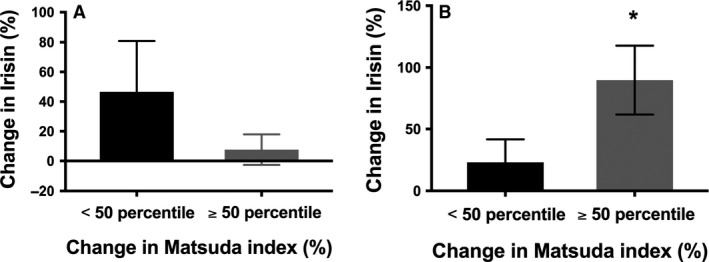
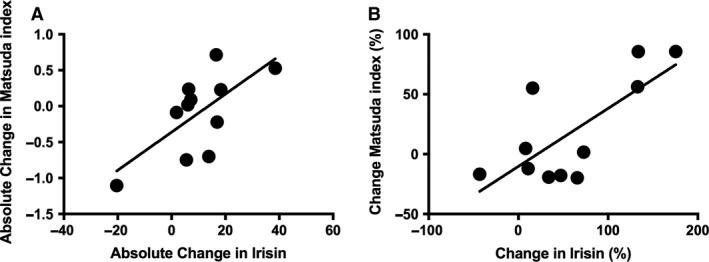
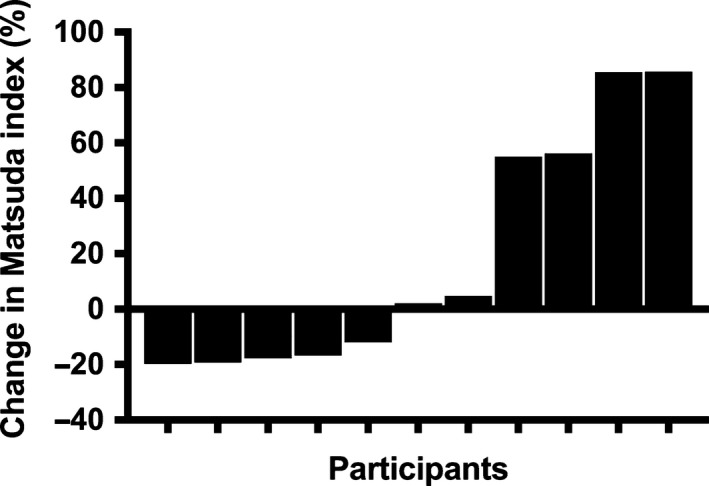
The mechanisms underlying the metabolic improvements following aerobic exercise training remain poorly understood. The primary aim of this study was to determine if an adipomyokine, irisin, responded to acute exercise was associated with the metabolic adaptations to chronic aerobic exercise in obese youth. The acute response to exercise was assessed in 11 obese youth following 45-min acute bouts of aerobic (AE) and resistance exercise (RE). The irisin area under the curve (pre-exercise, 15, 30, and 45 min) during these AE sessions were the main exposure variables. The primary outcome measure was the change in insulin sensitivity using the Matsuda index, following 6 weeks of RE training, delivered for 45 min, three times per week at 60-65% 1RM. Participants were also categorized as either responders (above) or nonresponders (below) based on the percentage change in the Matsuda index following the 6-week intervention. Irisin increased significantly during the acute bout of AE from 29.23 ± 6.96 to 39.30 ± 7.05 ng/mL; = 0.028, but not significantly during the RE session ( = 0.182). Absolute and relative change in irisin during the acute bout of AE was associated with absolute and relative change in Matsuda index ( = 0.68; = 0.022 and = 0.63; = 0.037) following the 6-week RE intervention. No such association was observed with the irisin response to acute RE (all > 0.05). Responders to the 6-week RE intervention displayed a fourfold greater irisin response to acute AE (90.0 ± 28.0% vs. 22.8 ± 18.7%; = 0.024) compared to nonresponders. Irisin increases significantly following an acute bout of AE, but not RE, and this response is associated with a greater improvement in insulin sensitivity in response to chronic resistance training.
有氧运动训练后代谢改善的潜在机制仍未得到充分理解。本研究的主要目的是确定一种脂肪因子鸢尾素对急性运动的反应是否与肥胖青少年对慢性有氧运动的代谢适应有关。在11名肥胖青少年进行45分钟的急性有氧运动(AE)和抗阻运动(RE)后,评估其对运动的急性反应。这些AE训练期间鸢尾素的曲线下面积(运动前、15分钟、30分钟和45分钟)是主要的暴露变量。主要结局指标是在进行为期6周、每周三次、每次45分钟、强度为60 - 65% 1RM的抗阻训练后,使用松田指数评估胰岛素敏感性的变化。参与者还根据6周干预后松田指数的百分比变化分为反应者(高于)或无反应者(低于)。鸢尾素在急性AE训练期间从29.23±6.96显著增加至39.30±7.05 ng/mL;P = 0.028,但在抗阻训练期间无显著变化(P = 0.182)。急性AE训练期间鸢尾素的绝对和相对变化与6周抗阻训练干预后松田指数的绝对和相对变化相关(r = 0.68;P = 0.022和r = 0.63;P = 0.037)。未观察到鸢尾素对急性抗阻运动的反应有此类关联(所有P > 0.05)。与无反应者相比,6周抗阻训练干预的反应者对急性AE的鸢尾素反应高出四倍(90.0±28.0%对22.8±18.7%;P = 0.024)。急性AE训练后鸢尾素显著增加,但抗阻训练后未增加,且这种反应与慢性抗阻训练后胰岛素敏感性的更大改善相关。