Mohammad Rahimi Gholam Rasul, Hejazi Keyvan, Hofmeister Martin
Department of Sports Sciences, Vahdat Institute of Higher Education, Torbat-e-Jam, Iran.
Department of Physical Education and Sport Sciences, Hakim Sabzevari University, Sabzevar, Iran.
EXCLI J. 2022 Feb 25;21:524-539. doi: 10.17179/excli2022-4703. eCollection 2022.
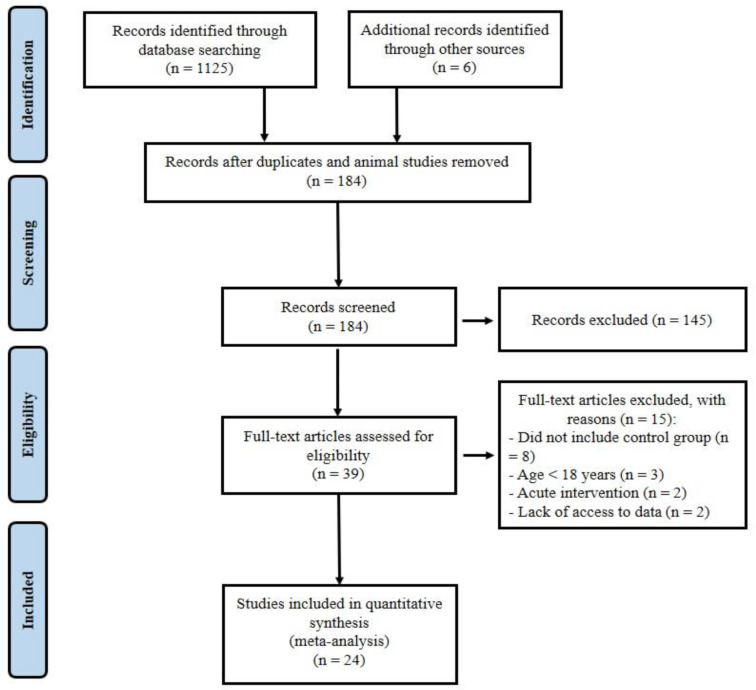
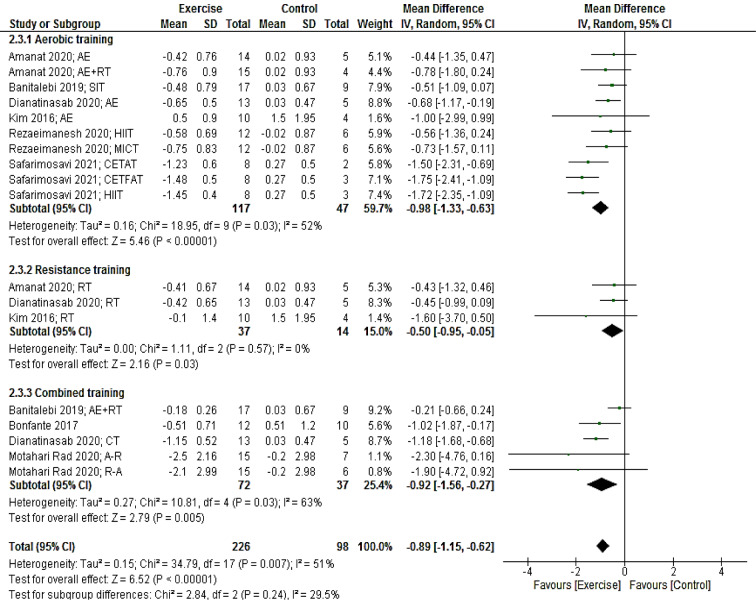
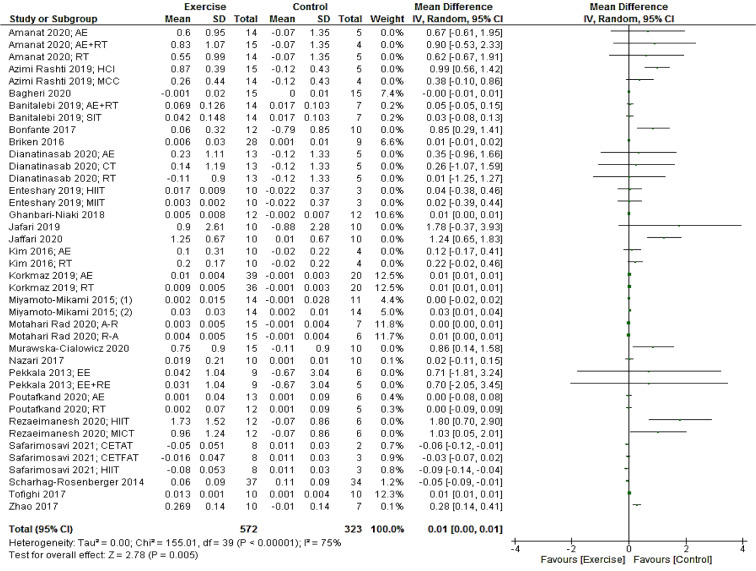
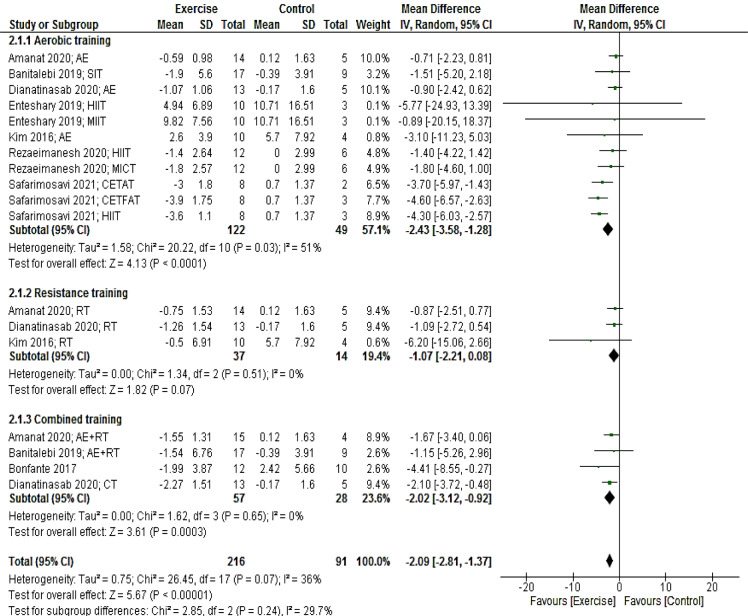
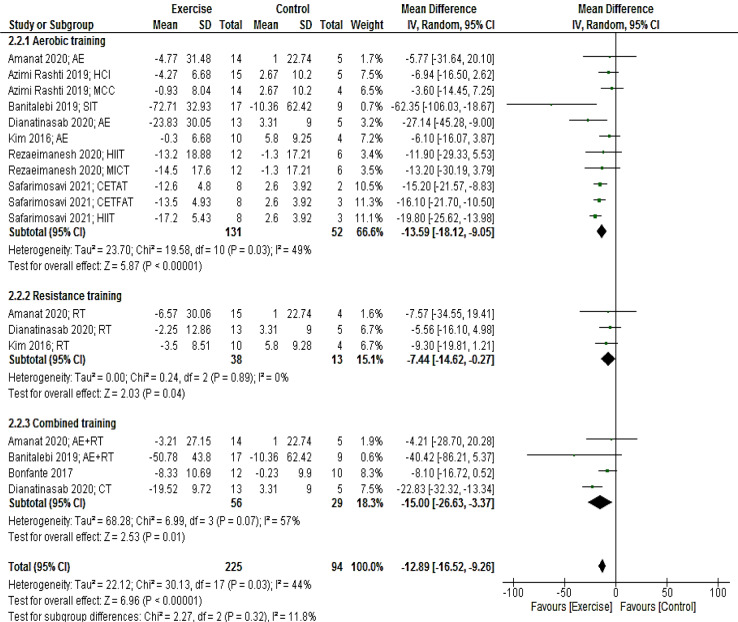
Irisin is a hormone that is offered to be a hopeful remedial target in obesity and type 2 diabetes. It has received striking attention recently, whereas, the interactions between exercise training and irisin are still unclear. Therefore, this systematic review and meta-analysis investigated the impacts of exercise interventions on circulating irisin in adults. A systematic search was conducted in PubMed, CINAHL, MEDLINE, Cochrane, Google Scholar, and Scopus up to July 15, 2021. Twenty-four studies, which assessed a total of 921 participants were included and analyzed using a random-effects model to estimate weighted mean differences (MD) with 95 % confidence intervals (CI). Overall, data revealed that exercise training significantly increased circulating irisin (MD: 0.01, 95 % CI: 0.00, 0.01, p = 0.005), and declined insulin (MD: -2.09, 95 % CI: -2.81, -1.37, p < 0.00001), glucose (MD: -12.89, 95 % CI: -16.52, -9.26, p < 0.00001), and insulin resistance (MD: -0.89, 95 % CI: -1.15, -0.62, p < 0.00001). Subgroup analysis revealed that irisin raised significantly when resistance training (p = 0.04) and combined training (p = 0.002) were applied, and for the type 2 diabetes and prediabetes (p = 0.002 for both) groups. Moreover, subgroup analysis by the type of intervention demonstrated that insulin reduced when aerobic training (p < 0.00001) and combined training (p = 0.0003) were employed, but glucose and HOMA-IR reduced after all three types of exercise training. These findings demonstrate that exercise interventions may produce ameliorations in circulating irisin. Further long-term studies are required to confirm these findings.
鸢尾素是一种有望成为肥胖症和2型糖尿病治疗靶点的激素。它最近受到了极大关注,然而,运动训练与鸢尾素之间的相互作用仍不清楚。因此,本系统评价和荟萃分析研究了运动干预对成年人循环鸢尾素的影响。截至2021年7月15日,在PubMed、CINAHL、MEDLINE、Cochrane、谷歌学术和Scopus中进行了系统检索。纳入了24项研究,共评估了921名参与者,并使用随机效应模型进行分析,以估计加权平均差(MD)和95%置信区间(CI)。总体而言,数据显示运动训练显著增加了循环鸢尾素(MD:0.01,95%CI:0.00,0.01,p = 0.005),并降低了胰岛素(MD:-2.09,95%CI:-2.81,-1.37,p < 0.00001)、血糖(MD:-12.89,95%CI:-16.52,-9.26,p < 0.00001)和胰岛素抵抗(MD:-0.89,95%CI:-1.15,-0.62,p < 0.00001)。亚组分析显示,当进行抗阻训练(p = 0.04)和联合训练(p = 0.002)时,以及在2型糖尿病和糖尿病前期组(两组p均 = 0.002)中,鸢尾素显著升高。此外,按干预类型进行的亚组分析表明,进行有氧训练(p < 0.00001)和联合训练(p = 0.0003)时胰岛素降低,但在所有三种类型的运动训练后血糖和稳态模型评估的胰岛素抵抗均降低。这些发现表明运动干预可能会改善循环鸢尾素水平。需要进一步的长期研究来证实这些发现。