
腹腔镜与开腹直肠切除术治疗直肠癌的短期临床结局:系统评价和荟萃分析。
Short-term clinical outcomes of laparoscopic vs open rectal excision for rectal cancer: A systematic review and meta-analysis.
机构信息
Department of Digestive, Hepatobiliary Surgery and Liver Transplantation, Henri Mondor University Hospital, AP-HP, Université Paris Est - UPEC, 94010 Créteil, France.
Rothschild Hospital, AP-HP, Université Paris VII, 75012 Paris, France.
出版信息
World J Gastroenterol. 2017 Nov 28;23(44):7906-7916. doi: 10.3748/wjg.v23.i44.7906.
AIM
To review evidence on the short-term clinical outcomes of laparoscopic (LRR) open rectal resection (ORR) for rectal cancer.
METHODS
A systematic literature search was performed using Cochrane Central Register, MEDLINE, EMBASE, Scopus, OpenGrey and ClinicalTrials.gov register for randomized clinical trials (RCTs) comparing LRR vs ORR for rectal cancer and reporting short-term clinical outcomes. Articles published in English from January 1, 1995 to June, 30 2016 that met the selection criteria were retrieved and reviewed. The Preferred Reporting Items for Systematic reviews and Meta-Analysis (PRISMA) statements checklist for reporting a systematic review was followed. Random-effect models were used to estimate mean differences and risk ratios. The robustness and heterogeneity of the results were explored by performing sensitivity analyses. The pooled effect was considered significant when < 0.05.
RESULTS
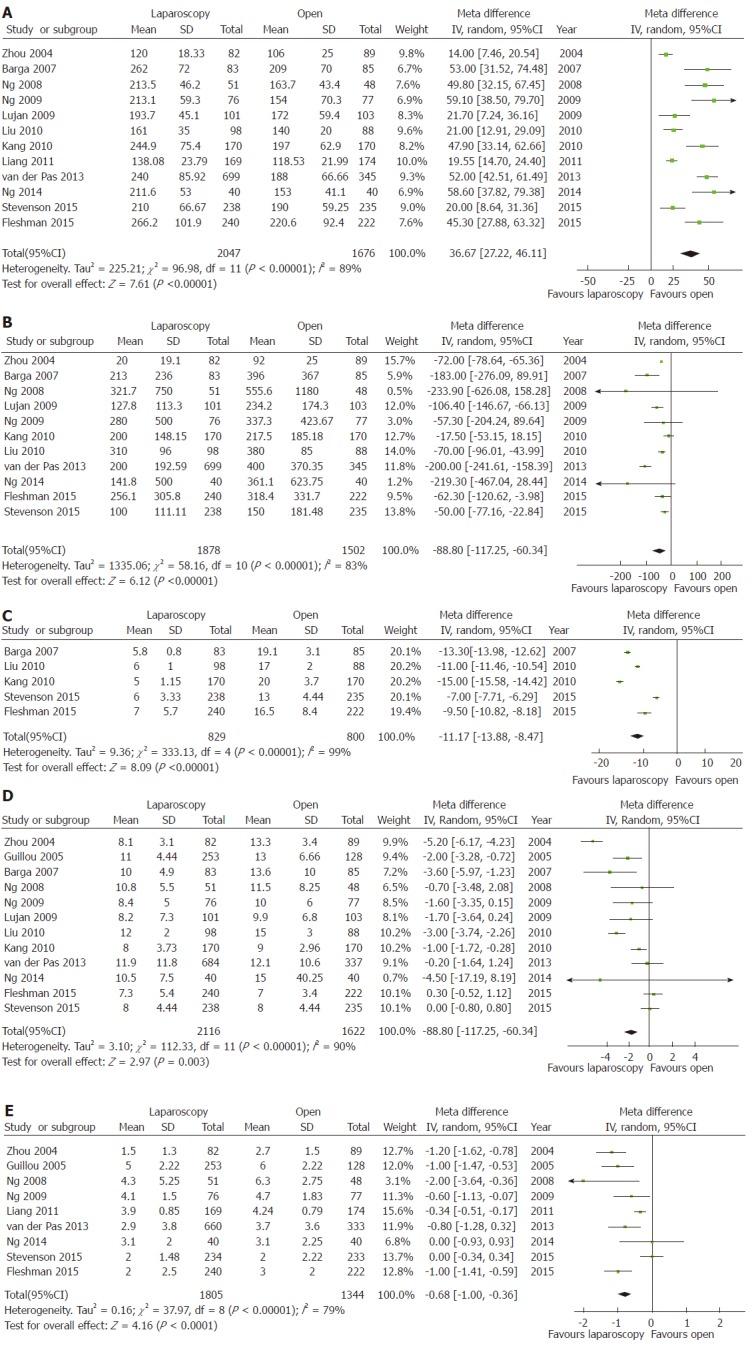
Overall, 14 RCTs were included. No differences were found in postoperative mortality ( = 0.19) and morbidity ( = 0.75) rates. The mean operative time was 36.67 min longer (95%CI: 27.22-46.11, < 0.00001), the mean estimated blood loss was 88.80 ml lower (95%CI: -117.25 to -60.34, < 0.00001), and the mean incision length was 11.17 cm smaller (95%CI: -13.88 to -8.47, < 0.00001) for LRR than ORR. These results were confirmed by sensitivity analyses that focused on the four major RCTs. The mean length of hospital stay was 1.71 d shorter (95%CI: -2.84 to -0.58, < 0.003) for LRR than ORR. Similarly, bowel recovery (., day of the first bowel movement) was 0.68 d shorter (95%CI: -1.00 to -0.36, < 0.00001) for LRR. The sensitivity analysis did not confirm a significant difference between LRR and ORR for these latter two parameters. The overall quality of the evidence was rated as high.
CONCLUSION
LRR is associated with lesser blood loss, smaller incision length, and longer operative times compared to ORR. No differences are observed for postoperative morbidity and mortality.
目的
综述腹腔镜(LRR)与开腹直肠切除术(ORR)治疗直肠癌短期临床结局的证据。
方法
采用系统检索 Cochrane 中央注册数据库、MEDLINE、EMBASE、Scopus、OpenGrey 和 ClinicalTrials.gov 登记处,检索比较 LRR 与 ORR 治疗直肠癌并报告短期临床结局的随机临床试验(RCT)。纳入符合标准的 1995 年 1 月 1 日至 2016 年 6 月 30 日发表的英文文献,并进行回顾。报告采用系统综述和荟萃分析(PRISMA)声明清单。采用随机效应模型估计均数差值和风险比。通过敏感性分析探索结果的稳健性和异质性。当 < 0.05 时,认为汇总效应有统计学意义。
结果
共纳入 14 项 RCT。两组术后死亡率( = 0.19)和发病率( = 0.75)无差异。LRR 的手术时间平均延长 36.67 分钟(95%CI:27.22-46.11, < 0.00001),估计失血量平均减少 88.80 ml(95%CI:-117.25 至 -60.34, < 0.00001),切口长度平均减少 11.17 cm(95%CI:-13.88 至 -8.47, < 0.00001)。这些结果通过重点关注四项主要 RCT 的敏感性分析得到了证实。LRR 的住院时间平均缩短 1.71 天(95%CI:-2.84 至 -0.58, < 0.003)。同样,LRR 的首次排便时间(首次排气时间)平均缩短 0.68 天(95%CI:-1.00 至 -0.36, < 0.00001)。敏感性分析未证实 LRR 与 ORR 在这两个参数上有显著差异。证据的总体质量被评为高。
结论
与 ORR 相比,LRR 术中出血量更少、切口更小、手术时间更长。两组术后发病率和死亡率无差异。

 Zotero 插件