Zhang Yuan, Sun Qiying, Yi Minhan, Zhou Xun, Guo Jifeng, Xu Qian, Tang Beisha, Yan Xinxiang
Department of Neurology, Xiangya Hospital, Central South University, Changsha, Hunan 410008, China.
Department of Geriatrics, Xiangya Hospital, Central South University, Changsha, Hunan 410008, China.
Parkinsons Dis. 2017;2017:8093124. doi: 10.1155/2017/8093124. Epub 2017 Oct 25.
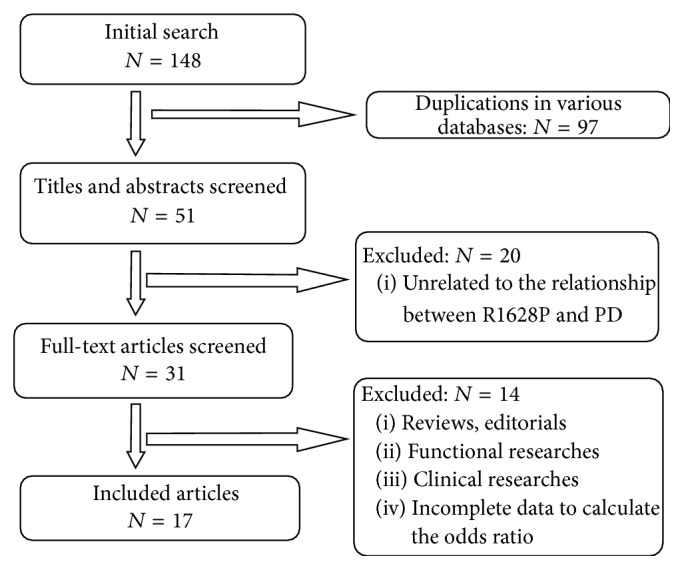
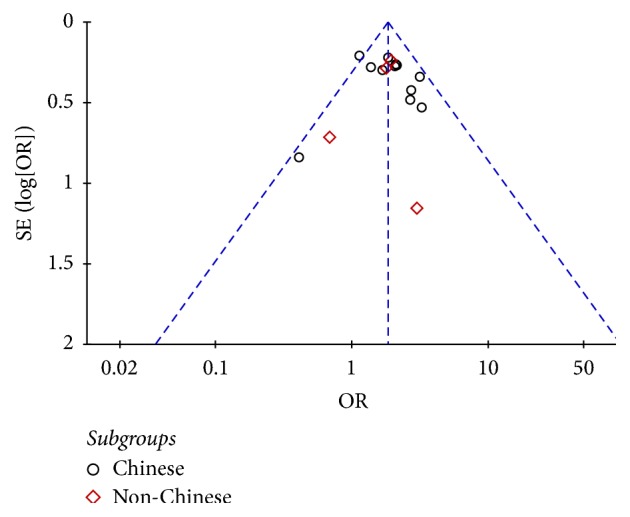
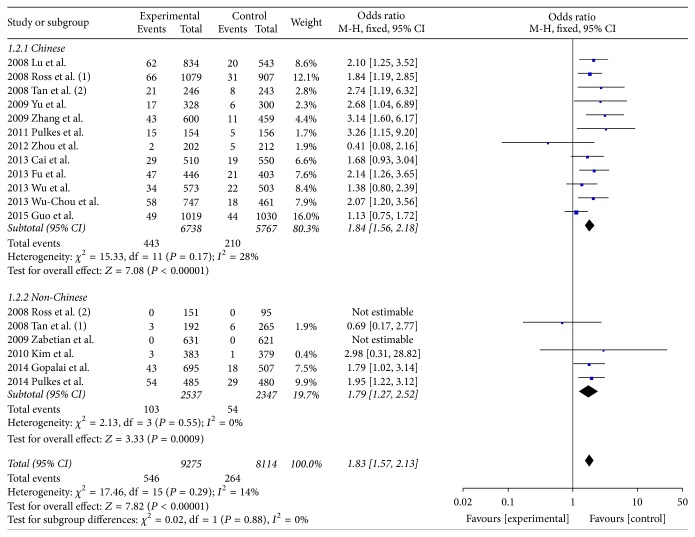
Although the etiology of Parkinson's disease (PD) remains unclear, there is increasing evidence of genetic factors contributing to the onset of PD. Various mutations and risk variants of the gene have been reported, but the association between R1628P and PD is still inconsistent. Thus, we conducted a meta-analysis to determine the potential relationship between R1628P and PD. Our study sample was an aggregate of 17 publications, which in total consisted of 9,275 PD patients and 8,114 controls. All of these articles are of high quality according to NOS, and there was no obvious reporting bias or heterogeneity. In a general Asian population, the pooled OR of the risk genotype contrasts was 1.83 (95% CI: 1.57, 2.13). When stratified by ethnicity, the pooled ORs were 1.84 (95% CI: 1.56, 2.18) in a Chinese population and 1.79 (95% CI: 1.27, 2.52) in a non-Chinese population. Our study suggests that R1628P appears to be a risk factor for PD in Asian populations, both Chinese and non-Chinese.
尽管帕金森病(PD)的病因仍不明确,但越来越多的证据表明遗传因素与PD的发病有关。已报道了该基因的各种突变和风险变异,但R1628P与PD之间的关联仍不一致。因此,我们进行了一项荟萃分析,以确定R1628P与PD之间的潜在关系。我们的研究样本是17篇出版物的汇总,总共包括9275例PD患者和8114例对照。根据NOS,所有这些文章质量都很高,并且没有明显的报告偏倚或异质性。在一般亚洲人群中,风险基因型对比的合并OR为1.83(95%CI:1.57,2.13)。按种族分层时,中国人群的合并OR为1.84(95%CI:1.56,2.18),非中国人群的合并OR为1.79(95%CI:1.27,2.52)。我们的研究表明,R1628P似乎是亚洲人群(包括中国人和非中国人)患PD的一个风险因素。