Al-Hihi Eyad, Shankweiler Caylin, Stricklen David, Gibson Cheryl, Dunn Winston
Department of General and Geriatric Medicine, The University of Kansas Health System, Kansas, USA.
Department of Organizational Improvement, The University of Kansas Health System, Kansas, USA.
BMJ Open Qual. 2017 Oct 21;6(2):e000084. doi: 10.1136/bmjoq-2017-000084. eCollection 2017.
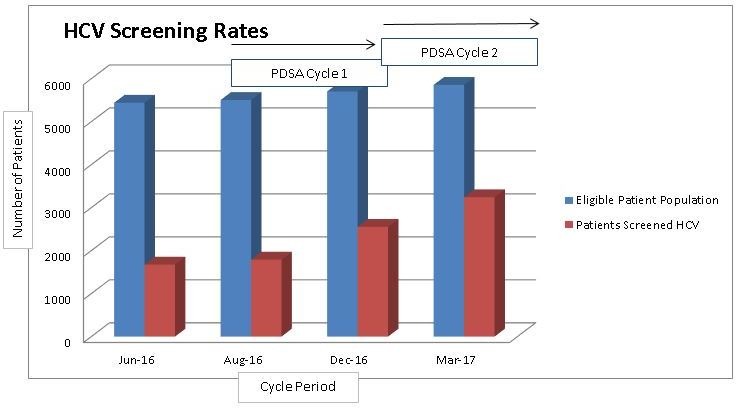
This project aims to implement the HCV birth cohort screening guidelines over a 9-month period in the primary care setting at the University of Kansas Health System General Internal Medicine Division. The project team measured the number of patients in the baby boomer population who received a one-time screen for HCV. An electronic medical record (EMR) intervention was implemented to identify baby boomers who did not have an HCV screening or diagnosis. Additionally, education was provided to all primary care providers in the clinic to increase awareness of the HCV birth cohort screening.
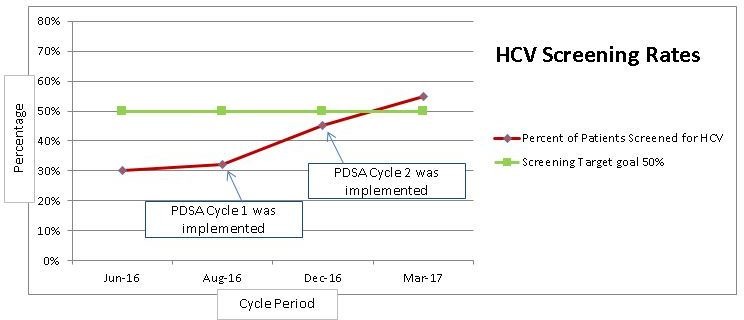
The quality improvement methods increased the percentage of baby boomers who obtained a one-time screening test for HCV from a baseline of 30% to a 55% screening rate during the nine-month project period.
Identifying the HCV screening needs and creating a visual reminder in the EMR can be used to facilitate sustainable awareness and improvement of screening rates. The project team recognizes that continued work is required to close the HCV screening care gaps in the primary care setting.
本项目旨在堪萨斯大学健康系统普通内科部门的初级保健环境中,在9个月的时间内实施丙型肝炎出生队列筛查指南。项目团队统计接受过一次丙型肝炎筛查的婴儿潮一代患者数量。实施了电子病历(EMR)干预措施,以识别未进行丙型肝炎筛查或诊断的婴儿潮一代。此外,还为诊所的所有初级保健提供者提供了教育,以提高对丙型肝炎出生队列筛查的认识。
质量改进方法使接受丙型肝炎一次性筛查测试的婴儿潮一代比例从基线的30%提高到了9个月项目期间的55%筛查率。
识别丙型肝炎筛查需求并在电子病历中创建视觉提醒,可用于促进持续的认识并提高筛查率。项目团队认识到,需要继续努力缩小初级保健环境中丙型肝炎筛查护理差距。