Department of Urology, Polytechnic University of Marche Region, University Hospital "Ospedali Riuniti", Ancona, Italy.
Int Braz J Urol. 2018 Mar-Apr;44(2):362-369. doi: 10.1590/S1677-5538.IBJU.2017.0298.
Non-palpable isolated septal plaques of the penis are likely present in a significant number of patients affected by erectile dysfunction (ED) and penile pain without deformity or curvature. The aim of this study was to evaluate the ultrasound (US) patterns observed in patients investigated for ED or penile pain without curvature.
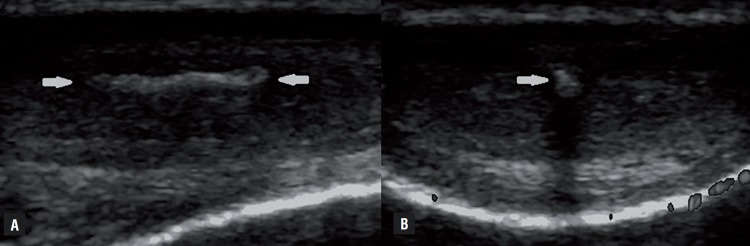
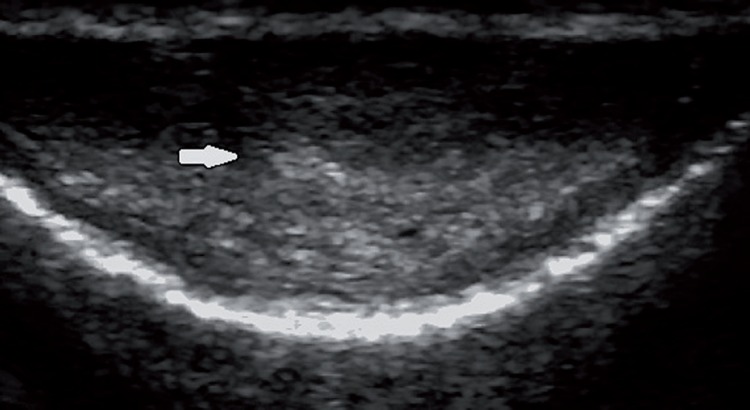
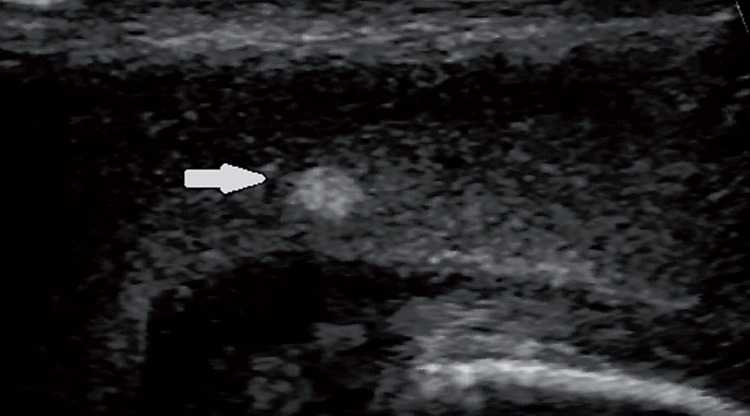
We reviewed the medical records of 386 patients who underwent an initial colour-Doppler ultrasonography (CDU) of the penis for DE and/or penile pain without curvature. After satisfying inclusion criteria, 41 patients were individualized. All patients had a non-palpable plaque with involvement of the penile septum. Three US patterns were identified: focal hyperecoic thickening of the intercavernosum septum (IS) with acoustic shadow (pattern 1), non-calcified thickening (isoechoic or slightly hyperechoic (pattern 2), and microcalcifications in the IS without associated acoustic shadow (pattern 3).
Patients' mean age was 51.3±16.7. ED was the predominant disorder in 73.2% of patients, followed by penile pain and length loss in 19.5% and 7.3% of patients, respectively. 32(78.1%) patients showed the pattern 1, 6 (14.6%) pattern 2, and 3 (7.3%) pattern 3. Plaques size varied from 3 to 13 mm. The penile hemodynamic response to CDU reported abnormal findings distally to the septal plaques in 20 patients (<25cm/sec). Median left and right cavernosum artery flows measured a peak systolic velocity of 31cm/sec and 33 cm/sec, respectively.
We believe that an US study with CDU provides a way to characterize, localize, and deliver treatment choice in patients with Peyronie's Disease.
在许多患有勃起功能障碍(ED)和阴茎疼痛而无畸形或弯曲的患者中,可能存在大量无法触及的孤立的阴茎隔斑。本研究旨在评估因 ED 或无弯曲阴茎疼痛而接受检查的患者的超声(US)模式。
我们回顾了 386 名因 DE 和/或无弯曲阴茎疼痛而接受初始彩色多普勒超声(CDU)检查的患者的病历。在满足纳入标准后,对 41 名患者进行了个体化分析。所有患者均存在累及阴茎隔的无法触及的斑块。确定了三种 US 模式:海绵体隔局灶性强回声增厚伴声影(模式 1)、无钙化性增厚(等回声或稍高回声(模式 2)和 IS 中的微钙化而无相关声影(模式 3)。
患者的平均年龄为 51.3±16.7。ED 是 73.2%患者的主要疾病,其次是阴茎疼痛和长度损失,分别占 19.5%和 7.3%的患者。32(78.1%)例患者表现为模式 1,6(14.6%)例患者表现为模式 2,3(7.3%)例患者表现为模式 3。斑块大小从 3 到 13 毫米不等。 CDU 报告海绵体血流动力学反应异常,在隔斑远端 20 例患者(<25cm/sec)。左侧和右侧海绵体动脉的峰值收缩速度分别为 31cm/sec 和 33cm/sec。
我们认为 CDU 的 US 研究为患者提供了一种对 Peyronie 病进行特征描述、定位和治疗选择的方法。