Department of Biotechnology, IPEN-CNEN/SP, São Paulo, Brazil.
Department of Pharmacy, Faculty of Pharmaceutical Sciences, University of São Paulo, São Paulo, Brazil.
Oncol Res. 2018 Jun 11;26(5):743-751. doi: 10.3727/096504017X15120379906339. Epub 2017 Dec 1.
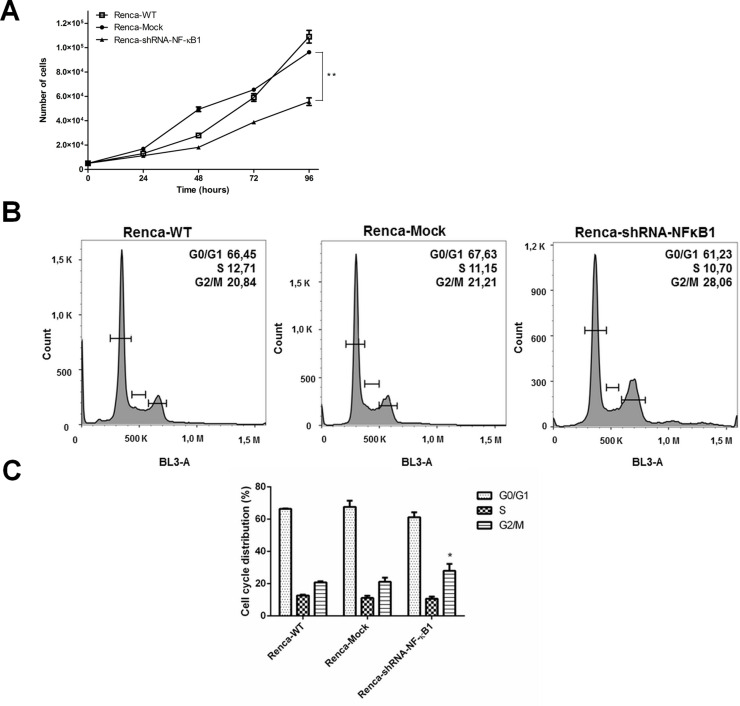
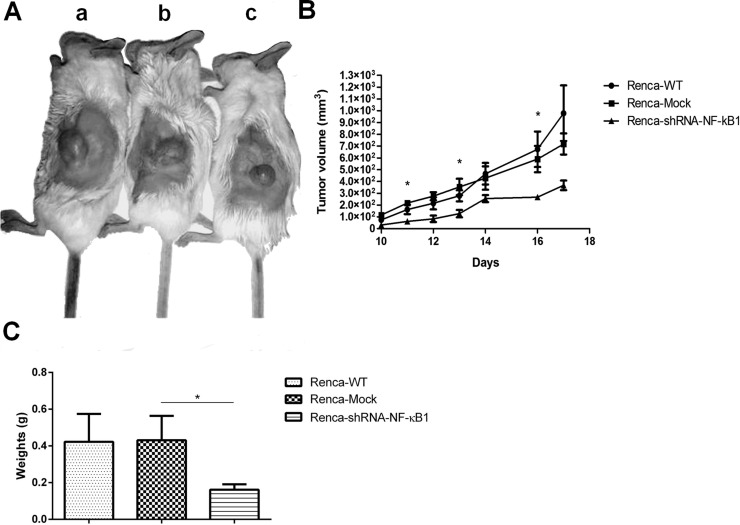
Renal cell carcinoma (RCC) accounts for approximately 2%-3% of human malignancies and is the most aggressive among urologic tumors. Biological heterogeneity, drug resistance, and chemotherapy side effects are the biggest obstacles to the effective treatment of RCC. The NF-κB transcription factor is one of several molecules identified to be responsible for the aggressive phenotype of this tumor. In the past decade, several studies have demonstrated the activation of NF-κB in RCC, and many have implicated NF-κB1 (p50) as an important molecule in tumor progression and metastasis. In the present study, a lentivirus was used to deliver shRNA targeting NF-κB1 into mouse RCC (Renca) cells. It was determined that the knockdown of the NF-κB1 gene led to a reduction in cell proliferation and late apoptosis/necrosis in vitro. Flow cytometry analysis demonstrated G2/M arrest in the cells. In addition, immunoblotting analysis revealed a significant increase in cyclin B1 and Bax. In vivo experiments showed that Renca-shRNA-NF-κB1 cells have significantly diminished tumorigenicity. Moreover, immunohistochemical analysis revealed an increase in necrotic areas of Renca-shRNA-NF-κB1 tumors. Thus, this study indicates that downregulation of NF-κB1 can suppress RCC tumorigenesis by inducing late apoptosis/necrosis. Therefore, NF-κB1 may be a potential therapeutic target for RCC.
肾细胞癌 (RCC) 约占人类恶性肿瘤的 2%-3%,是泌尿系统肿瘤中最具侵袭性的一种。生物学异质性、耐药性和化疗副作用是有效治疗 RCC 的最大障碍。NF-κB 转录因子是被确定负责这种肿瘤侵袭表型的几个分子之一。在过去的十年中,几项研究表明 NF-κB 在 RCC 中被激活,许多研究表明 NF-κB1(p50)是肿瘤进展和转移的重要分子。在本研究中,使用慢病毒将靶向 NF-κB1 的 shRNA 递送至小鼠 RCC(Renca)细胞中。结果表明,NF-κB1 基因的敲低导致体外细胞增殖减少和晚期细胞凋亡/坏死。流式细胞术分析显示细胞出现 G2/M 期阻滞。此外,免疫印迹分析显示细胞周期蛋白 B1 和 Bax 显著增加。体内实验表明 Renca-shRNA-NF-κB1 细胞的致瘤性明显降低。此外,免疫组织化学分析显示 Renca-shRNA-NF-κB1 肿瘤的坏死区域增加。因此,本研究表明下调 NF-κB1 可以通过诱导晚期细胞凋亡/坏死来抑制 RCC 肿瘤发生。因此,NF-κB1 可能是 RCC 的一个潜在治疗靶点。