
比较该物种地表形态和洞穴形态的生长情况:来自鳞片的见解。
Comparing growth in surface and cave morphs of the species : insights from scales.
作者信息
Simon Victor, Elleboode Romain, Mahé Kélig, Legendre Laurent, Ornelas-Garcia Patricia, Espinasa Luis, Rétaux Sylvie
机构信息
Paris-Saclay Institute of Neuroscience, CNRS UMR9197, Avenue de la terrasse, 91198 Gif-sur-Yvette, France.
Université Paris Sud and Paris-Saclay, Orsay, France.
出版信息
Evodevo. 2017 Dec 1;8:23. doi: 10.1186/s13227-017-0086-6. eCollection 2017.
BACKGROUND
Life in the darkness of caves is accompanied, throughout phyla, by striking phenotypic changes including the loss or severe reduction in eyes and pigmentation. On the other hand, cave animals have undergone constructive changes, thought to be adaptive, to survive in this extreme environment. The present study addresses the question of the evolution of growth in caves, taking advantage of the comparison between the river-dwelling and the cave-dwelling morphs of the Mexican tetra, .
RESULTS
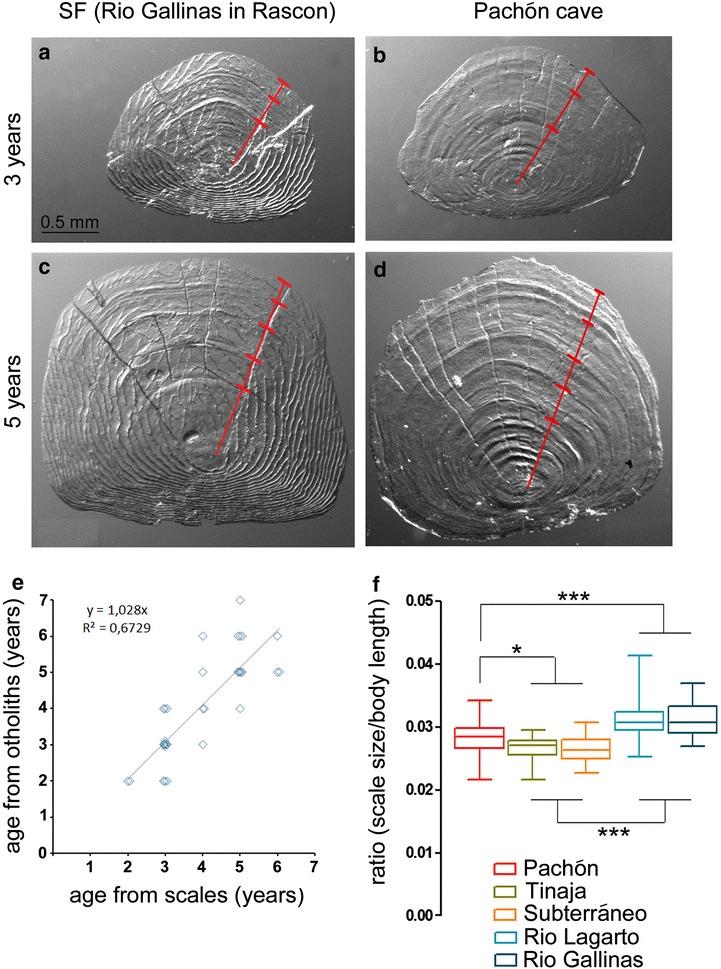
A sclerochronology approach was undertaken to document the growth of the species in these two very distinct habitats. Scales from 158 wild specimens were analyzed from three caves (Pachón, Tinaja and Subterráneo) and two rivers (Rio Gallinas and Arroyo Lagarto) in San Luis Potosi and Tamaulipas, Mexico. A 10-13% reduction in scales size was observed in the cave morphs compared to the surface morphs. Age could be reliably inferred from annual growth increments on the scales from the two morphs of the species. Further comparisons with growth curves in laboratory conditions, obtained using the von Bertalanffy growth model, were also performed. In the wild and in the laboratory, cavefish originating from the Pachón cave reached smaller sizes than surface fish from three different locations: Rio Gallinas and Arroyo Lagarto (wild sampling) and Texas (laboratory population), respectively. Wild Pachón cavefish also seemed to grow to smaller sizes than the two other wild cavefish populations studied, Tinaja and Subterráneo. Finally, growth in the laboratory was faster than in the wild, particularly in the two first years of life.
CONCLUSIONS
These data suggest that cavefish originating from the Pachón cave are subjected to an intrinsic limitation of their final size, which is at least in part independent from energy/food availability. This growth limitation may be an advantageous way of limiting energy expenditure and food needs in the cave environment. Moreover, growth regulation evolved differently in independently evolved cave populations. These results are discussed with regard to the sources of energy or general ecological conditions present in caves, and to the differences in behavior or feeding skills known in cavefish.
背景
在洞穴的黑暗环境中,各个动物门类的生物都伴随着显著的表型变化,包括眼睛退化或严重缩小以及色素沉着消失。另一方面,洞穴动物也经历了一些被认为是适应性的结构性变化,以便在这种极端环境中生存。本研究利用墨西哥丽脂鲤在河流环境和洞穴环境中的形态差异,探讨洞穴生物生长进化的问题。
结果
采用硬组织年代学方法记录该物种在这两种截然不同的栖息地中的生长情况。对来自墨西哥圣路易斯波托西州和塔毛利帕斯州的三个洞穴(帕琼洞、蒂纳亚洞和地下洞)以及两条河流(加利纳斯河和拉加托河)的158个野生样本的鳞片进行了分析。与地表形态相比,洞穴形态的鳞片尺寸减小了10 - 13%。通过物种两种形态鳞片上的年度生长增量可以可靠地推断年龄。还进一步比较了使用冯·贝塔朗菲生长模型在实验室条件下获得的生长曲线。在野外和实验室中,来自帕琼洞的洞穴鱼达到的体型比来自三个不同地点的地表鱼小:分别是加利纳斯河和拉加托河(野生样本)以及得克萨斯州(实验室种群)。野生的帕琼洞洞穴鱼似乎也比所研究的其他两个野生洞穴鱼种群(蒂纳亚洞和地下洞)长得更小。最后,在实验室中的生长速度比在野外快,尤其是在生命的头两年。
结论
这些数据表明,来自帕琼洞的洞穴鱼最终体型受到内在限制,这至少部分独立于能量/食物供应情况。这种生长限制可能是在洞穴环境中限制能量消耗和食物需求的一种有利方式。此外,在独立进化的洞穴种群中,生长调节的进化方式有所不同。结合洞穴中存在的能量来源或一般生态条件,以及洞穴鱼已知的行为或摄食技能差异,对这些结果进行了讨论。




 Zotero 插件