Research Institute of Bacterial Resistance and Department of Laboratory Medicine, Yonsei University College of Medicine, Seoul, Korea.
Brain Korea 21 PLUS Project for Medical Science, Yonsei University, Seoul, Korea.
Ann Lab Med. 2018 Mar;38(2):110-118. doi: 10.3343/alm.2018.38.2.110.
Diverse microbiota exist in the lower respiratory tract. Although next generation sequencing (NGS) is the most widely used microbiome analysis technique, it is difficult to implement NGS in clinical microbiology laboratories. Therefore, we evaluated the performance of conventional culture methods together with matrix-assisted laser desorption/ionization time-of-flight mass spectrometry (MALDI-TOF MS) in identifying microbiota in bronchoalveolar lavage (BAL) fluid.
BAL fluid samples (n=27) were obtained from patients undergoing diagnostic bronchoscopy for lung mass evaluation. Bacterial and fungal culture was performed with conventional media used in clinical microbiology laboratories. On an average, 20 isolated colonies were picked from each agar plate and identified by MALDI-TOF MS. Microbiome analysis using 16S rRNA NGS was conducted for comparison.
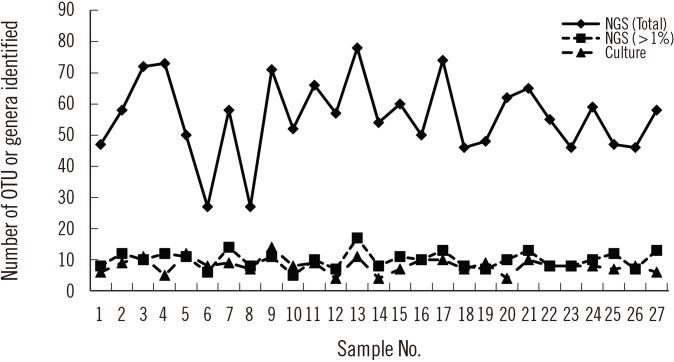
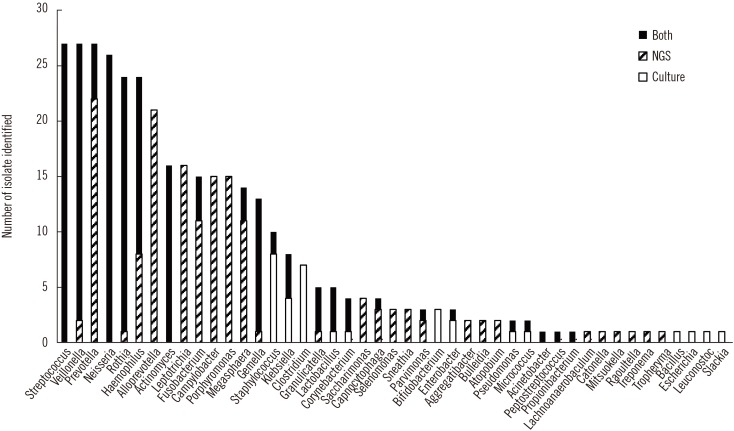
Streptococcus spp. and Neisseria spp. were most frequently cultured from the BAL fluid samples. In two samples, Enterobacteriaceae grew predominantly on MacConkey agar. Actinomyces and Veillonella spp. were commonly identified anaerobes; gut bacteria, such as Lactobacillus, Bifidobacterium, and Clostridium, and fungi were also isolated. NGS revealed more diverse bacterial communities than culture, and Prevotella spp. were mainly identified solely by NGS. Some bacteria, such as Staphylococcus spp., Clostridium spp., and Bifidobacterium spp., were identified solely by culture, indicating that culture may be more sensitive for detecting certain bacteria.
Culture and NGS of BAL fluid samples revealed common bacteria with some different microbial communities. Despite some limitations, culture combined with MALDI-TOF MS might play a complementary role in microbiome analysis using 16S rRNA NGS.
下呼吸道存在多样的微生物群。虽然下一代测序(NGS)是最广泛使用的微生物组分析技术,但在临床微生物学实验室中实施 NGS 具有一定难度。因此,我们评估了常规培养方法与基质辅助激光解吸/电离飞行时间质谱(MALDI-TOF MS)联合应用于鉴定支气管肺泡灌洗液(BAL)中微生物群的性能。
从接受肺部肿块评估诊断性支气管镜检查的患者中获取 BAL 液样本(n=27)。使用临床微生物学实验室中常规的培养基进行细菌和真菌培养。平均而言,从每个琼脂平板上挑取 20 个分离菌落,并通过 MALDI-TOF MS 进行鉴定。进行 16S rRNA NGS 微生物组分析以作比较。
BAL 液样本中最常培养到的细菌是链球菌属和奈瑟菌属。在两个样本中,大肠埃希菌在麦康凯琼脂上生长占优势。放线菌属和韦荣球菌属是常见的厌氧菌;还分离到肠道细菌,如乳酸杆菌属、双歧杆菌属和梭菌属,以及真菌。NGS 揭示的细菌群落比培养更具多样性,普雷沃菌属主要通过 NGS 鉴定。某些细菌,如金黄色葡萄球菌属、梭菌属和双歧杆菌属,仅通过培养鉴定,表明培养法可能对某些细菌的检测更敏感。
BAL 液样本的培养和 NGS 揭示了具有一些不同微生物群落的常见细菌。尽管存在一些局限性,但培养联合 MALDI-TOF MS 可能在 16S rRNA NGS 微生物组分析中发挥互补作用。