Lenk Kathleen M, Erickson Darin J, Forster Jean L
1 Division of Epidemiology and Community Health, School of Public Health, University of Minnesota, Minneapolis, MN, USA.
Am J Health Promot. 2018 Jun;32(5):1214-1220. doi: 10.1177/0890117117696358. Epub 2017 Mar 6.
To identify trajectories of smoking behaviors of a cohort of youth followed through young adulthood from 2000 to 2013.
The Minnesota Adolescent Community Cohort study, a population-based cohort study.
Nationwide, originating in the Midwestern United States.
Cohort of youth surveyed for 14 years beginning at ages 12 to 16 (N = 4241 at baseline; 59% recruitment rate).
Main variable of interest was the number of days smoked in the past 30 days. Also included time-varying and time-invariant covariates.
We utilized growth mixture modeling to group individuals into trajectories over time.
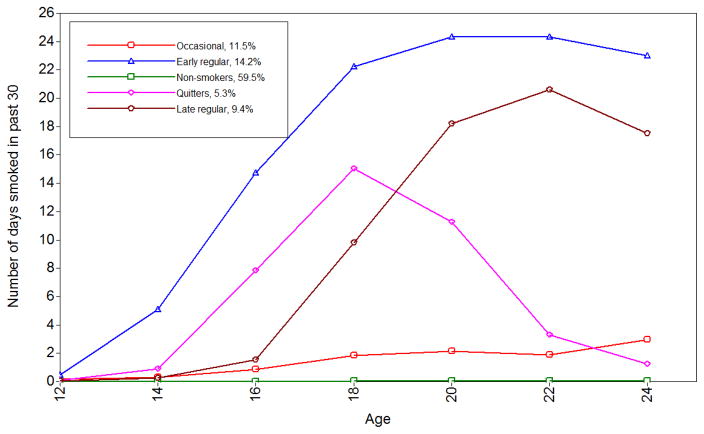
We identified 5 distinct trajectories: nonsmokers (59.5%), early-onset regular smokers (14.2%), occasional smokers (11.5%), late-onset regular smokers (9.4%), and quitters (5.3%). Adjusted models showed that early- and late-onset regular smokers (compared to nonsmokers) had lower odds of attending or graduating from a 4-year college ( P < .05). Participants in all smoking classes compared to nonsmokers had greater odds of having more close friends who smoked ( P < .05).
Our results show that individuals in their teens through young adulthood can be classified into 5 smoking trajectories. More people in this age range remained abstainers than found in most previous studies; however, a sizable group was identified as regular smokers by the time they reached young adulthood. Interventions targeted at teens, including those that address social and environmental influences, are clearly still needed to prevent escalation of smoking as they move toward young adulthood.
确定2000年至2013年一组青年从青少年期到成年早期的吸烟行为轨迹。
明尼苏达青少年社区队列研究,一项基于人群的队列研究。
美国全国范围,起源于美国中西部。
一组从12至16岁开始接受了14年调查的青年(基线时N = 4241;招募率59%)。
主要关注变量是过去30天内吸烟的天数。还包括随时间变化和不随时间变化的协变量。
我们利用生长混合模型随时间将个体分组为不同轨迹。
我们确定了5种不同的轨迹:不吸烟者(59.5%)、早发型规律吸烟者(14.2%)、偶尔吸烟者(11.5%)、晚发型规律吸烟者(9.4%)和戒烟者(5.3%)。调整后的模型显示,早发型和晚发型规律吸烟者(与不吸烟者相比)进入四年制大学就读或毕业的几率较低(P < .05)。与不吸烟者相比,所有吸烟类别中的参与者有更多吸烟密友的几率更高(P < .05)。
我们的结果表明,十几岁到成年早期的个体可分为5种吸烟轨迹。与大多数先前研究相比,这个年龄范围内更多的人保持不吸烟;然而,相当大的一部分人在成年早期被确定为规律吸烟者。显然仍需要针对青少年的干预措施,包括那些应对社会和环境影响的措施,以防止他们在步入成年早期时吸烟情况的升级。