School of Biological Sciences, Georgia Institute of Technology, Atlanta, Georgia, USA.
IHRC-Georgia Tech Applied Bioinformatics Laboratory, Atlanta, Georgia, USA.
Sci Rep. 2017 Dec 7;7(1):17127. doi: 10.1038/s41598-017-17380-4.
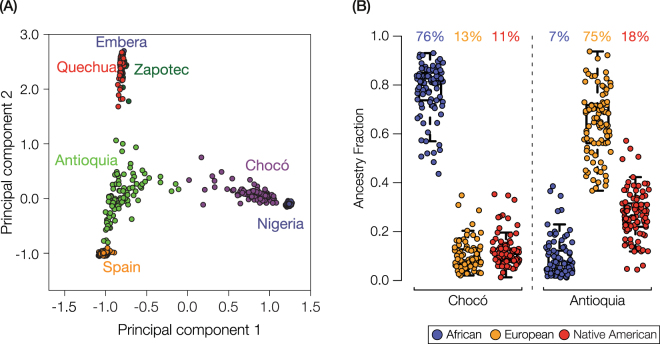
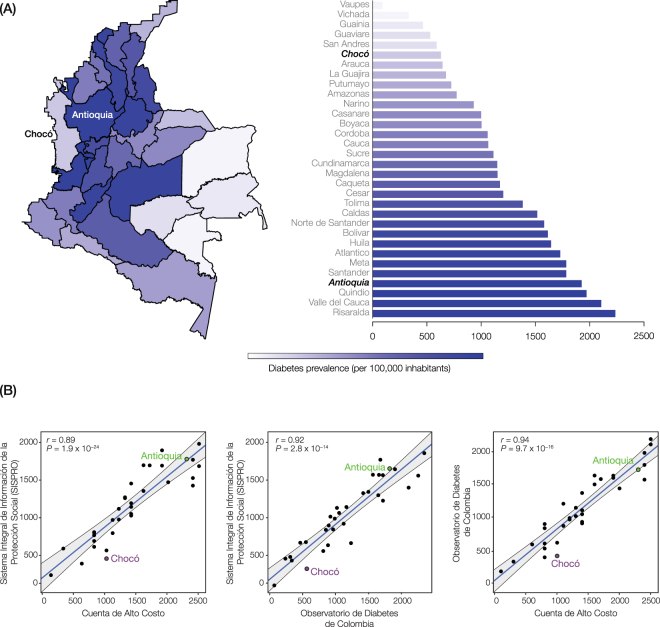
Differences in genetic ancestry and socioeconomic status (SES) among Latin American populations have been linked to health disparities for a number of complex diseases, such as diabetes. We used a population genomic approach to investigate the role that genetic ancestry and socioeconomic status (SES) play in the epidemiology of type 2 diabetes (T2D) for two Colombian populations: Chocó (Afro-Latino) and Antioquia (Mestizo). Chocó has significantly higher predicted genetic risk for T2D compared to Antioquia, and the elevated predicted risk for T2D in Chocó is correlated with higher African ancestry. Despite its elevated predicted genetic risk, the population of Chocó has a three-times lower observed T2D prevalence than Antioquia, indicating that environmental factors better explain differences in T2D outcomes for Colombia. Chocó has substantially lower SES than Antioquia, suggesting that low SES in Chocó serves as a protective factor against T2D. The combination of lower prevalence of T2D and lower SES in Chocó may seem surprising given the protective nature of elevated SES in many populations in developed countries. However, low SES has also been documented to be a protective factor in rural populations in less developed countries, and this appears to be the case when comparing Chocó to Antioquia.
拉丁美洲人群的遗传背景和社会经济地位(SES)差异与多种复杂疾病(如糖尿病)的健康差异有关。我们使用群体基因组学方法研究了遗传背景和社会经济地位(SES)在哥伦比亚两个人群中的 2 型糖尿病(T2D)流行病学中的作用:乔科(非裔拉丁裔)和安提奥基亚(混血)。与安提奥基亚相比,乔科的 T2D 预测遗传风险显著更高,而乔科 T2D 的升高预测风险与更高的非洲血统相关。尽管乔科的预测遗传风险较高,但该地区的 T2D 患病率却比安提奥基亚低三倍,这表明环境因素更好地解释了哥伦比亚 T2D 结果的差异。乔科的 SES 明显低于安提奥基亚,这表明乔科的 SES 较低是 T2D 的保护因素。考虑到 SES 升高在许多发达国家的许多人群中具有保护作用,乔科的 T2D 患病率和 SES 较低的组合似乎令人惊讶。然而,在欠发达国家的农村人口中,低 SES 也被记录为保护因素,在将乔科与安提奥基亚进行比较时,情况似乎就是如此。