Bognar Zita, Fekete Katalin, Antus Csenge, Hocsak Eniko, Bognar Rita, Tapodi Antal, Boronkai Arpad, Farkas Nelli, Gallyas Ferenc, Sumegi Balazs, Szanto Arpad
Department of Biochemistry and Medical Chemistry, University of Pecs, Pecs, Hungary.
Department of Oncotherapy, University of Pecs, Pecs, Hungary.
PLoS One. 2017 Dec 8;12(12):e0189470. doi: 10.1371/journal.pone.0189470. eCollection 2017.
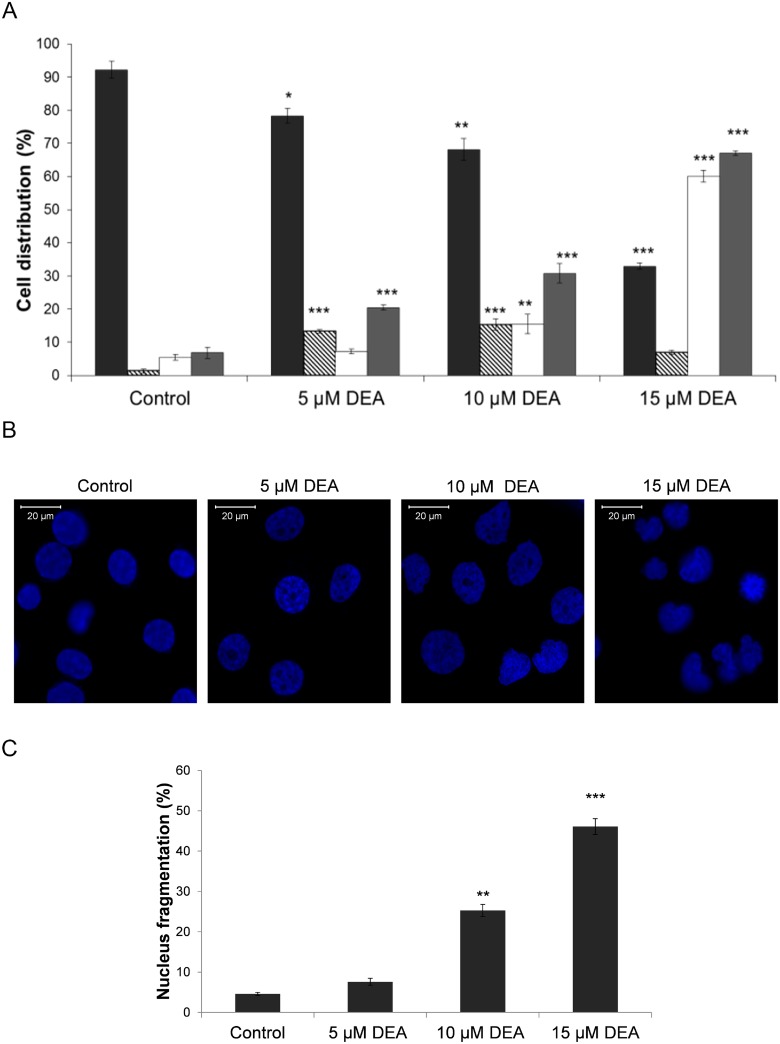
Bladder cancer (BC) is a common malignancy of the urinary tract that has a higher frequency in men than in women. Cytostatic resistance and metastasis formation are significant risk factors in BC therapy; therefore, there is great interest in overcoming drug resistance and in initiating research for novel chemotherapeutic approaches. Here, we suggest that desethylamiodarone (DEA)-a metabolite of amiodarone-may have cytostatic potential. DEA activates the collapse of mitochondrial membrane potential (detected by JC-1 fluorescence), and induces cell death in T24 human transitional-cell bladder carcinoma cell line at physiologically achievable concentrations. DEA induces cell cycle arrest in the G0/G1 phase, which may contribute to the inhibition of cell proliferation, and shifts the Bax/Bcl-2 ratio to initiate apoptosis, induce AIF nuclear translocation, and activate PARP-1 cleavage and caspase-3 activation. The major cytoprotective kinases-ERK and Akt-are inhibited by DEA, which may contribute to its cell death-inducing effects. DEA also inhibits the expression of B-cell-specific Moloney murine leukemia virus integration site 1 (BMI1) and reduces colony formation of T24 bladder carcinoma cells, indicating its possible inhibitory effect on metastatic potential. These data show that DEA is a novel anti-cancer candidate of multiple cell death-inducing effects and metastatic potential. Our findings recommend further evaluation of its effects in clinical studies.
膀胱癌(BC)是一种常见的泌尿系统恶性肿瘤,男性发病率高于女性。细胞抑制耐药性和转移形成是BC治疗中的重要风险因素;因此,克服耐药性以及开展新型化疗方法的研究备受关注。在此,我们提出胺碘酮的代谢产物去乙基胺碘酮(DEA)可能具有细胞抑制潜力。DEA可激活线粒体膜电位的崩溃(通过JC-1荧光检测),并在生理可达到的浓度下诱导T24人移行细胞膀胱癌细胞系的细胞死亡。DEA诱导细胞周期停滞在G0/G1期,这可能有助于抑制细胞增殖,并改变Bax/Bcl-2比值以启动凋亡、诱导AIF核转位以及激活PARP-1裂解和caspase-3激活。主要的细胞保护激酶——ERK和Akt——被DEA抑制,这可能有助于其诱导细胞死亡的作用。DEA还抑制B细胞特异性莫洛尼鼠白血病病毒整合位点1(BMI1)的表达,并减少T24膀胱癌细胞的集落形成,表明其对转移潜能可能具有抑制作用。这些数据表明DEA是一种具有多种诱导细胞死亡作用和转移潜能的新型抗癌候选物。我们的研究结果建议在临床研究中进一步评估其作用。