Department of Pediatrics, Division of Hematology/Oncology, Vanderbilt-Meharry Center for Excellence in Sickle Cell Disease, Vanderbilt University Medical Center, Nashville, Tennessee.
Department of Pediatrics, Division of Pediatric Pulmonary and Allergy, Boston University School of Medicine, Boston, Massachusetts.
Am J Hematol. 2018 Mar;93(3):408-415. doi: 10.1002/ajh.25003. Epub 2018 Jan 25.
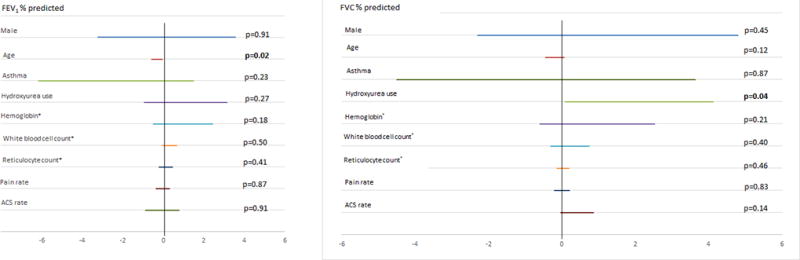
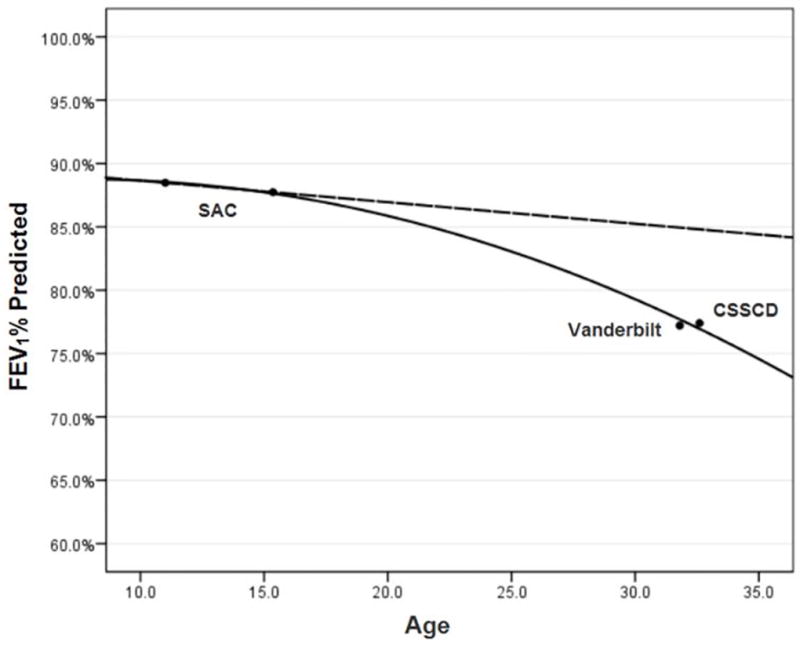
The longitudinal pattern of lung function in children with sickle cell anemia (SCA) has shown a decrease in FEV % predicted, a risk factor for death in adults with SCA, but predictors for this decline are poorly characterized. In a prospective longitudinal multi-center cohort of children with SCA, we tested the hypotheses that: (1) FEV % predicted declines over time; and (2) SCA-specific characteristics and therapy predict this decline. At three clinical centers, children with SCA (HbSS or HbSβ thalassemia), unselected for respiratory disease, were enrolled in the Sleep and Asthma Cohort (SAC) study. Study-certified pulmonary function technicians performed spirometry and lung volumes. Each assessment was reviewed centrally. Predicted values were determined for TLC, FEV , FVC, and FEV /FVC ratio. A total of 197 participants, mean age 11.0 years at first testing (range 4-19.3 years), had a minimum of three spirometry measurements, over an average of 4.4 years (range 1.1-6.5 years) from baseline to endpoint. In a multivariable model, FEV % predicted declines by 0.3% for every additional year of age (95% CI -0.56 to -0.05, P = .020). Sex, asthma history, hemoglobin, reticulocyte count, white blood cell count, incidence rate of severe acute pain and acute chest syndrome episodes, and hydroxyurea therapy were not associated with a decline in FEV % predicted. In a large, rigorously evaluated, prospective cohort of an unselected group of children with SCA, FEV % predicted declines minimally over an average of 4 years, and none of the examined disease features predict the decline.
儿童镰状细胞贫血(SCA)的肺功能纵向变化显示,FEV%预测值下降,这是 SCA 成人死亡的一个危险因素,但这种下降的预测因素描述得很差。在一项前瞻性、多中心的 SCA 儿童队列研究中,我们检验了以下假设:(1)FEV%预测值随时间下降;(2)SCA 特异性特征和治疗预测这种下降。在三个临床中心,未选择患有呼吸系统疾病的 SCA(HbSS 或 HbSβ地中海贫血)患儿,纳入睡眠和哮喘队列(SAC)研究。经过研究认证的肺功能技师进行了肺活量测定和肺容量测定。每次评估均进行了中心审查。测定了 TLC、FEV、FVC 和 FEV/FVC 比值的预测值。共有 197 名参与者,首次测试时的平均年龄为 11.0 岁(范围为 4-19.3 岁),在基线至终点期间,平均进行了 4.4 年(范围为 1.1-6.5 年)以上的三次肺活量测定。在多变量模型中,FEV%预测值每增加 1 岁下降 0.3%(95%CI-0.56 至-0.05,P=0.020)。性别、哮喘史、血红蛋白、网织红细胞计数、白细胞计数、严重急性疼痛和急性胸痛综合征发作的发生率以及羟基脲治疗与 FEV%预测值的下降无关。在一个大型的、经过严格评估的、前瞻性的、未选择的 SCA 儿童队列中,FEV%预测值平均在 4 年内略有下降,且未发现检查的疾病特征可预测下降。