Soplata Austin E, McCarthy Michelle M, Sherfey Jason, Lee Shane, Purdon Patrick L, Brown Emery N, Kopell Nancy
Graduate Program for Neuroscience, Boston University, Boston, Massachusetts, United States of America.
Department of Mathematics & Statistics, Boston University, Boston, Massachusetts, United States of America.
PLoS Comput Biol. 2017 Dec 11;13(12):e1005879. doi: 10.1371/journal.pcbi.1005879. eCollection 2017 Dec.
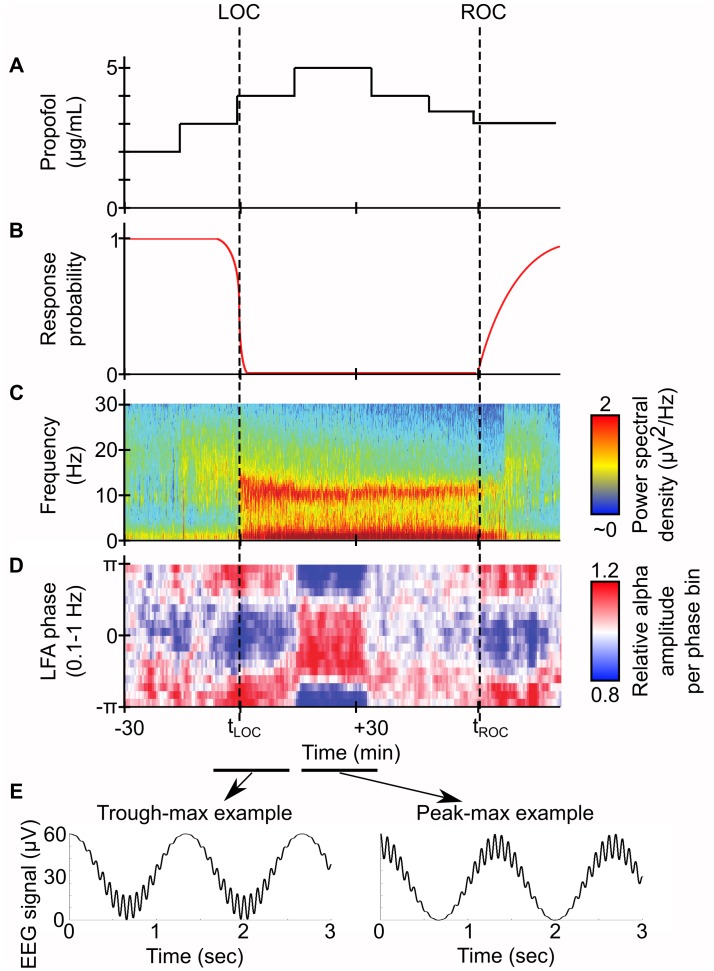
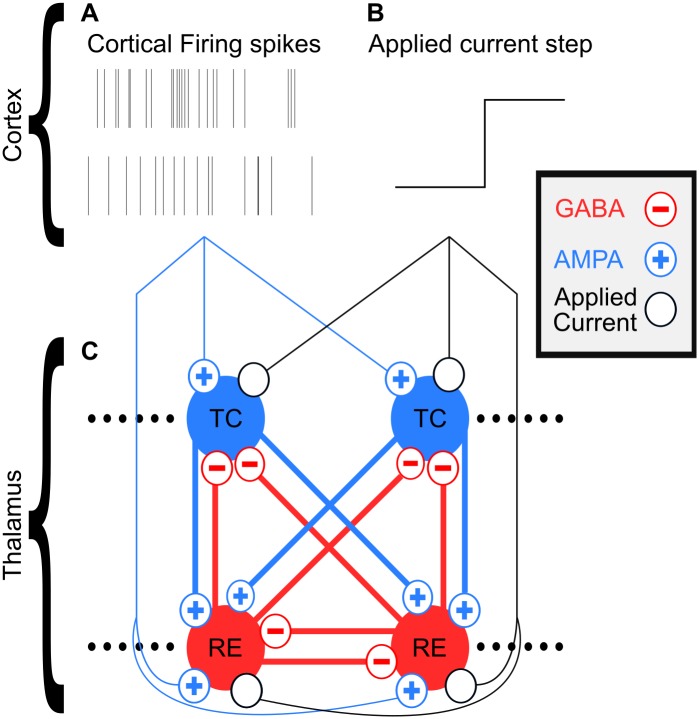
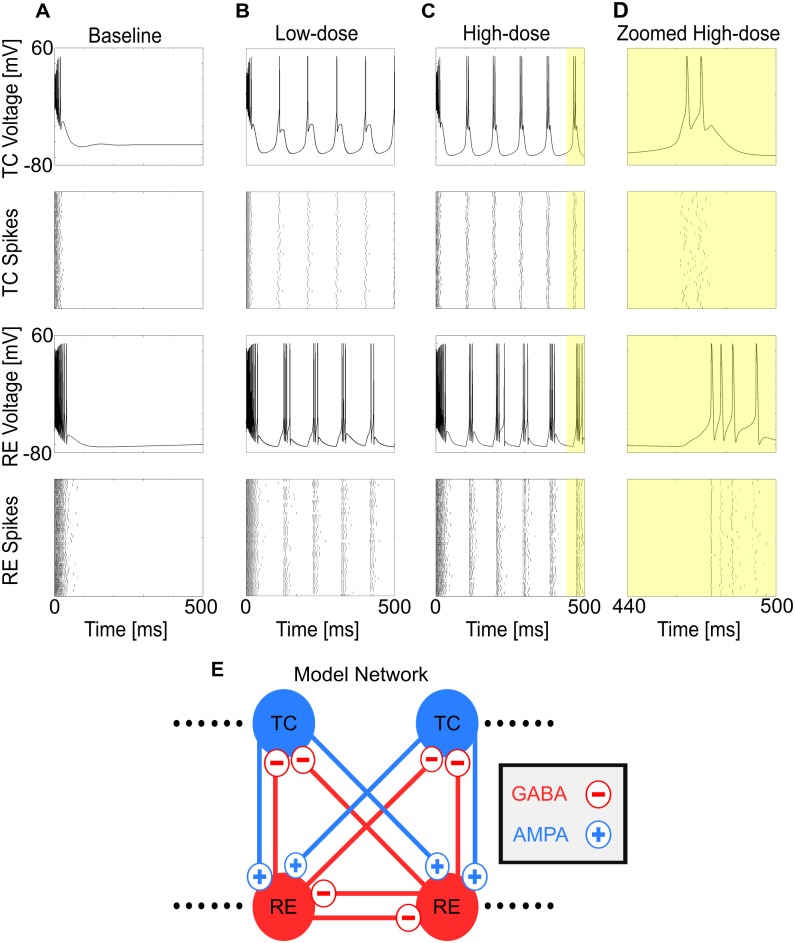
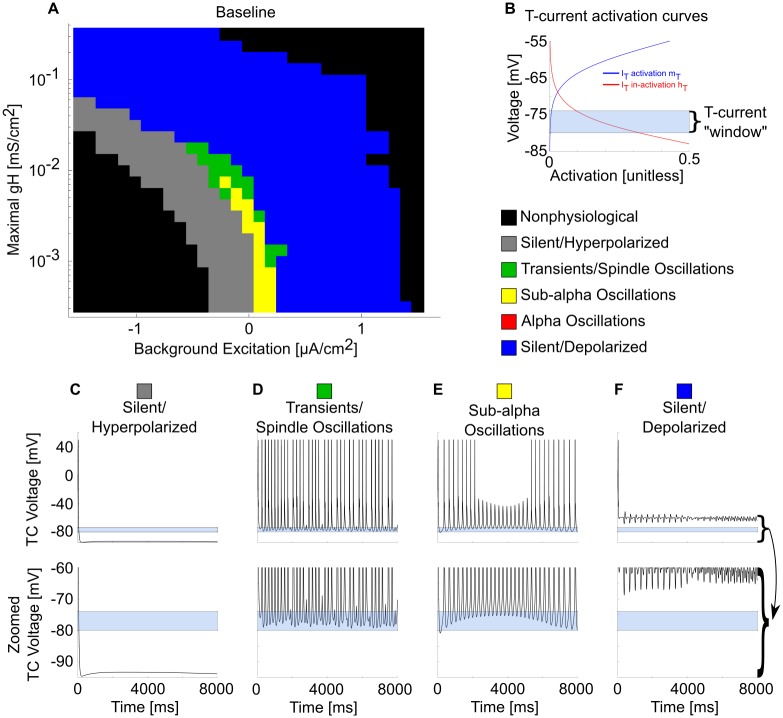
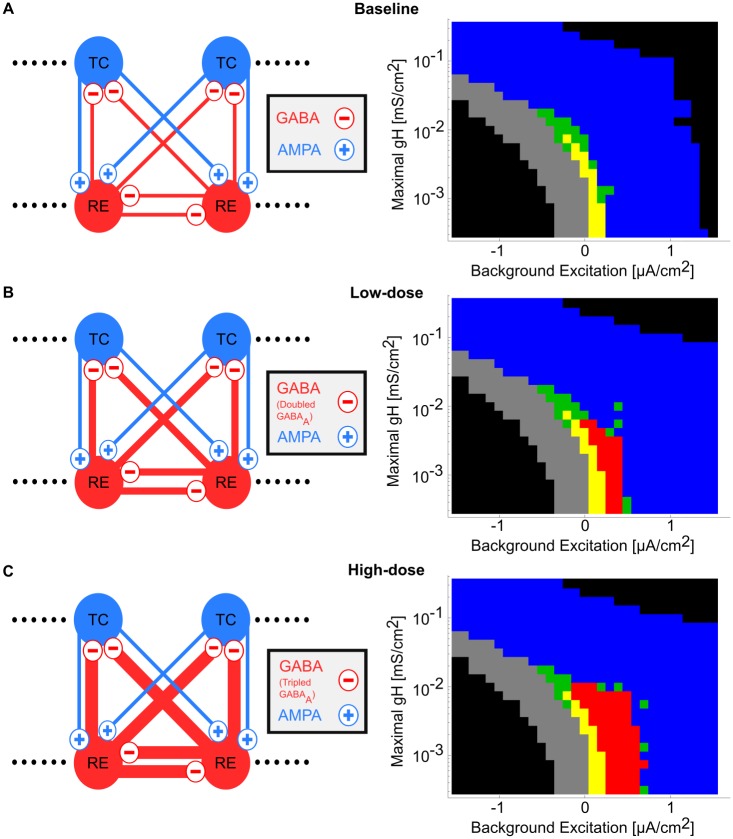
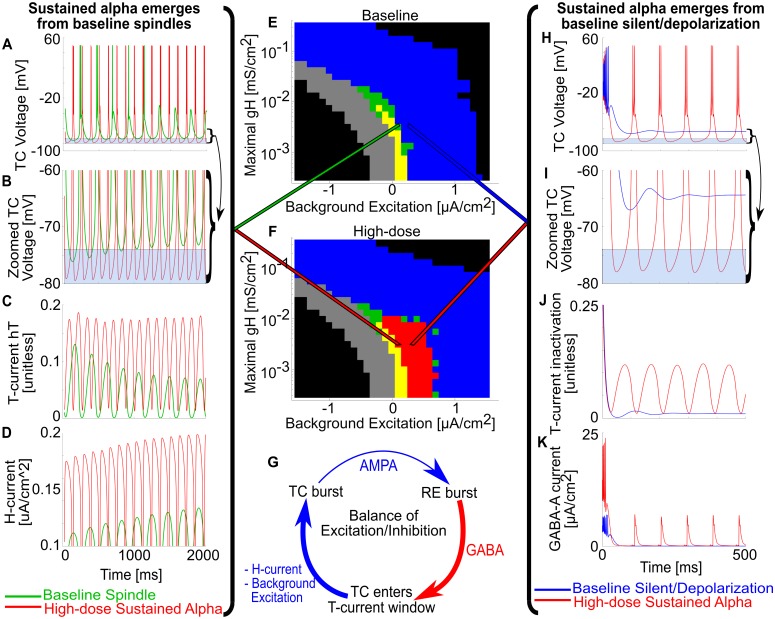
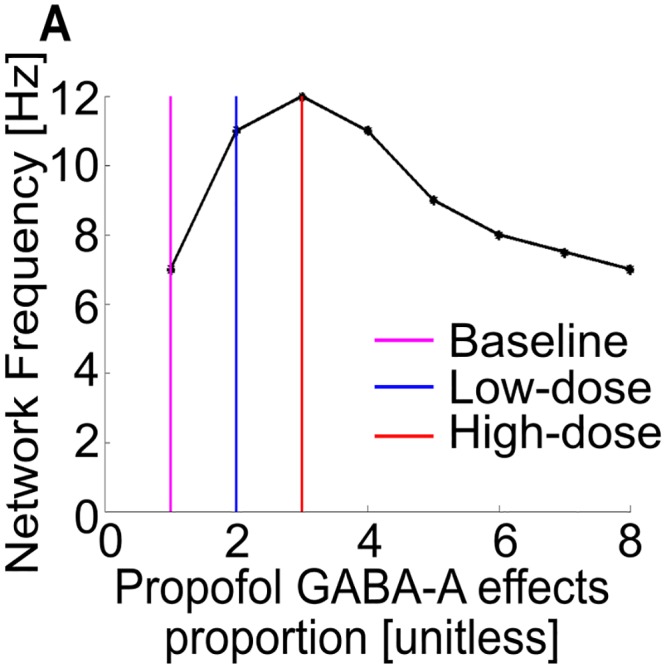
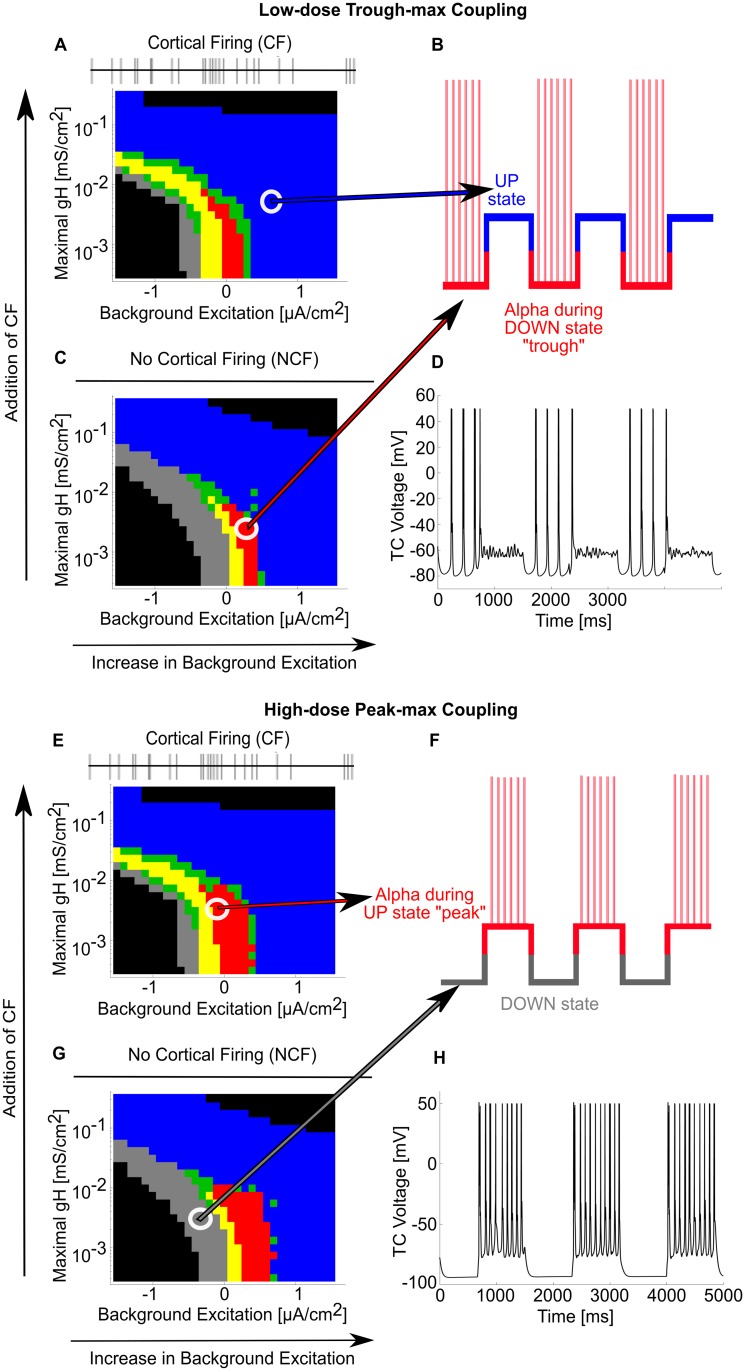
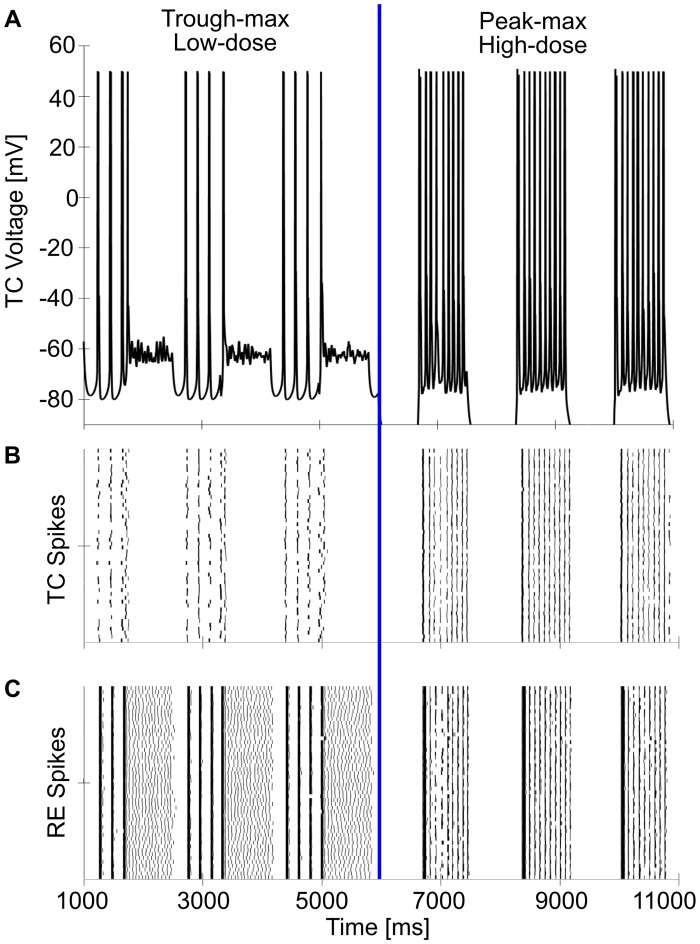
The anesthetic propofol elicits many different spectral properties on the EEG, including alpha oscillations (8-12 Hz), Slow Wave Oscillations (SWO, 0.1-1.5 Hz), and dose-dependent phase-amplitude coupling (PAC) between alpha and SWO. Propofol is known to increase GABAA inhibition and decrease H-current strength, but how it generates these rhythms and their interactions is still unknown. To investigate both generation of the alpha rhythm and its PAC to SWO, we simulate a Hodgkin-Huxley network model of a hyperpolarized thalamus and corticothalamic inputs. We find, for the first time, that the model thalamic network is capable of independently generating the sustained alpha seen in propofol, which may then be relayed to cortex and expressed on the EEG. This dose-dependent sustained alpha critically relies on propofol GABAA potentiation to alter the intrinsic spindling mechanisms of the thalamus. Furthermore, the H-current conductance and background excitation of these thalamic cells must be within specific ranges to exhibit any intrinsic oscillations, including sustained alpha. We also find that, under corticothalamic SWO UP and DOWN states, thalamocortical output can exhibit maximum alpha power at either the peak or trough of this SWO; this implies the thalamus may be the source of propofol-induced PAC. Hyperpolarization level is the main determinant of whether the thalamus exhibits trough-max PAC, which is associated with lower propofol dose, or peak-max PAC, associated with higher dose. These findings suggest: the thalamus generates a novel rhythm under GABAA potentiation such as under propofol, its hyperpolarization may determine whether a patient experiences trough-max or peak-max PAC, and the thalamus is a critical component of propofol-induced cortical spectral phenomena. Changes to the thalamus may be a critical part of how propofol accomplishes its effects, including unconsciousness.
麻醉剂丙泊酚在脑电图上会引发许多不同的频谱特性,包括阿尔法振荡(8 - 12赫兹)、慢波振荡(SWO,0.1 - 1.5赫兹)以及阿尔法与SWO之间的剂量依赖性相位 - 振幅耦合(PAC)。已知丙泊酚会增强GABAA抑制作用并降低H电流强度,但它如何产生这些节律及其相互作用仍不清楚。为了研究阿尔法节律的产生及其与SWO的PAC,我们模拟了超极化丘脑和皮质丘脑输入的霍奇金 - 赫胥黎网络模型。我们首次发现,模型丘脑网络能够独立产生丙泊酚作用下所见的持续阿尔法节律,该节律随后可能被传递至皮层并在脑电图上表现出来。这种剂量依赖性的持续阿尔法节律严重依赖丙泊酚对GABAA的增强作用来改变丘脑的内在纺锤波机制。此外,这些丘脑细胞的H电流电导和背景兴奋性必须在特定范围内才能表现出任何内在振荡,包括持续阿尔法振荡。我们还发现,在皮质丘脑SWO的上升和下降状态下,丘脑皮质输出在该SWO的峰值或谷值处可表现出最大阿尔法功率;这意味着丘脑可能是丙泊酚诱导的PAC的来源。超极化水平是丘脑表现出谷值最大PAC(与较低丙泊酚剂量相关)或峰值最大PAC(与较高剂量相关)的主要决定因素。这些发现表明:丘脑在GABAA增强作用下(如在丙泊酚作用下)会产生一种新的节律,其超极化可能决定患者经历谷值最大还是峰值最大的PAC,并且丘脑是丙泊酚诱导的皮质频谱现象的关键组成部分。丘脑的变化可能是丙泊酚实现其效应(包括意识丧失)的关键部分。