Li Xinxing, Wang Weijun, Ruan Canping, Wang Yi, Wang Haolu, Liang Xiaowen, Sun Yanping, Hu Zhiqian
Department of General Surgery, Changzheng Hospital, The Second Military Medical University, Shanghai, 200003, China.
Therapeutics Research Centre, School of Medicine, The University of Queensland, Princess Alexandra Hospital, Woolloongabba, QLD 4102, Australia.
Oncotarget. 2017 Sep 28;8(57):97090-97100. doi: 10.18632/oncotarget.21350. eCollection 2017 Nov 14.
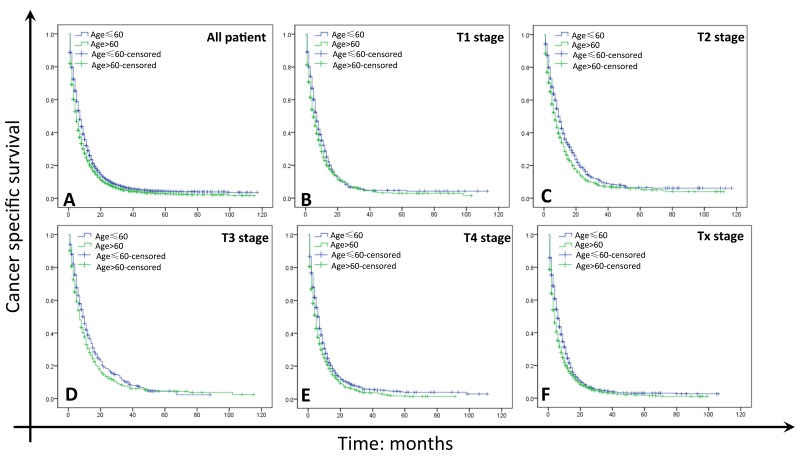
The age-specific impact on the survival of gastric cancer patients with distant metastasis is still unclear. In this study, we identified 11, 299 gastric cancer patients with distant metastasis between 2004 and 2013 from Surveillance, Epidemiology, and End Results population-based dataset. Patients were divided into young (≤60) and elderly groups (>60). Kaplan-Meier methods and multivariable Cox regression were used for the analysis of long-term survival outcomes and risk factors. There were significant differences between the two groups in terms of race, primary site, grade, histologic type, surgery, marital status and clinical T stage (P<0.05). The 1- and 3-year cancer specific survival rates were 29.0% and 6.2% in young group and 22.8% and 4.8% in elderly group in both univariate (X=116.430, P<0.001) and multivariate analysis (P<0.001). Young patients had significantly better 1- and 3-year cancer specific survival than elderly patients in each T stage. Age was further validated as an independent survival factor in all T stages (T1, T2, T3, T4 and T, P<0.05). In conclusion, age was an independent prognostic factor for gastric cancer patients with distant metastasis.
年龄对伴有远处转移的胃癌患者生存的影响仍不明确。在本研究中,我们从监测、流行病学和最终结果人群数据库中识别出2004年至2013年间11299例伴有远处转移的胃癌患者。患者被分为年轻组(≤60岁)和老年组(>60岁)。采用Kaplan-Meier方法和多变量Cox回归分析长期生存结果和危险因素。两组在种族、原发部位、分级、组织学类型、手术、婚姻状况和临床T分期方面存在显著差异(P<0.05)。在单因素分析(X=116.430,P<0.001)和多因素分析(P<0.001)中,年轻组1年和3年的癌症特异性生存率分别为29.0%和6.2%,老年组分别为22.8%和4.8%。在每个T分期中,年轻患者的1年和3年癌症特异性生存率均显著高于老年患者。年龄在所有T分期(T1、T2、T3、T4和T)中均被进一步验证为独立的生存因素(P<0.05)。总之,年龄是伴有远处转移的胃癌患者的独立预后因素。